Abliterated vs Uncensored Local LLMs: Labels and Trade-Offs
>Understand the technical differences between abliterated models and uncensored fine-tunes in 2026, including activation steering, refusal removal, and risk mitigation.
🎧 Listen — ~9 min
Audio summary not available yet

Short answer: “Abliterated” usually refers to a weight-editing approach intended to reduce refusals, while “uncensored” is a broader label that may describe fine-tuning, editing, or a maintainer’s claim. Neither label proves capability or safety. Compare the exact model card, license, task fit, and evaluation—and keep agent permissions outside the model.
The local LLM alignment dilemma
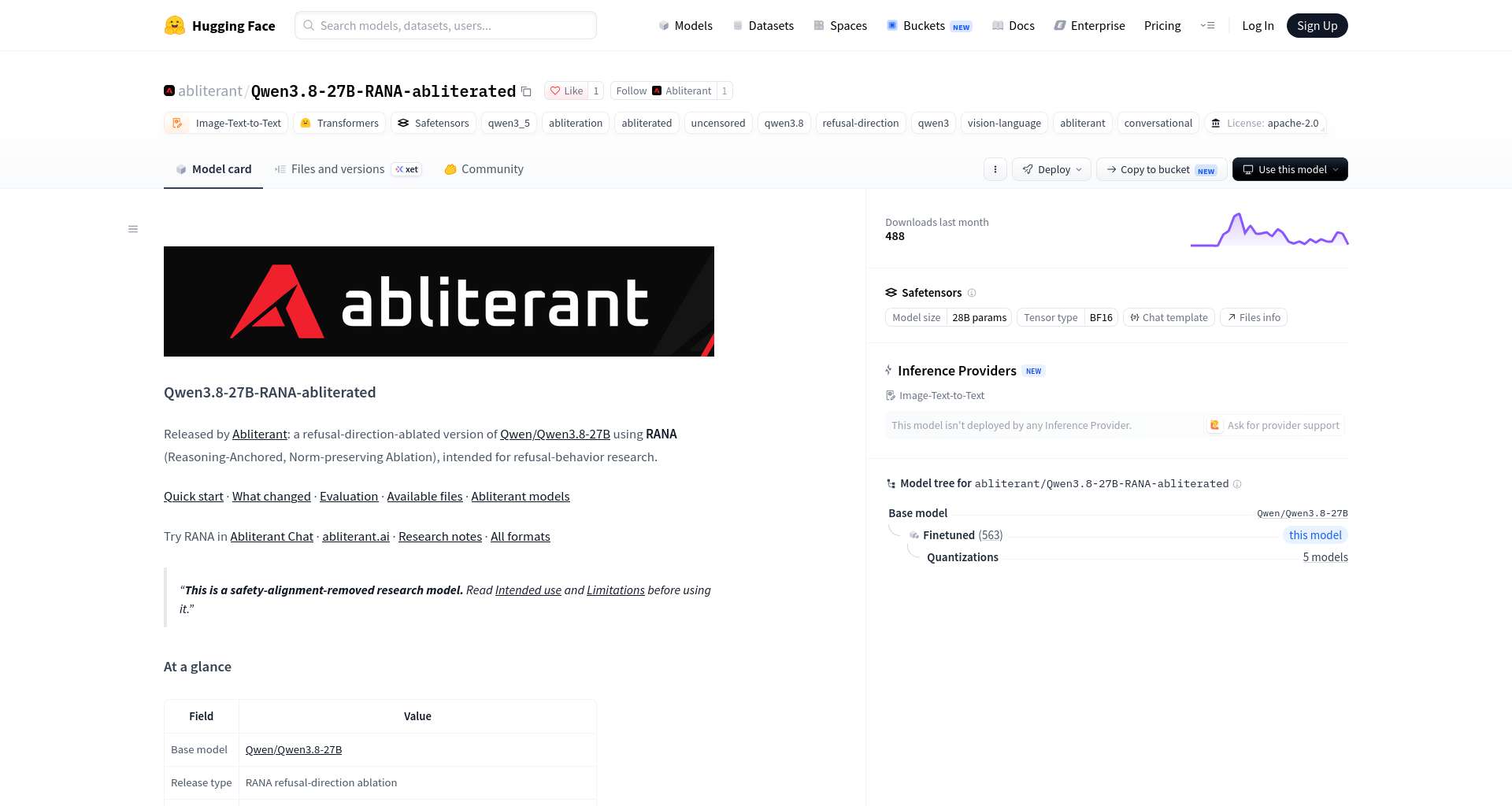
“Uncensored” and “abliterated” often appear together in open-weight listings, but they are not interchangeable technical terms. Uncensored is a broad, non-standardized label for a model whose publisher intends or claims a different refusal profile. Abliteration describes a family of interventions that target refusal-related behavior. A repository label alone does not prove which method was used or how the resulting checkpoint behaves.
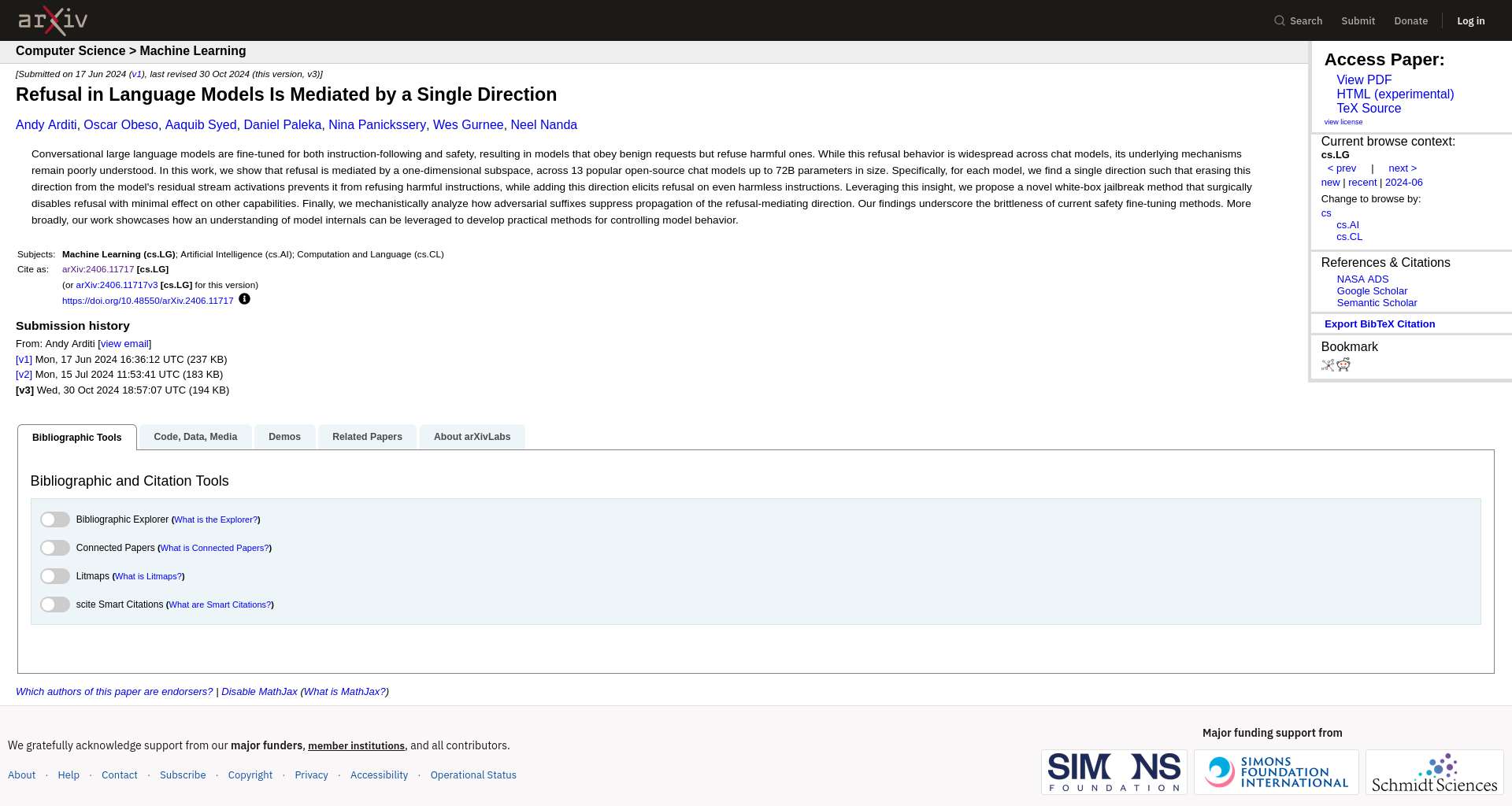
The 2024 Refusal in Language Models Is Mediated by a Single Direction study manipulated a refusal-associated direction in tested open chat models and reported reduced refusals. That paper does not show that every community conversion uses the same implementation or preserves all other capabilities. A 2026 preprint on off-target effects reports changes in decision disposition for two tested model families. It is useful, recent evidence—but still a bounded study, not a universal law for every checkpoint.
The practical question is therefore not which label sounds more “open.” It is what changed in the exact model revision, what evidence supports that claim, and whether the artifact still performs your ordinary tasks reliably.
Key takeaways
- The terms describe different things: “uncensored” is a loose label; “abliterated” points to an intended refusal-reduction intervention, but neither label is a certification.
- The implementation varies: model cards may describe fine-tuning, merges, weight or activation edits, or provide little methodology. Do not infer the pipeline from the name alone.
- Trade-offs require testing: research reports side effects in specific settings; it does not establish that every derivative degrades, or that any derivative preserves every capability.
- Agent safety is separate: a model’s refusal behavior does not define tool permissions, sandboxing, approval gates, or the application’s policy.
| Listing term | What it can tell you | What it cannot prove | What to verify next |
|---|---|---|---|
| Uncensored | The publisher is signaling a changed or reduced refusal profile | A standard method, consistent behavior, factuality, safety, or quality | Base checkpoint, training/merge notes, exact revision, sample prompts, and independent task tests |
| Abliterated | The publisher claims a refusal-related intervention | That a named research method was followed exactly, or that unrelated capabilities are unchanged | Method description, before/after provenance, quantization, chat template, and matched base-versus-derivative evaluation |
| Fine-tuned / merged | A training or merge step may be part of the lineage when documented | That the model is “uncensored” in any standardized sense | Dataset notes, license, model lineage, and the exact files used |
| Agent-ready | Nothing by itself; this is an application-level property | Safe command execution or reliable tool use | Tool-call correctness, isolated runtime, least privilege, human approvals, and rollback controls |
2. Evaluation criteria: Comparing modification methods
Before choosing an unaligned or de-aligned checkpoint for local execution, evaluate candidate weights against five engineering criteria:
- Inference stability: Does the modification introduce perplexity degradation or token-generation loops?
- Instruction retention: Does the model still adhere strictly to complex system prompts, markdown constraints, and JSON schemas?
- Refusal attenuation: How completely does the model eliminate false-positive refusals on technical, cybersecurity, or creative prompts?
- Catastrophic forgetting: Were general domain capabilities (such as code generation or logical deduction) preserved during the modification?
- Compute requirements: How accessible is the conversion or build pipeline for independent engineering teams?
| Metric / Attribute | Base Aligned Instruct | Uncensored (Fine-Tuned) | Abliterated (Vector-Orthogonalized) |
|---|---|---|---|
| Modification Method | RLHF / DPO / Direct Alignment | Supervised Fine-Tuning (SFT) / LoRA | Latent Subspace Nullification |
| Retraining Compute | High (Cluster-scale) | Moderate (GPU hours to days) | Minimal (Minutes on single GPU or CPU) |
| Risk of Catastrophic Forgetting | Low (Baseline) | Moderate to High | Low (Specific to refusal features) |
| Collateral Feature Damage | None (Intended baseline) | General reasoning drift | Concept bleed on adjacent boundaries |
| Instruct/JSON Compliance | High | Variable (Depends on dataset quality) | High (Preserves original instruct weights) |
| Refusal Failure Rate | High false-positive rate on edge cases | Low (Dataset-dependent) | Very Low across broad topics |
3. Evidence of trade-offs: Capability vs degradation
Removing safety interventions often results in measurable side effects. Choosing between these paths requires evaluating concrete evidence of how the model's internals change.
The collateral cost of abliteration: Concept bleed
Because high-dimensional representations in transformer models are rarely completely orthogonal (a phenomenon known as polysemanticity), the refusal direction frequently shares latent space with related features.
When maintainers aggressively nullify the refusal vector, the model may lose nuance when handling tasks that require negative evaluations, such as:
- Flagging syntax or logic bugs in defensive code review.
- Parsing offensive speech or harassment within content moderation pipelines.
- Discriminating between secure and insecure system architectural patterns.
If an abliteration script uses an over-broad contrastive dataset, the modified model may exhibit subtle degradations in nuanced moral or technical discrimination. Maintainers exploring these topics should cross-reference our analysis on best abliterated models and local trade-offs.
The collateral cost of uncensoring: Format drift
Uncensored fine-tuning faces a different vulnerability: dataset bias. If an uncensored dataset features a distinct conversational voice or fails to include robust multi-turn synthetic data, the fine-tuned checkpoint may lose the base model's rigorous instruction-following ability.
Developers frequently observe that uncensored checkpoints show higher rates of hallucination in tightly bounded tasks, such as generating valid schema-compliant payloads. When structured outputs are paramount, review practical techniques in our guide on prompt engineering for structured outputs.
4. Architectural deployment: Building responsible local guardrails
Running unaligned weights locally—whether on personal macOS hardware using runtimes like Private LLM or dedicated inference clusters—demands practical responsibility. As noted by Atal Upadhyay's analysis on local LLM privacy, moving away from centralized cloud providers grants developer sovereignty, but transfers safety management entirely to the local host.
Relying on model weights for containment is brittle. In enterprise or multi-user production environments, safety guardrails should live in the orchestration layer rather than the latent weights of the LLM.
User Prompt
    │
    ▼
[ Orchestration Input Filter ] ── (Regex / Semantic Heuristics)
    │
    ▼
[ Local LLM (Abliterated / Uncensored) ] ── (Inference execution)
    │
    ▼
[ Orchestration Output Filter ] ── (Deterministic Policy Validation)
    │
    ▼
Validated Response
Implementing deterministic local validation
When integrating de-aligned models into automated pipelines or local agents, wrap the client inference loop with deterministic policy checks. If you are integrating local LLMs with autonomous tooling, review our guide on building local AI agents within VRAM budgets to maintain runtime stability.
A robust Python orchestration pattern ensures that output generation is validated independently of the model's internal alignment state:
1import re
2from typing import Optional
3
4def execute_safe_inference(client, model: str, prompt: str) -> Optional[str]:
5    if not prompt.strip():
6        raise ValueError("Prompt payload cannot be empty.")
7    response = client.chat.completions.create(
8        model=model,
9        messages=[
10            {"role": "system", "content": "You are a precise, compliant technical assistant."},
11            {"role": "user", "content": prompt}
12        ],
13        temperature=0.2,
14    )
15
16    output_text = response.choices[0].message.content
17    if re.search(r"<\|endoftext\|>|\[MALFORMED\]", output_text):
18        return None
19
20    return output_text
5. Decision framework: Selecting the right tool responsibly
Use this decision matrix to determine which model paradigm fits your project constraints:
When to choose an abliterated model
- Technical research and penetration testing: You require a model that analyzes defensive exploit scripts or security vulnerability scenarios without triggering false-positive refusals.
- Complex formatting retention: You need the original base model's reasoning capabilities, system prompt adherence, and coding performance intact, with minimal parameter alteration.
- Fast evaluation: You want to experiment with de-alignment using open-source Python scripts on consumer hardware without fine-tuning infrastructure.
When to choose an uncensored fine-tune
- Stylistic adaptation: Your application demands a specific conversational tone, voice, or persona that an aligned base model resists.
- Domain-specific instruction sets: You are training on a dedicated, proprietary corpus where both alignment refusals and baseline instruct biases must be replaced by curated domain knowledge.
- Predictable conversational defaults: You prefer an assistant tuned on curated dialogue examples over one subjected to mathematical vector subtraction.
For a deeper survey of specific model releases, explore our guide to the best uncensored local LLMs in 2026.
Practical verdict
Neither "uncensored" nor "abliterated" models are objectively superior; they solve refusal suppression from different angles.
Abliterated models are the preferred choice when you need the exact capability, reasoning depth, and instruct discipline of an existing checkpoint (such as Llama 3 or Qwen variations) while surgically bypassing overactive refusal triggers for authorized technical workflows.
Uncensored fine-tunes remain appropriate when you intend to reshape the conversational demeanor or specialize weights on curated datasets. Regardless of the label on Hugging Face, treat these claims as experimental parameter edits, benchmark your downstream tasks for concept degradation, and maintain deterministic validation in your runtime code.
Frequently asked questions
Does abliteration permanently remove a model's safety data?
No. Abliteration does not erase the underlying token relationships or concepts learned during pretraining. It removes or rotates the specific activation direction that triggers a refusal response, meaning the model's underlying knowledge base remains largely intact.
Can an abliterated model still refuse requests?
Yes. If a prompt triggers latent features outside the specific vector direction targeted during the abliteration process, or if the model's base system prompt instructs it to prioritize alternative constraints, the model may still produce a refusal.
Are abliterated models faster than standard models?
No. Abliterated models maintain the exact same architecture, layer depth, and parameter count as their base counterparts. They run at identical inference speeds, token-per-second rates, and memory footprints.
Is it legal to run abliterated or uncensored models locally?
In most jurisdictions, running open-weight models locally is legal, provided that the usage complies with local laws regarding cybersecurity, intellectual property, and content generation. However, end-user license agreements (such as Meta's Llama Community License) may impose acceptable use policies regardless of model modifications.
Source website screenshots
Explore related directories
For a source-first model choice, browse the AI model directory. To compare the software that can run these models in coding workflows, see the coding-agent directory.
Sources and image references
Sources
⚡ AI Engineering Briefing
AI model releases, practical tutorials, developer tools, and engineering research. Unsubscribe anytime.
Comments
Comments are temporarily unavailable while the public discussion space is being configured.