Abliteration Explained: How Uncensored LLMs Change in 2026
>A research-led 2026 guide to LLM abliteration, refusal directions, newer evidence, model trade-offs, and a responsible way to evaluate uncensored local models.
🎧 Listen — ~10 min
Audio summary not available yet

Short answer: abliteration is a family of weight-editing methods inspired by research on refusal-related representations in language models. It aims to reduce a model’s tendency to refuse by suppressing a learned direction or feature. That does not simply remove a neat “safety switch”: 2026 research finds refusal behavior can differ by context, and a model that refuses less may also over-comply, lose calibration, or behave unpredictably. Treat “abliterated” as a claim about a modification—not a quality score or a guarantee.
This article explains the mechanism at a research level, what changed in the evidence by 2026, and how to assess a community model without treating lower refusal as the only goal. For model candidates and a hands-on evaluation plan, see our abliterated model shortlist, uncensored local LLM guide, and evaluation test plan. Browse the AI model directory for individual model records and the coding-agent directory for the separate agent layer.
AI-generated conceptual illustration. The lines are not empirical activation measurements and do not depict a particular model.
What does “abliteration” mean?
The term combines ablation—removing a component or signal—and obliteration. In current open-weight model discussions it commonly refers to editing model weights to reduce a refusal-associated behavior, often using a direction estimated from internal activations. The exact procedure, data, target layers, and validation vary by implementation and uploader.
At a high level, a researcher compares internal model activations on two classes of examples, estimates a vector associated with a behavior, then modifies selected weights or activations to weaken the vector’s contribution. The popular intuition is a direction in representation space: if a behavior has a component along that direction, projecting it out can change how the model responds.
That is a useful explanatory model, not proof that every refusal is one feature. It also does not mean the model has been retrained from scratch, that every refusal disappears, or that the model’s other capabilities remain unchanged. A repository using the word “abliterated” may be a full-precision checkpoint, a quantized conversion, a merge, or a repackaging; inspect the exact card and lineage.
The research timeline: one direction, then more context
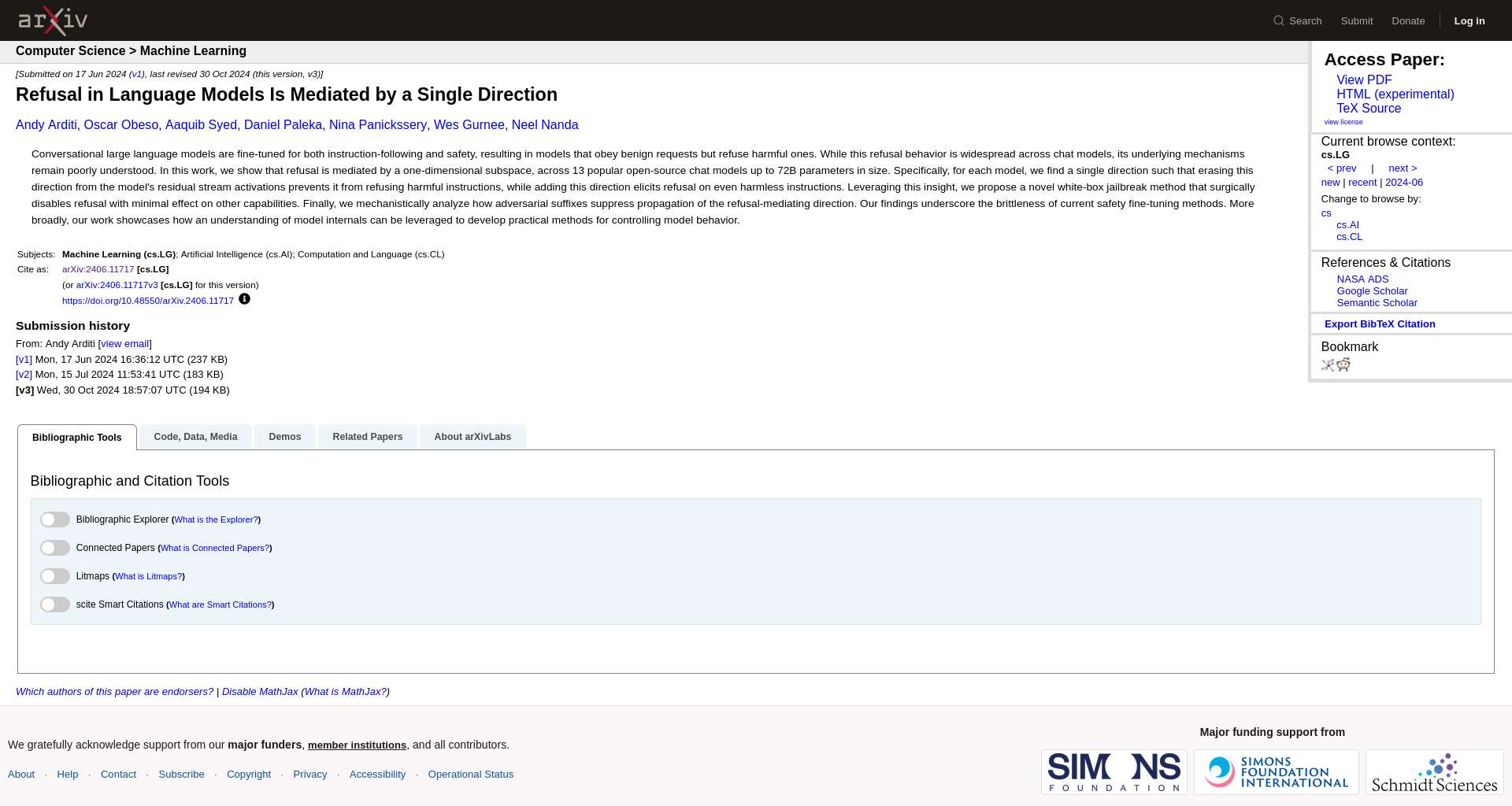
The influential 2024 paper, “Refusal in Language Models Is Mediated by a Single Direction”, studied 13 open-source chat models up to 72 billion parameters. The authors reported that removing a learned refusal direction could reduce refusal on harmful prompts, while adding it could induce refusal on harmless prompts. They also measured language-task behavior and observed changes on some evaluations. The work made a strong case that a direction can causally matter in the models and settings tested; it did not establish that all refusal is always one-dimensional.
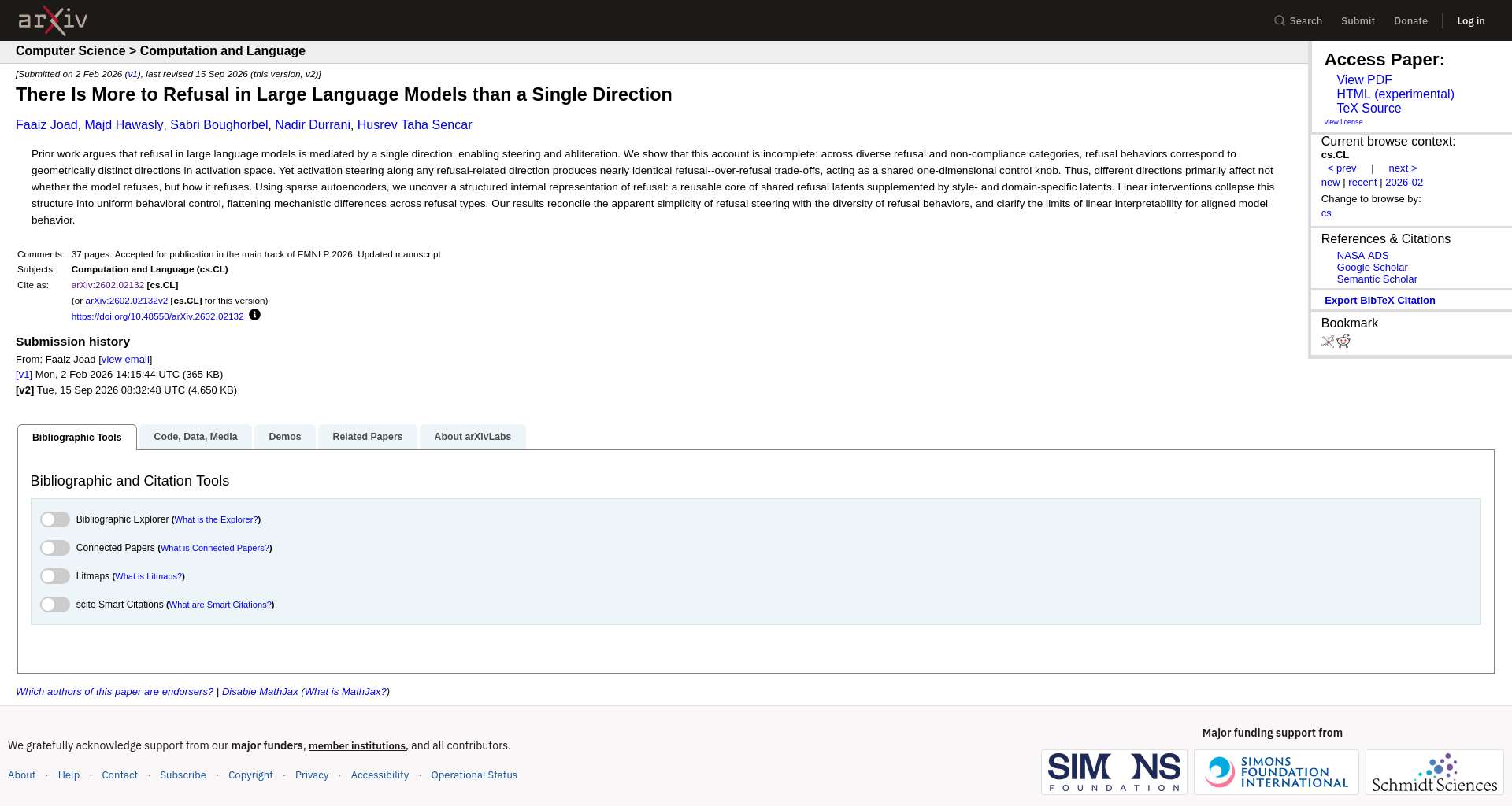
A February 2026 preprint, “There Is More to Refusal in Large Language Models than a Single Direction”, broadened the question beyond safety refusals. It examined 11 types of refusal or non-compliance—including incomplete, unsupported, humanizing, advice-related, and over-refusal cases—on Gemma 2 9B Instruct and Llama 3.1 8B Instruct. Its authors report geometrically distinct directions across categories, while steering along them can still produce similar refusal-versus-over-refusal trade-offs. In their analysis, the direction can affect how a model refuses, not merely whether it does.
An October 2026 preprint, “On the Steering Dimensionality of Refusal in Language Models”, asks how many directions are needed to control different refusal behaviors. Its abstract reports that safety-alignment refusal can be captured by a low-dimensional subspace in its experiments, while refusal in general contexts has richer geometry that was not reliably captured even by five-dimensional subspaces. This is newer evidence, but it remains a preprint and should not be generalized to every architecture, refusal policy, or fine-tune.
| Research question | What the cited work reports | Practical interpretation |
|---|---|---|
| Can a refusal-related direction matter causally? | The 2024 study reports effects from adding or ablating a direction in tested models | A vector can be a useful intervention target; it is not a universal safety switch |
| Are all refusals the same behavior? | The 2026 February study finds distinct directions for several refusal/non-compliance categories in two 8–9B model families | “Refusal” includes different contexts and styles; one score hides important differences |
| Is one vector enough for every context? | The 2026 October preprint reports low-dimensional safety refusal but richer general-context refusal geometry | A simple geometric story can work for a narrow behavior and fail for a broader one |
The evidence is not a contest in which the newer paper makes the older result “wrong.” They study different definitions, interventions, models, and evaluation splits. Together they support a narrower conclusion: a refusal-related vector can be meaningful, but the broader behavior called “refusal” is context-sensitive and should be evaluated by category.
Why a model can answer more—and still be worse
An abliterated model may be more willing to respond to benign requests that a baseline incorrectly refused. That can be valuable for a tightly scoped local workflow. But a lower refusal rate alone cannot tell you whether the model has improved. It may also comply when it should ask for clarification, express unjustified confidence, ignore an application policy, or produce lower-quality answers.
Separate at least four outcomes:
- Helpful completion: Does it correctly complete allowed work, such as summarizing a document or writing a routine code change?
- Over-refusal: Does it unnecessarily decline benign, answerable, or clearly scoped tasks?
- Policy behavior: Does it follow the rules of the application in the intended test cases? Measure this independently from helpfulness.
- General capability and calibration: Does ordinary task quality, factual accuracy, uncertainty handling, and format reliability remain acceptable?
This distinction matters for developer agents. A model can produce a syntactically valid shell command without having authority to run it. Keep tool permissions, network access, secrets, production writes, and human approval in the agent harness—not in the model’s “uncensored” label. Our guide to building a stronger agent harness and the coding-agent directory cover that surrounding layer.
How to read an “uncensored” model card
Community cards are useful first-party descriptions of the upload, but they are not independent certifications. For each candidate, check:
| Check | What to verify |
|---|---|
| Base model | Exact upstream repository and family; confirm the derivative is based on what the card claims |
| Modification | Whether the maintainer describes abliteration, fine-tuning, merging, or only uses an “uncensored” tag |
| Artifact | Exact revision, file format, quantization, and hash; a GGUF conversion may be a separate artifact from the source weights |
| License | Base-model and derivative terms, including any attribution, use, or distribution conditions |
| Evidence | Prompt set, sample size, baseline, scoring method, and whether results are independently reproduced |
| Runtime | Chat template, inference engine, context setting, and hardware used for reported performance |
For example, our Hugging Face model-card screenshot is a courtesy capture of one public repository card. It illustrates publisher-provided metadata; it is not an endorsement or an independent test. Model cards and repository tags can change, so open the live source before downloading or deploying anything.

Courtesy screenshot of the public Huihui Qwen3.8 27B abliterated model card captured for context. Model files, card content, and marks belong to their respective owners; details may change.
A compact, responsible evaluation plan
Compare the modified artifact with its base model where licensing and access permit. Keep the runtime, prompt template, quantization, context length, sampling settings, hardware, and test set constant. Pin revisions; otherwise a changed repository may invalidate the comparison.
Create a small, private, policy-reviewed test set with separate benign and policy-sensitive categories. Include ordinary tasks that matter to your intended workload, deliberately ambiguous requests that should trigger clarification, and clearly answerable benign edge cases. Use established datasets such as XSTest to study over-refusal and the data/resources cited in the 2026 papers as starting points. Follow the dataset terms and do not publish operationally harmful test prompts.
| Metric | Report it as | Why it belongs in the report |
|---|---|---|
| Benign task success | Correct completions / applicable benign prompts | Detects whether the change actually helps the intended work |
| Over-refusal | Unnecessary declines / benign prompts | Measures the specific false-refusal problem, rather than all refusals |
| Policy handling | Correct decisions / reviewed policy prompts | Checks application-specific behavior separately from helpfulness |
| Calibration | Accuracy and uncertainty on answerable/unanswerable pairs | Reveals confident guesses and missing clarification |
| Capability regression | Same task benchmark before and after modification | Detects off-target changes beyond refusal behavior |
| Repeatability | Variation over repeated runs with recorded settings | Separates stable behavior from sampling noise |
Use human review for ambiguous outputs and report sample sizes. A tiny private test is a screening tool, not a universal benchmark or safety certification. Our local model fit tool can help estimate whether a candidate fits your hardware; it cannot validate behavior or guarantee real-world speed.
Choosing where an abliterated model belongs
For offline research or a personal sandbox, a small, explicitly versioned local checkpoint can be an experiment. For a team coding assistant, evaluate it on your own repository tasks and run it with narrow permissions first. For a public-facing product, do not treat weight modification as a substitute for application policy, input/output controls, monitoring, or incident handling. If a model can invoke tools, the tools need independent allowlists and confirmation gates.
The model and the agent are different choices: model pages describe checkpoints and their reported attributes; agent pages describe products that orchestrate models with tools and workflows. Start from the AI model directory to inspect model candidates, and the coding-agent directory to compare the harnesses that might run them. Don’t infer that an agent supports a particular checkpoint unless its documentation says so.
Frequently asked questions
Is abliteration the same as fine-tuning?
No. Abliteration usually refers to a targeted weight or activation-space edit inspired by refusal-direction analysis. Fine-tuning updates weights through training examples and an optimization process. Some community repositories may combine techniques, so inspect the card instead of assuming from a tag.
Does an abliterated model have no safeguards?
No. The label does not prove that every refusal has been removed, nor that other safety behavior is absent. The result depends on the model, method, test set, and runtime—and it can change as the model is further modified.
Does “uncensored” mean more intelligent or more accurate?
No. It describes an informal behavior claim, not a capability benchmark. Compare the exact model against a baseline on the tasks you care about, including correctness and calibration.
Are the 2026 refusal-geometry findings settled science?
The papers provide evidence from specific models and experiments, not a universal law. The October 2026 work is a preprint. Treat the results as important research signals and test your own exact checkpoint.
Bottom line
Abliteration is best understood as a targeted intervention that can shift a model’s refusal behavior—not as a one-click quality upgrade. The 2024 single-direction result helped explain a causal mechanism in tested models; 2026 studies expand the picture to multiple refusal categories and context-dependent geometry. For real model selection, compare the exact derivative with a baseline, measure helpfulness and over-refusal separately, check capability regressions, and keep agent permissions outside the model. Start with our abliterated-model guide, uncensored LLM guide, AI model directory, and coding-agent directory.
Source website screenshots
Sources and image references
- Arditi et al. (2024), “Refusal in Language Models Is Mediated by a Single Direction”
- Joad et al. (2026), “There Is More to Refusal in Large Language Models than a Single Direction” (preprint)
- “On the Steering Dimensionality of Refusal in Language Models” (October 2026 preprint)
- FailSpy/abliterator source repository
- Huihui Qwen3.8 27B public model card and its courtesy screenshot at essamamdani.com.
- Hero image: AI-generated editorial illustration; conceptual only, not an empirical research figure.
Keep reading
Related reading
⚡ AI Engineering Briefing
AI model releases, practical tutorials, developer tools, and engineering research. Unsubscribe anytime.
Comments
Comments are temporarily unavailable while the public discussion space is being configured.