AI Model Tracking Briefing: Evaluating Benchmarks and Releases
>Navigate late-2026 AI model tracking, API changelogs, and benchmark evaluation frameworks with practical vetting criteria for engineering teams.
🎧 Listen — ~6 min
Audio summary not available yet

Engineering teams in late 2026 face an unprecedented cadence of foundation model releases, context window upgrades, and pricing revisions. Sifting through marketing claims to identify functional architectural improvements requires structured verification rather than reliance on public leaderboard rankings alone.
Evaluating newly deployed models demands a systematic methodology: cataloging API updates, auditing runtime costs, validating actual benchmark provenance, and measuring production workload fit.
Key takeaways
- Changelog fragmentation: Major labs frequently update weights, deprecate model IDs, and revise token pricing without extended deprecation horizons, making automated tracking essential.
- Leaderboard decay: Public composite benchmarks often suffer from dataset contamination or cherry-picked evaluations; source-verified evaluation matrices provide more reliable operational signals.
- Production validation: Upgrading an inference provider or foundational model requires structured regression testing for schema conformance, latency, and context degradation.
- Cost-to-latency trade-offs: Newer quantized or architectural checkpoints alter the economics of disaggregated inference and self-hosted pipelines.
2. Navigating Benchmark Provenance and Evaluation Traps
Aggregated leaderboards provide a broad initial snapshot of capability, but production utility frequently diverges from synthetic test scores. Aggregation engines such as BenchLM compile hundreds of benchmark runs across model architectures, illustrating both the breadth of available checkpoints and the variance between evaluation protocols.
Evaluating an updated model requires understanding the underlying test conditions:
[Upstream Release]
       │
       ▼
[Source Benchmark Audit] ──► Check contamination & evaluation harness
       │
       ▼
[Internal Canary Test]   ──► Validate against deterministic domain schemas
       │
       ▼
[Production Rollout]     ──► Monitor TTFT, latency drift, and error rates
Deconstructing Benchmark Discrepancies
Synthetic benchmarks often emphasize academic problem-solving over operational stability. When assessing a newly cataloged checkpoint on a leaderboard:
- Check contamination audits: Open-weights models evaluated against public sets (e.g., MMLU-Pro, HumanEval) may have ingested problem variations during pretraining or supervised fine-tuning.
- Inspect the inference harness: Different frameworks (vLLM, SGLang, TensorRT-LLM) employ varying sampling parameters, temperature settings, and top-p thresholds that significantly affect repeatability.
- Measure real structured output compliance: Many high-scoring models degrade when constrained to rigid JSON schemas or complex nested data structures.
For developers seeking to enforce rigorous output contracts, pairing evaluation pipelines with structured extraction patterns minimizes breakage, as detailed in our guide on prompt engineering for structured outputs.
3. Systematic Model Evaluation Framework
Before adopting a newly announced model into a mission-critical pipeline, run it through a four-stage qualification framework:
          ┌───────────────────────────────────┐
          │     1. Architectural Audit        │
          │  - Weights, context, licensing    │
          └─────────────────┬─────────────────┘
                            │
          ┌─────────────────▼─────────────────┐
          │     2. Schema & Tool Conformance  │
          │  - Function calls, zero-shot JSON │
          └─────────────────┬─────────────────┘
                            │
          ┌─────────────────▼─────────────────┐
          │     3. Cost & Latency Profile     │
          │  - TTFT, throughput, token pricing│
          └─────────────────┬─────────────────┘
                            │
          ┌─────────────────▼─────────────────┐
          │     4. Production Shadow Canary   │
          │  - Dual-run live request diffing  │
          └───────────────────────────────────┘
Stage 1: Architectural and Licensing Audit
Confirm whether the model is closed-API or open-weight. If open-weight, verify commercial use clauses, fine-tuning rights, and hardware memory footprints. Teams managing on-premise hardware should consult the open-weight LLM licensing and VRAM sizing guide to avoid sizing bottlenecks.
Stage 2: Schema and Tool Conformance
Run automated evaluation suites with strict JSON schema targets. The primary failure mode of incremental updates is not general intelligence loss, but subtle degradation in edge-case syntax escaping and function parameter passing.
Stage 3: Cost and Latency Profiling
Measure Time to First Token (TTFT) and inter-token latency under concurrent load. For self-hosted instances, benchmark decode speeds against optimized inference setups like disaggregated LLM inference architectures.
Stage 4: Production Shadow Testing
Deploy the candidate model in shadow mode alongside your primary endpoint. Fork live production traffic to evaluate drift in tone, reasoning depth, and failure modes without impacting end users.
4. Comparing Evaluation Metrics Across Model Tiers
The table below breaks down the practical evaluation criteria engineering organizations should apply across foundational, mid-tier, and specialized local models.
| Evaluation Metric | Cloud Frontier APIs | Open-Weight Enterprise Models (30B–70B) | Lightweight Local Checkpoints (1B–8B) |
|---|---|---|---|
| Primary Source Signals | Provider changelogs, API documentation | Hugging Face model cards, technical papers | Git repositories, GGUF/quantization logs |
| Primary Bottlenecks | Vendor rate limits, price per output token | GPU VRAM capacity, host memory bandwidth | Quantization loss, context coherence |
| Benchmark Focus | Complex agentic workflows, multi-turn reasoning | Code generation, strict schema compliance | Single-task throughput, edge latency |
| Deployment Risk | Undocumented silent weight shifts | Dependency drift, driver/runtime updates | Hallucination on zero-shot domain queries |
| Verification Strategy | Shadow canary routing, semantic assertions | Offline validation harness, VRAM stress tests | Deterministic local evaluation suites |
5. Architectural Trade-offs: Cloud APIs vs. Self-Hosted Weights
When a new model is indexed across release trackers, engineering leaders must decide whether to consume the capability via managed endpoints or integrate the open-weight release into private infrastructure.
1from typing import Dict, Any
2import time
3
4def evaluate_model_checkpoint(
5    endpoint_client: Any,
6    test_suite: list[Dict[str, Any]],
7    max_latency_ms: float = 1200.0
8) -> Dict[str, Any]:
9    """
10    Validates latency, schema adherence, and status of a candidate model release.
11    """
12    results = {
13        "passed": 0,
14        "failed": 0,
15        "latency_violations": 0,
16        "total_duration_ms": 0.0
17    }
18
19    for test in test_suite:
20        start_time = time.perf_counter()
21        try:
22            response = endpoint_client.generate(
23                prompt=test["prompt"],
24                schema=test.get("schema")
25            )
26            elapsed_ms = (time.perf_counter() - start_time) * 1000.0
27            results["total_duration_ms"] += elapsed_ms
28
29            if elapsed_ms > max_latency_ms:
30                results["latency_violations"] += 1
31
32            if test["validator"](response):
33                results["passed"] += 1
34            else:
35                results["failed"] += 1
36        except Exception:
37            results["failed"] += 1
38
39    return results
Managed APIs simplify day-one adoption but expose organizations to sudden upstream deprecations and regional availability variance. Conversely, self-hosting requires configuring dedicated inference engines, managing memory quantization profiles, and continuously verifying kernel optimizations.
6. Implementation Checklist for Model Upgrades
When integrating newly released models into production, follow this operational checklist:
- Verify primary release notes: Confirm source claims directly on official repository changelogs or provider documentation.
- Freeze model identifiers: Pin exact checkpoint snapshots (e.g., using date-stamped revision tags) rather than floating
defaultorlatestpointers. - Execute deterministic regression tests: Run internal regression test suites with fixed random seeds to catch syntax or semantic anomalies.
- Monitor cold-start latency: For containerized and serverless environments, evaluate checkpoint loading times alongside token generation speeds.
- Document deprecation timelines: Maintain a calendar for vendor model retirements to prevent cascading failures across downstream integrations.
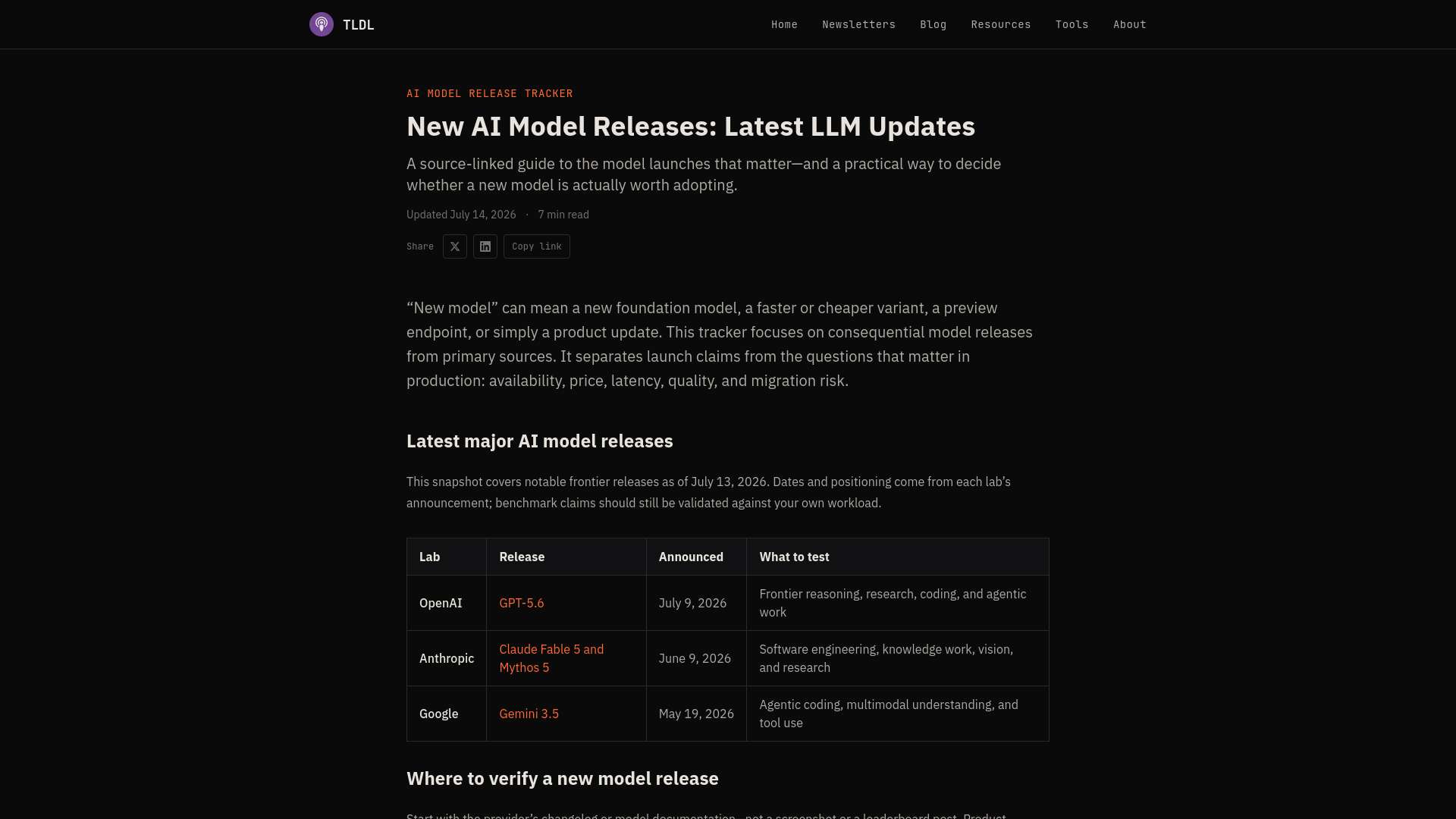
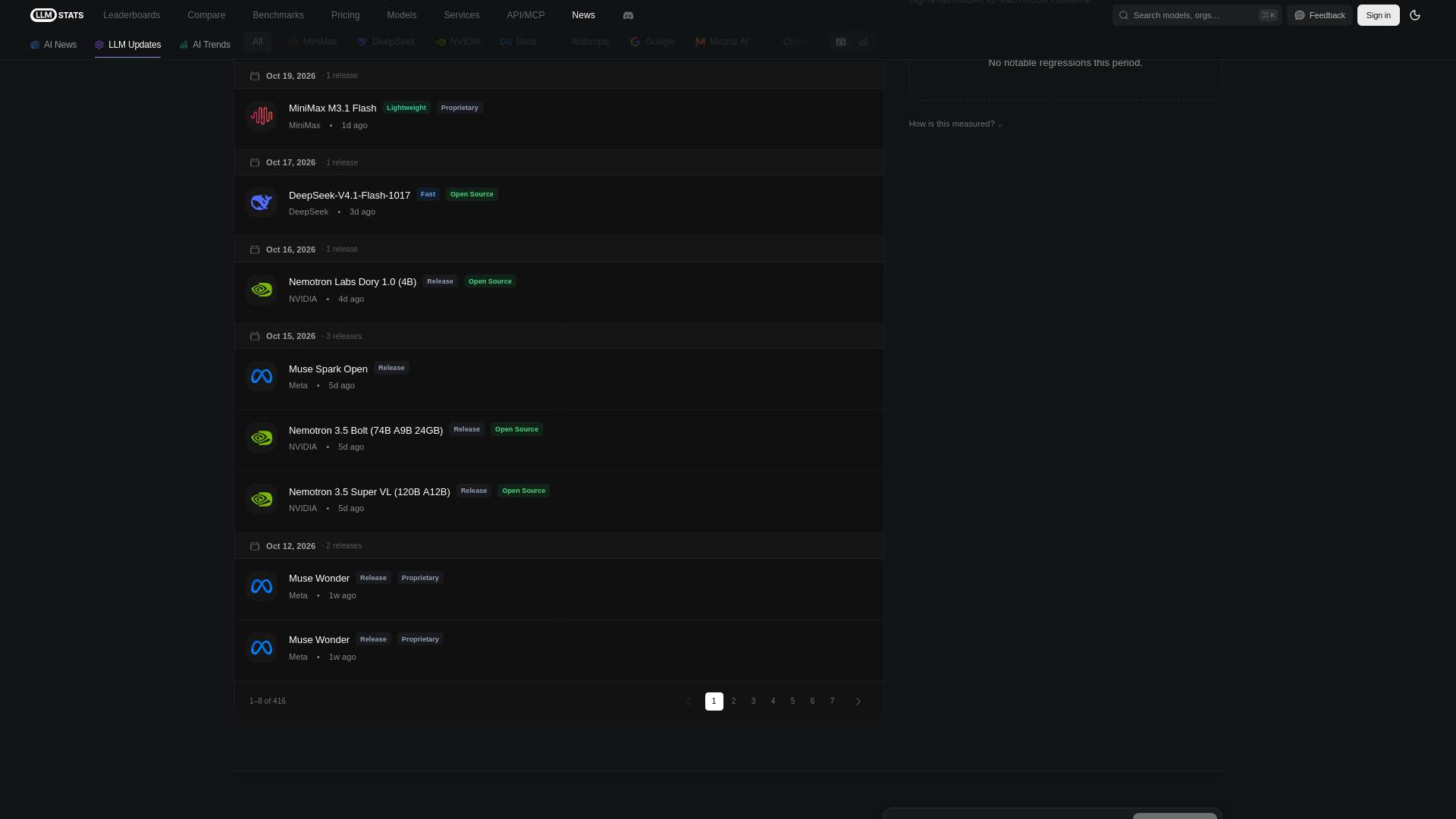
Source website screenshots
Frequently asked questions
How often should engineering teams review LLM release trackers?
Reviewing centralized trackers weekly or bi-weekly is typically sufficient for application-layer development. Infrastructure teams self-hosting models or managing large token budgets should track daily provider changelogs to capture critical security patches and pricing adjustments immediately.
Why do leaderboard scores often fail to reflect production performance?
Public benchmark suites measure broad academic reasoning or synthetic multi-choice capabilities. Production workloads typically hinge on edge-case schema adherence, prompt-instruction compliance, low-latency performance, and deterministic behavior under strict error budgets.
What is the safest way to deprecate an older model in production?
Adopt a phased canary migration: route 5% of traffic to the candidate model while logging validation errors and latency. Increase traffic gradually to 25%, 50%, and 100% while retaining an automated fallback mechanism to route queries back to the prior stable checkpoint if error thresholds are exceeded.
Sources and image references
- TLDL AI Model Release Tracker: https://www.tldl.io/guides/model-releases-new
- LLM Stats Model Updates Changelog: https://llm-stats.com/llm-updates
- BenchLM Benchmark Directory: https://benchlm.ai
Keep reading
Related reading
⚡ AI Engineering Briefing
AI model releases, practical tutorials, developer tools, and engineering research. Unsubscribe anytime.
Comments
Comments are temporarily unavailable while the public discussion space is being configured.