Auditing Sub-3B Uncensored Local LLMs: Model Cards & Quantization
>Evaluate sub-3B uncensored and open-weight LLMs in 2026. Inspect Hugging Face model cards, licensing gates, GGUF quantization formats, and safe local runtime setups.
🎧 Listen — ~8 min
Audio summary not available yet

Deploying small language models (SLMs) under 3 billion parameters directly on edge machines, development laptops, or constrained CPU instances provides immense operational autonomy. However, searching for "uncensored" or lightweight models on Hugging Face often introduces confusion surrounding model lineage, permissive open-source licenses versus restrictive community licenses, and degraded reasoning quality after extreme quantization.
Before pulling an unvetted checkpoint onto a workstation or integrating it into local tooling, engineers must verify what the model card actually certifies, understand the math and tradeoffs behind sub-4-bit quantization, and configure a sandboxed local serving stack.
Key takeaways
- Model-card claims require manual verification: An "uncensored" tag on an SLM repository often masks an experimental merge or untracked fine-tune. Check base lineage, parent tokenizer configurations, and refusal evaluations rather than relying on repository tags.
- Licensing governs commercial redistributability: Base weights like IBM Granite 3.x or Microsoft Phi-4-mini carry specific permissive or proprietary terms (such as Apache 2.0 or custom community agreements). Downstream fine-tunes cannot legally strip upstream behavioral or attribution clauses.
- Quantization floors hit sub-3B models harder: While 70B models maintain coherence at
Q4_K_Mor evenIQ3_XXS, sub-3B architectures experience noticeable perplexity degradation and broken JSON tool calling below 4 bits. TargetQ5_K_MorQ6_Kfor everyday reliability. - Edge sandbox isolation is mandatory: Unfiltered small models are prone to hallucinating unsafe system commands and falling prey to simple prompt injections. Run local endpoints behind reverse proxies or restricted process boundaries.
2. Inspecting Hugging Face Model Cards and License Gates
Model cards serve as the initial gate of defense. An unverified "Apache 2.0" label in a repository header does not guarantee that the model is safe or legal for commercial use if upstream dependencies dictate otherwise.
Step-by-step model card audit
To audit a candidate repository before downloading gigabytes of binary artifacts:
- Verify base repository inheritance: Check the
base_modelmetadata key in theREADME.mdfrontmatter. If an uncensored model claims an MIT license but stems from an upstream model with a custom commercial restriction or non-commercial clause, the downstream claim is void. - Review dataset provenance: Genuine uncensored builds document the exact datasets used to retrain weights (e.g., unfiltered synthetic instructions). Repositories lacking dataset descriptions often suffer from catastrophic forgetting on standard reasoning tasks.
- Validate the tokenizer configuration: Ensure
tokenizer.jsonandtokenizer_config.jsonmatch the parent model. Mismatched special tokens (<|im_start|>,<|endoftext|>, or<turn_start>) cause models to emit runaway generation loops or break prompt parsing. - Inspect the git commit history: Check for original conversion scripts and signed commits from known maintainers rather than single-commit dumps of raw binaries.
For comprehensive architectural comparisons of edge sizing and deployment parameters, see our Open-Weight LLM Licensing and VRAM Sizing Guide.
3. Quantization Mechanics: Choosing Formats for Sub-3B Models
Quantization reduces memory footprint by converting high-precision 16-bit floating-point weights (FP16 or BF16) to lower-bit representations. In 70B models, weight redundancy allows extreme quantization down to 3 or 4 bits with negligible output divergence. In sub-3B models, parameter capacity is tightly constrained; every discarded bit disproportionately affects reasoning and syntax compliance.
Quantization comparison for sub-3B weights
The following trade-offs apply when converting or deploying sub-3B parameters using modern GGUF formats:
| Format / Type | Average Bits Per Weight | Memory Footprint (2.5B–3B) | Quality Retention & Perplexity | Recommended Use Case |
|---|---|---|---|---|
| BF16 / FP16 | 16.0 | 5.0 GB – 6.5 GB | Baseline (100%) | Fine-tuning, perplexity benchmarking, high-end VRAM |
| Q8_0 | 8.0 | 2.8 GB – 3.4 GB | Near-lossless (<0.5% degradation) | Accuracy-critical edge evaluation |
| Q6_K | 6.56 | 2.2 GB – 2.7 GB | Excellent (<1.5% degradation) | Optimal sweet spot for local developers |
| Q5_K_M | 5.5 | 1.8 GB – 2.3 GB | Very Good (~2–3% degradation) | Best balance of speed, RAM, and syntax validity |
| Q4_K_M | 4.5 | 1.5 GB – 1.9 GB | Moderate (~5–8% degradation) | Minimum viable tier for structured coding tasks |
| IQ3_XXS / Q3_K | 3.0 | 1.1 GB – 1.4 GB | Poor (>15% degradation) | Not recommended; causes broken syntax and hallucinations |
When configuring local coding agents and tool pipelines (evaluated in our coding-agent directory), avoid going below Q4_K_M. Sub-3B models quantized below 4 bits frequently drop mandatory punctuation, fail JSON escaping, and fail to respect delimiter boundaries.
4. Practical Implementation: Converting, Quantizing, and Serving via llama.cpp
Below is an end-to-end operational workflow for pulling an open sub-3B model, verifying its SHA-256 integrity, converting the checkpoint to a high-retention GGUF format, and serving it on a Linux workstation.
Prerequisites
- Linux host (Ubuntu 24.04 or Debian 12 recommended)
git,python3-venv,build-essential, andcmakeinstalled- At least 8 GB of unified memory or system RAM
Step 1: Clone and build the runtime
1git clone https://github.com/ggerganov/llama.cpp.git
2cd llama.cpp
3cmake -B build -DGGML_NATIVE=ON
4cmake --build build --config Release -j$(nproc)
Step 2: Download the base model and audit artifacts
Create a dedicated virtual environment and download the verified model weights directly from the hub:
1python3 -m venv .venv
2source .venv/bin/activate
3pip install huggingface_hub torch transformers
4huggingface-cli download \
5  Qwen/Qwen2.5-1.5B-Instruct \
6  --local-dir ./models/Qwen2.5-1.5B \
7  --local-dir-use-symlinks False
Step 3: Convert and quantize to Q5_K_M
Run the conversion script to produce an intermediate FP16 GGUF, then quantize the file to Q5_K_M:
1python3 convert_hf_to_gguf.py ./models/Qwen2.5-1.5B/ \
2  --outfile ./models/qwen2.5-1.5b-f16.gguf \
3  --outtype f16
4./build/bin/llama-quantize \
5  ./models/qwen2.5-1.5b-f16.gguf \
6  ./models/qwen2.5-1.5b-q5_k_m.gguf \
7  Q5_K_M
Step 4: Serve the local endpoint with sandboxed parameters
Start the local HTTP server exposing an OpenAI-compatible interface, binding strictly to loopback (127.0.0.1):
1./build/bin/llama-server \
2  --model ./models/qwen2.5-1.5b-q5_k_m.gguf \
3  --host 127.0.0.1 \
4  --port 8080 \
5  --ctx-size 4096 \
6  --n-predict 512 \
7  --temp 0.2 \
8  --threads $(nproc)
5. Security, Guardrails, and Sandbox Blast-Radius Isolation
Deploying an uncensored model locally removes artificial platform refusals, but it also strips inherent training safety boundaries. In automated software engineering loops, a sub-3B model can execute dangerous patterns if prompted incorrectly or poisoned by untrusted data sources.
Isolation best practices
- Strict network binding: Never expose a local model server to
0.0.0.0. Bind directly to127.0.0.1or unix domain sockets, and use an authenticated reverse proxy (such as Nginx or Caddy) if remote access is required. - Process sandboxing: If the local model is integrated with agentic tooling to execute shell commands, run the model and its execution worker inside an unprivileged Docker container or an isolated Linux user namespace. Read more in our guide on Securing AI Agent Infrastructure: Sandboxing and Blast-Radius Control.
- Structured validation: Small models struggle with strict adherence over long horizons. Enforce deterministic JSON output schemas via grammar files (
.gbnf) at the inference engine level rather than relying on standard prompting. - Prompt injection defense: Treat all external inputs (such as parsed web scraping or document summaries) as untrusted text. See our guide on how to Test Uncensored Coding Agents for Prompt Injection for practical adversarial verification vectors.
6. Verification and Smoke-Testing Checklist
Before promoting a sub-3B local model into daily development workflows, execute this five-point verification battery:
- License audit: Does the parent repository license permit your target commercial or non-commercial use case?
- Tokenizer parity: Does generation terminate on proper stop tokens without emitting raw
<|im_end|>delimiters into standard output? - Grammar and JSON compliance: Does the model reliably emit valid JSON when constrained by a grammar file at temperatures below 0.3?
- Memory consumption test: Does RSS (resident set size) remain strictly under your target budget during a full 4,096-token context fill?
- Local socket boundaries: Is the HTTP port unreachable from external interfaces on the local subnet?
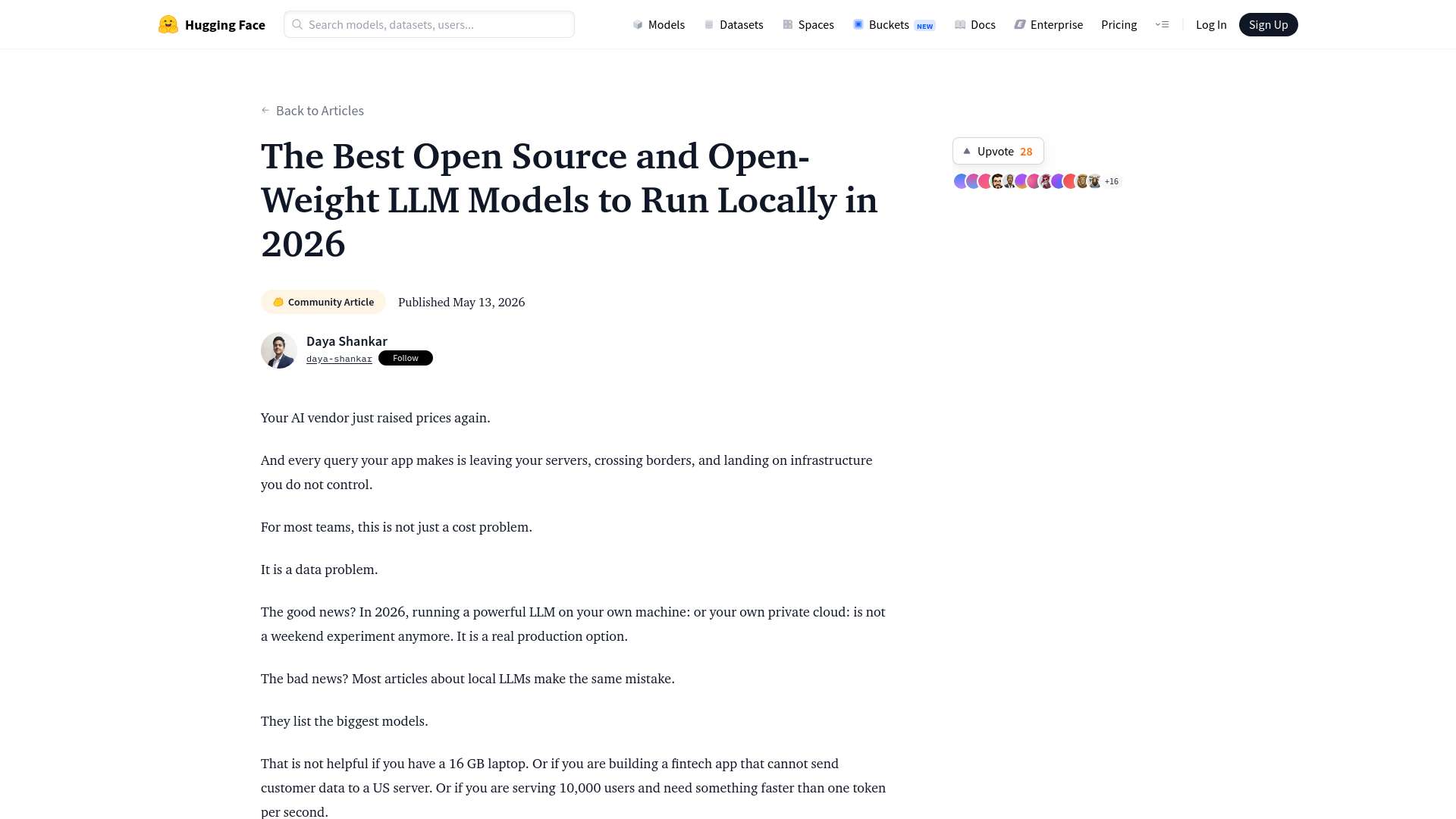
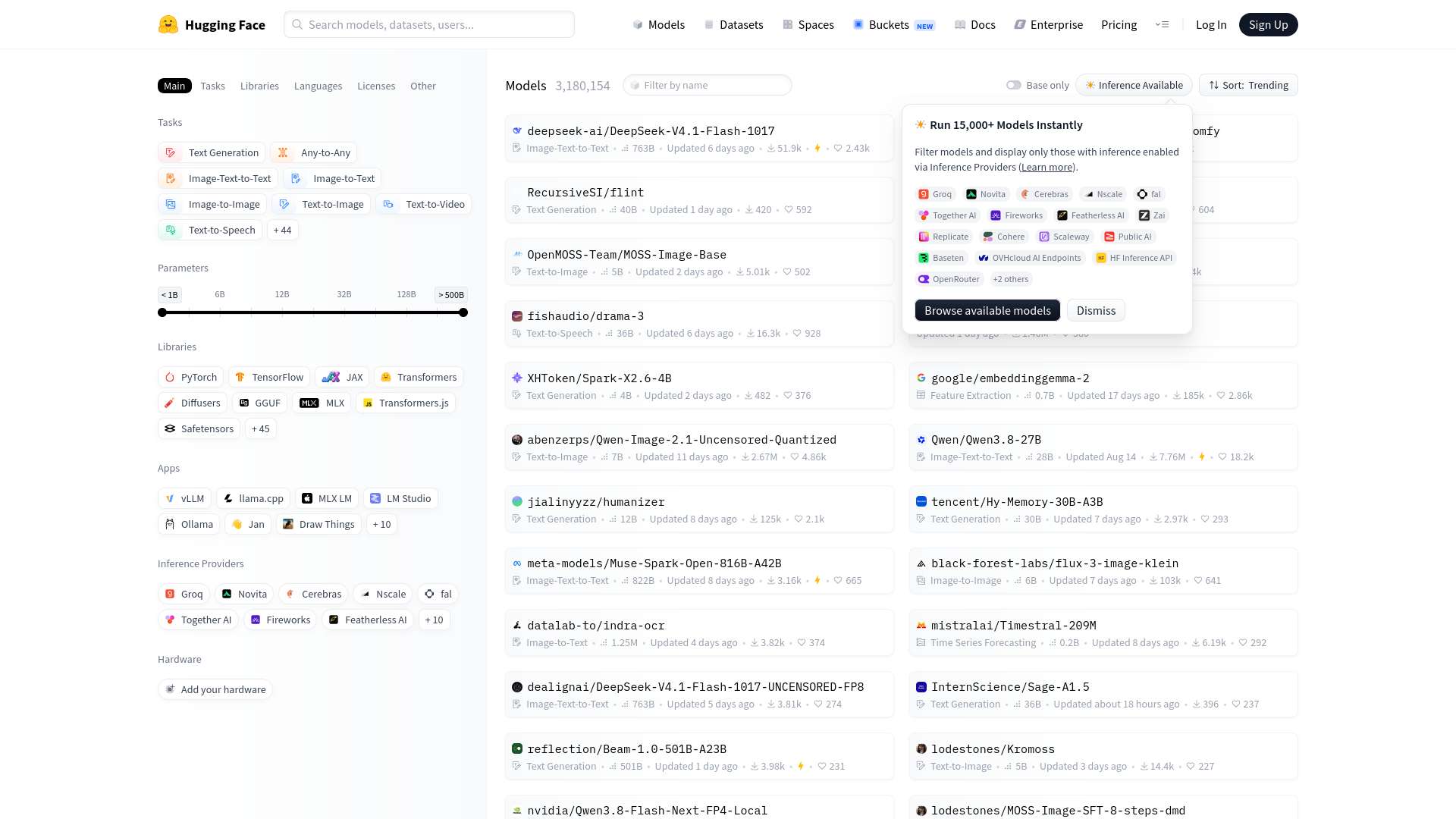
Source website screenshots
Frequently asked questions
What does "uncensored" mean on an official Hugging Face model card?
The label "uncensored" is a community convention, not a formal technical standard. It indicates that the model was fine-tuned on instruction datasets devoid of standard corporate refusal triggers (e.g., rejecting queries on offensive terminology, penetration testing examples, or fictional combat). It is not a guarantee of improved reasoning or raw capability.
Why do sub-3B models struggle with 3-bit or 4-bit quantization?
Large models (like 70B architectures) have billions of redundant parameters that can absorb the loss of precision incurred during quantization. Sub-3B models have a much higher parameter efficiency; reducing their bit precision below 5 bits severely impacts attention weights, leading to repetitive loops, degraded grammar, and hallucinated syntax.
Can an uncensored model run completely offline without telemetry?
Yes. When using native runtimes like llama.cpp or self-compiled execution binaries, inference runs entirely against local RAM and CPU/GPU hardware. No data leaves the machine unless external API plugins or unverified telemetry wrapper scripts are added to your runtime pipeline.
Explore source-linked model records in the AI model directory.
Sources and image references
- Daya Shankar, "The Best Open Source and Open-Weight LLM Models to Run Locally in 2026," Hugging Face Blog: https://huggingface.co/blog/daya-shankar/open-source-llm-models-to-run-locally
- Hugging Face Model Hub, "Uncensored Models Search Index": https://huggingface.co/models?search=uncensored
- Ramanath, "Best Small Language Models Under 3B 2026," Presenc AI Research: https://presenc.ai/research/best-small-language-models-under-3b-2026
- InsiderLLM Editorial Team, "Best Uncensored Local LLMs by VRAM Tier (2026)": https://insiderllm.com/guides/best-uncensored-local-llms/
- ComputingForGeeks, "Open Source LLM Comparison & License Tracker": https://computingforgeeks.com/open-source-llm-comparison/
Keep reading
Related reading
⚡ AI Engineering Briefing
AI model releases, practical tutorials, developer tools, and engineering research. Unsubscribe anytime.
Comments
Comments are temporarily unavailable while the public discussion space is being configured.