Auditing Uncensored LLMs: Licenses, Quantization, and Lineage
>Evaluate uncensored open-weight models in 2026. Audit upstream licenses, verify quantization provenance, and inspect model cards before enterprise deployment.
🎧 Listen — ~9 min
Audio summary not available yet

Deploying open-weight models that claim to be "uncensored" or stripped of refusal mechanisms introduces serious compliance, licensing, and stability challenges. While developers frequently adopt uncensored models to prevent refusals during offensive security research, synthetic data generation, or creative automation, downstream repackaging frequently strips upstream legal terms, obfuscates original weights, and alters inference behavior.
Engineering teams must systematically trace model lineage, verify commercial redistribution boundaries, and validate quantized artifacts prior to integrating uncensored model checkpoints into production environments.
Key takeaways
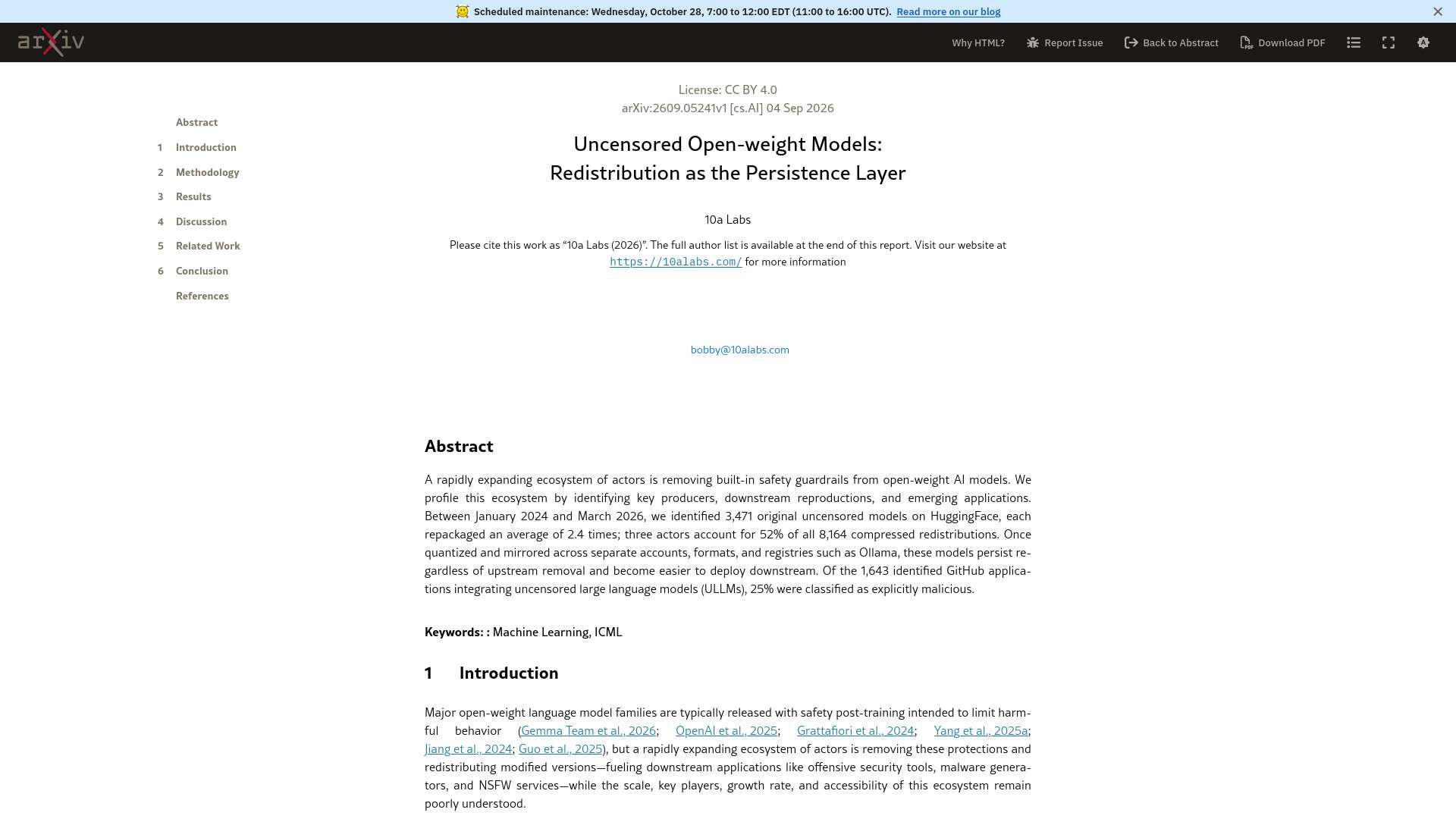
- Persistence through redistribution: Upstream takedowns fail to eliminate stripped models; researchers identified thousands of distinct uncensored variants mirrored an average of 2.4 times across multiple formats and registries.
- Licensing drift is rampant: Repackaged GGUF or AWQ checkpoints frequently omit base model commercial restrictions, exposing commercial deployments to copyright and license violation liabilities.
- Abliteration degrades reasoning: Removing refusal vectors often unintentionally impairs structured reasoning, tool calling, and calibration compared to baseline instruction-tuned models.
- Verification is non-negotiable: Teams must check SHA-256 hashes, review tokenizer chat templates, and inspect license clauses rather than relying on community upload descriptions.
2. Licensing traps: Base model terms vs. repackaged metadata
A recurring mistake in local model deployment is assuming that an open-weight release conforms to the Open Source Definition. In reality, most competitive foundation models utilize bespoke open-weight licenses with restrictive conditions.
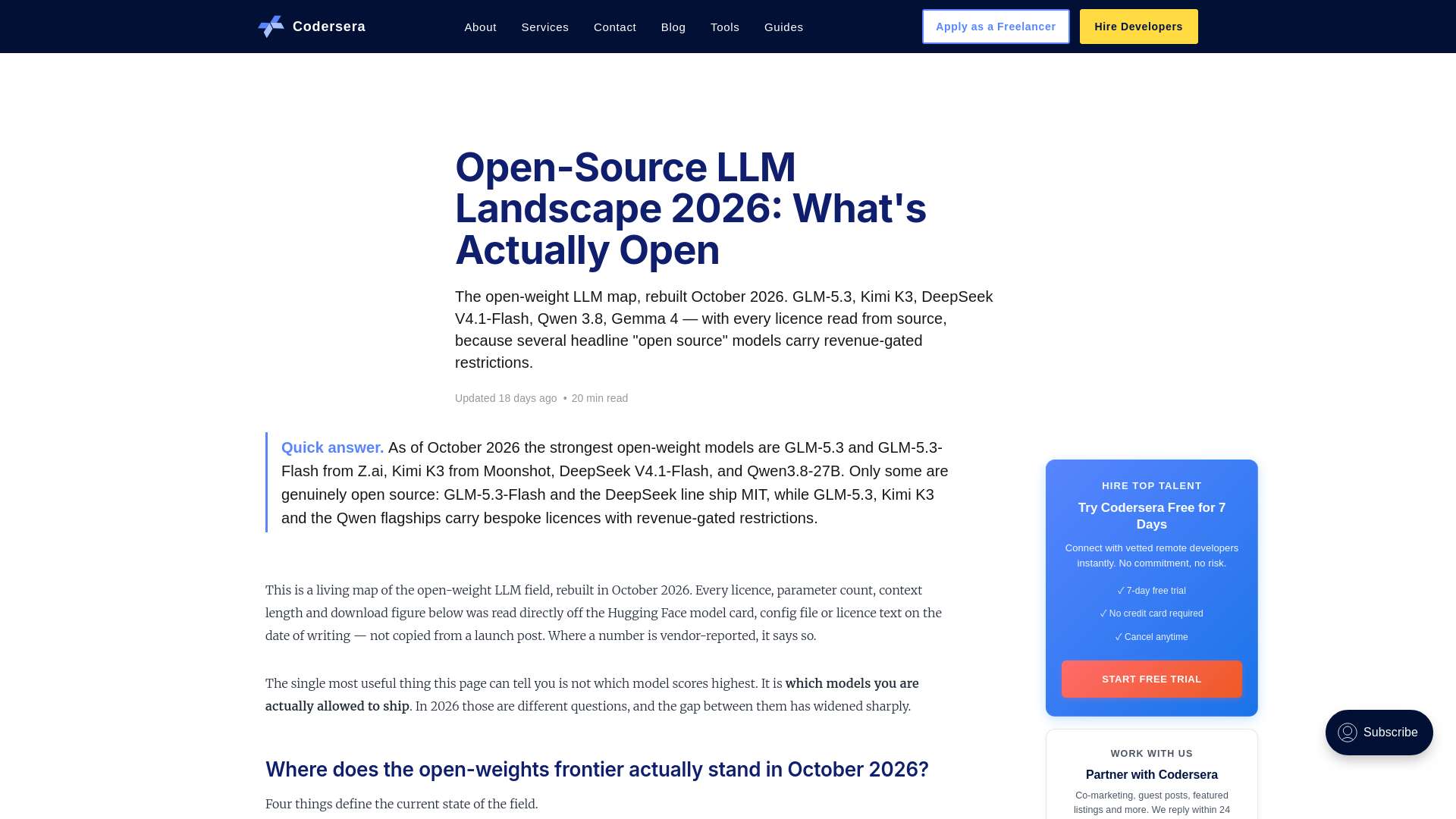
As documented in comprehensive industry reviews such as Codersera's Open-Source LLMs 2026 analysis, IntuitionLabs' commercial license audit, and the ComputingForGeeks comparison, model families apply diverse usage covenants:
- Monthly Active User (MAU) thresholds: Meta's Llama ecosystem historically mandates commercial licensing agreements once downstream products exceed specified user thresholds (e.g., 700 million MAU). Similar gating appears across modern frontier releases.
- Revenue caps and notification gates: Certain enterprise open-weight models allow free commercial use only up to strict annual gross revenue ceilings, requiring written enterprise agreements thereafter.
- Downstream distillation and training bans: Many licenses explicitly prohibit utilizing model outputs to train competing language models.
- Acceptable use policies (AUP): Base models commonly prohibit specific deployment categories (such as automated military applications, unlicensed medical advice, or specific scraping tasks). Removing the safety vector via fine-tuning does not legally release the deployer from these contractual requirements.
When an abliterated or uncensored fork is quantized into GGUF or AWQ formats, the quantization script typically outputs a bare-bones config.json and a placeholder README.md. If your legal or compliance team audits a repository, discovering an uncredited derivative of a restricted base model creates significant corporate risk. For an in-depth breakdown of calculating hardware requirements alongside compliance, see our open-weight LLM licensing and VRAM sizing guide.
3. Comparing base terms and derivative compliance
The table below outlines how upstream licensing restrictions persist into modified or uncensored community redistributions.
| Model Family / Architecture | Nominal License Type | Commercial Restrictions | Downstream Redistribution Rules | Verification Requirement |
|---|---|---|---|---|
| Apache 2.0 Permissive Base | Open Source (Apache 2.0) | None (Full commercial use permitted) | Must retain upstream copyright notices | Verify clean provenance and absence of tainted fine-tuning sets |
| Qwen Series Derivatives | Bespoke Permissive / Commercial Gate | MAU thresholds apply to large enterprise deployments | Derivatives must pass through upstream usage limitations | Inspect base model terms for size-specific commercial clauses |
| Gemma Series Derivatives | Google Gemma Terms of Use | Output generation restricted; prohibited use policies apply | Requires including Gemma attribution and compliance with terms | Audit model card for original tokenizer and parent weight hash |
| Community Uncensored Merges | Mismatched (often labeled MIT/Apache) | Inherits the most restrictive upstream parent model | Frequently stripped; fails compliance standards | Trace base tensor merges back to root repositories |
4. Quantization artifacts and technical side-effects
Uncensoring is rarely free from an engineering perspective. When fine-tuners abliterate refusal directions or train aggressively on unfiltered datasets, model internal activations shift. Pairing these modifications with aggressive quantization (such as 3-bit or 4-bit block-wise quantization) introduces compounding failure modes:
Perplexity and representation drift
Techniques like directional abliteration locate the orthogonal representation directions associated with refusal vectors and prune them. However, safety representations in dense transformer networks overlap significantly with reasoning, ethical nuance, and tool-validation logic. As detailed in our review of abliterated vs uncensored local LLMs, removing refusal behavior frequently degrades the model's calibration on standard benchmarks like MMLU or GSM8k.
Tool calling and schema validation degradation
When models are deployed as local agents, schema compliance is critical. If your pipeline relies on function calling, an uncensored derivative often produces malformed JSON or invokes non-existent endpoints. Teams integrating uncensored models into workflow engines should test structured outputs thoroughly; consult our guide on how uncensored LLMs handle tools reliably and check our coding-agent directory for production agent patterns.
Original Aligned Model:
[System Prompt] ──► [Input] ──► [Refusal Layer / Safety Weights] ──► [Structured Output]

Uncensored + Quantized:
[System Prompt] ──► [Input] ──► [Modified Weights (Abliterated)] ──► [Risk of Token Hallucination / Drift]
                                       │
                                       ▼
                       Quantization Noise (Q4_K_M / FP8)
5. Implementation: Auditing model provenance and tensors
To verify an open-weight checkpoint before running it on internal compute, engineers should execute an automated provenance audit. The following Python script inspects a Hugging Face repository or local directory, extracts original model configuration tags, cross-checks tokenizer metadata, and searches for stripped upstream markers.
1#!/usr/bin/env python3
2"""
3audit_model_provenance.py
4Inspects local or HuggingFace model directories for licensing discrepancies,
5base model parentage, and quantized GGUF metadata.
6"""
7
8import json
9import sys
10from pathlib import Path
11
12def audit_directory(model_path: str):
13    base_dir = Path(model_path)
14    if not base_dir.exists():
15        print(f"[-] Error: Path {model_path} does not exist.")
16        sys.exit(1)
17
18    print(f"[*] Auditing model metadata at: {base_dir.resolve()}")
19
20    config_file = base_dir / "config.json"
21    tokenizer_config = base_dir / "tokenizer_config.json"
22    readme_file = base_dir / "README.md"
23
24    audit_findings = {
25        "base_model": "Unknown",
26        "declared_architectures": [],
27        "upstream_license": "Unspecified",
28        "redistribution_warnings": []
29    }
30    if config_file.exists():
31        try:
32            with open(config_file, "r", encoding="utf-8") as f:
33                config_data = json.load(f)
34                audit_findings["declared_architectures"] = config_data.get("architectures", [])
35                if "_name_or_path" in config_data:
36                    audit_findings["base_model"] = config_data["_name_or_path"]
37        except Exception as e:
38            audit_findings["redistribution_warnings"].append(f"Failed to parse config.json: {e}")
39    else:
40        audit_findings["redistribution_warnings"].append("Missing config.json; weight lineage is obscured.")
41    if tokenizer_config.exists():
42        try:
43            with open(tokenizer_config, "r", encoding="utf-8") as f:
44                tok_data = json.load(f)
45                template = str(tok_data.get("chat_template", ""))
46                if "qwen" in template.lower():
47                    audit_findings["detected_lineage"] = "Qwen derivative"
48                elif "llama" in template.lower():
49                    audit_findings["detected_lineage"] = "Llama derivative"
50                elif "gemma" in template.lower():
51                    audit_findings["detected_lineage"] = "Gemma derivative"
52        except Exception as e:
53            audit_findings["redistribution_warnings"].append(f"Tokenizer inspection error: {e}")
54    if readme_file.exists():
55        content = readme_file.read_text(encoding="utf-8", errors="ignore").lower()
56        if "license:" in content:
57            for line in content.splitlines():
58                if line.strip().startswith("license:"):
59                    audit_findings["upstream_license"] = line.split("license:")[1].strip()
60        if any(w in content for w in ["abliterated", "uncensored", "refusal-free", "de-aligned"]):
61            print("[!] Model card contains explicit alignment-removal indicators.")
62
63    print("\n--- Audit Results ---")
64    print(f"Declared Architectures: {audit_findings['declared_architectures']}")
65    print(f"Reported Base Model:    {audit_findings['base_model']}")
66    print(f"Declared License:       {audit_findings['upstream_license']}")
67
68    if audit_findings["redistribution_warnings"]:
69        print("\nWarnings:")
70        for warning in audit_findings["redistribution_warnings"]:
71            print(f" [!] {warning}")
72
73    print("\nNext step: Cross-reference base model license against corporate deployment policies.")
74
75if __name__ == "__main__":
76    target = sys.argv[1] if len(sys.argv) > 1 else "."
77    audit_directory(target)
Running this audit script flags mismatches where a model repository claims permissive Apache 2.0 status while relying on a base architecture governed by proprietary covenants.
6. Operational failure modes and security considerations
When managing uncensored checkpoints across internal servers, technical teams encounter specific architectural hazards:
- Prompt injection vulnerability amplification: Aligned models contain residual defenses against malicious system prompt overwrites. Stripped uncensored models follow injected instructions inside untrusted retrieved context without resistance, dramatically increasing the surface area for data exfiltration.
- Inference engine compatibility bugs: Quantized GGUF derivatives produced with outdated versions of
llama.cppoften fail silently on modern KV-cache management implementations or produce corrupted output on specific matrix multiplication kernels. - Malicious weight serialization: Deserializing arbitrary checkpoints using insecure frameworks risks arbitrary code execution. Always download models in SafeTensors format or strictly validate GGUF header byte structures. Never load pickle-based
.binor.ptfiles from third-party community accounts. - API exposure risks: Deploying uncensored endpoints without network egress restrictions allows autonomous agents to execute destructive commands if granted bash or shell tools.
To properly isolate local LLM endpoints, reference our complete architecture guide on how to self-host uncensored LLMs as a secure API.
7. Verification checklist for deployment
Before running an uncensored or community-quantized model in an enterprise or production workflow, complete the following verification steps:
- Parentage trace: Document the exact base foundation model used prior to uncensoring or fine-tuning.
- License reconciliation: Compare the base model's upstream terms (MAU caps, domain-of-use exclusions) against your target product usage.
- Format verification: Confirm model weights are formatted exclusively as
.safetensorsor validated.ggufbinaries. - Quantization error check: Evaluate perplexity against standard test corpora (e.g., WikiText-2) to ensure quantization has not degraded coherent generation.
- Tool call validation: Run at least 100 benchmark queries requiring structured JSON outputs to verify that the alignment removal has not broken delimiter handling.
- Egress sandboxing: Ensure host inference containers run without access to sensitive internal networks or privileged cloud metadata endpoints.
Source website screenshots
Frequently asked questions
Does abliterating or uncensoring a model void the original license?
No. Modifying model weights creates a derivative work. In legal terms, derivative works remain governed by the intellectual property claims and terms of service of the original base model, unless the base model was released under an unrestricted public domain dedication or completely unencumbered open-source license.
Why do uncensored models frequently fail at structured JSON outputs?
Refusal ablation often dampens representations in layers responsible for adhering strictly to syntax delimiters and system role boundaries. Because safety tuning and instruction following share overlapping attention heads, removing safety behaviors can introduce token degradation during complex formatting tasks.
Are GGUF files safe from arbitrary code execution?
GGUF files are structured binary containers that store tensor metadata and raw weight arrays; they do not natively execute arbitrary Python code like legacy pickle (.pt) files. However, parsing bugs in inference engines (such as buffer overflows in C++ readers) remain possible. Always pull models from established maintainers and keep your inference engine updated.
Can an uncensored model be used commercially if the original model allows it?
Yes, provided your commercial use complies with all upstream covenants, including commercial revenue thresholds, MAU caps, brand attribution rules, and acceptable use restrictions defined in the original model card and license.
Explore source-linked model records in the AI model directory.
Sources and image references
- Primary research: 10a Labs. Uncensored Open-weight Models: Redistribution as the Persistence Layer. arXiv:2609.05241v1 [cs.AI], September 2026. https://arxiv.org/html/2609.05241v1
- License evaluations: Codersera. Open-Source LLMs 2026: Which Are Actually Open-Licensed. October 2026. https://codersera.com/blog/open-source-llms-landscape-2026/
- Commercial terms audit: IntuitionLabs. Open-Weight AI Model Licenses: Commercial Use Rules Explained. October 2026. https://intuitionlabs.ai/articles/open-weight-ai-model-licenses
- Model specifications: ComputingForGeeks. Open Source LLM Comparison Table (2026). September 2026. https://computingforgeeks.com/open-source-llm-comparison/
- Census data: Digital Applied. Open-Weight Model Licence Audit 2026. October 2026. https://www.digitalapplied.com/blog/open-weight-model-licence-audit-2026
Keep reading
Related reading
⚡ AI Engineering Briefing
AI model releases, practical tutorials, developer tools, and engineering research. Unsubscribe anytime.
Comments
Comments are temporarily unavailable while the public discussion space is being configured.