Building Secure AI Retrieval and Agents: Architecture Guide
>Learn how to architect secure multitenant RAG pipelines and autonomous AI agents using enterprise blueprints, fine-grained access, and guardrails.
🎧 Listen — ~10 min
Audio summary not available yet

Building enterprise AI systems requires shifting from experimental prototypes to hardened, production-grade architectures. When language models are granted access to internal company repositories, databases, and autonomous operational tools, standard application security assumptions quickly fall apart. Unbounded document retrieval introduces severe data leakage risks across tenant boundaries, while unconstrained autonomous tool execution exposes mission-critical infrastructure to prompt injection and indirect manipulation.
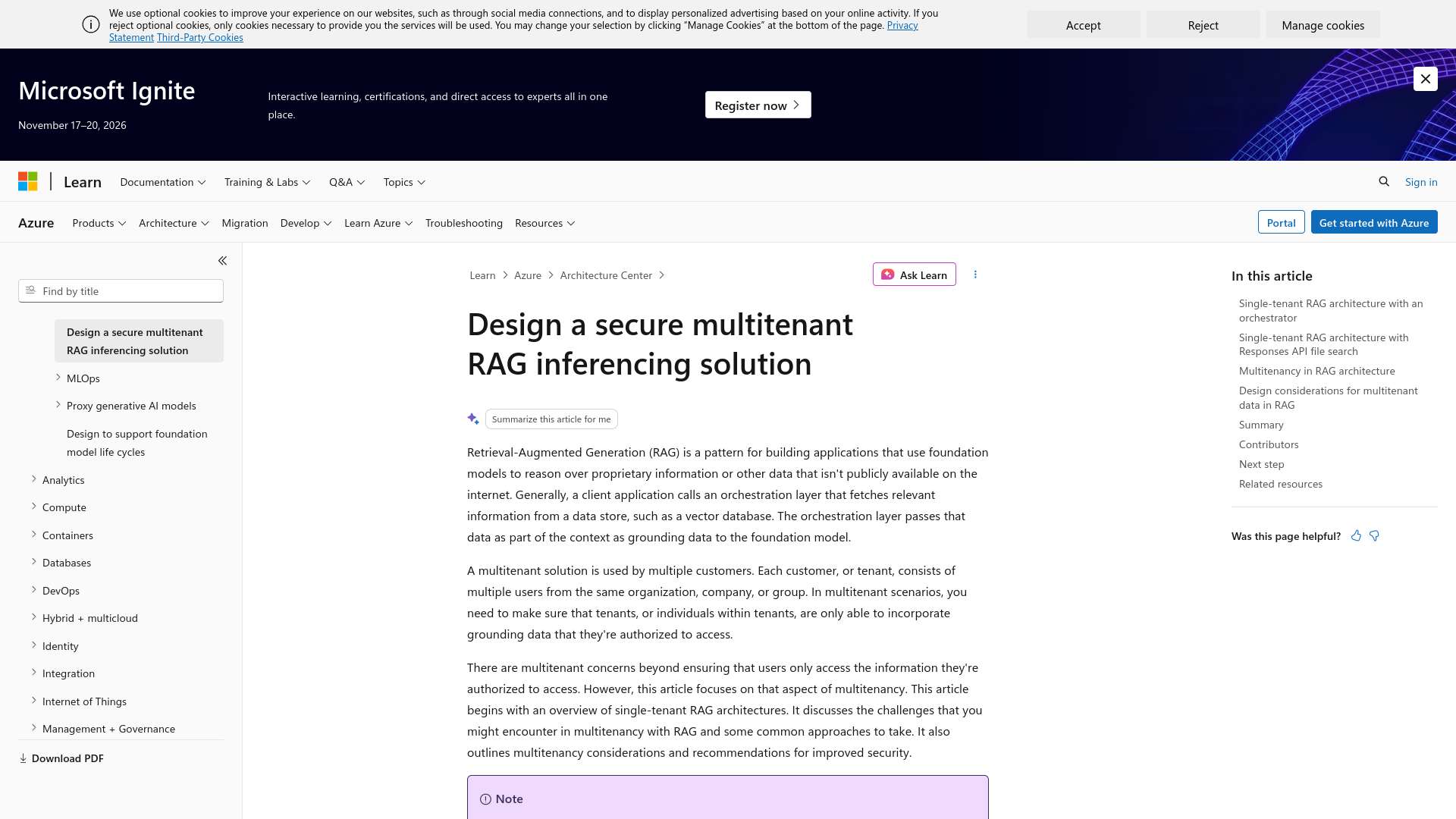
To mitigate these vulnerabilities, developers must build defense-in-depth pipelines where data retrieval, inference serving, and agentic tool invocation operate under verifiable boundaries. As detailed in NVIDIA's guidance on building and running secure data-driven AI agents, modern organizations require AI agents that remain strictly reliable and informed by business-specific context without overstepping authorization limits. Concurrently, implementing architectural blueprints such as Microsoft's secure multitenant RAG guide ensures that document indexing, vector stores, and inferencing solutions systematically prevent cross-tenant data exposure.
Key takeaways
- Enforce Identity at the Retrieval Boundary: Vector similarity calculations have zero intrinsic security awareness. Authorization filters must be evaluated during query planning or applied natively via access control lists (ACLs) before chunks are returned to context windows.
- Distinguish Data Isolation Strategies: Multitenant systems require explicit isolation models—ranging from fully separate vector indexes to row-level metadata partitioning—matching your compliance, blast-radius, and performance requirements.
- Separate System Prompts from Untrusted Context: Never rely on text formatting or prompt framing as a security perimeter. Retrieval outputs must be treated as untrusted payload data inspected by deterministic guardrails.
- Constrain Agent Execution Authority: Agentic tools must enforce least-privilege service identities, pre-execution schema validation, and human-in-the-loop gates for state-altering actions.
1----------+      +-------------------+      +-----------------------+
2| User Prompt | ---> | Retrieval Pipeline| ---> | Vector DB + ACL Gate  |
3+-------------+      +-------------------+      +-----------------------+
4                                                            |
v
1+-------------+      +-------------------+      +-----------------------+
2| Tool Action | <--- | Agent Execution   | <--- | LLM Inference Service |
3| (Least Priv)|      | Guardrails Engine |      | (Context Assembly)    |
4+-------------+      +-------------------+      +-----------------------+
Three primary vulnerability vectors emerge in these workflows:
- Cross-Tenant Data Exposure: When multitenant document corpuses share a unified index, standard nearest-neighbor vector searches return the top semantic matches regardless of document ownership. Without cryptographically validated user identity injected into the vector query filter, unauthorized users can easily surface privileged internal records.
- Indirect Prompt Injection: External knowledge sources—such as public web pages, customer ticketing databases, or shared cloud drives—can contain hidden adversarial instructions. When ingested into context, these instructions can override system prompts, hijacking agent control flow.
- Unbounded Agent Authority: Autonomous agents equipped with function calling or Model Context Protocol (MCP) toolkits often inherit elevated administrative service roles. An agent manipulated by poisoned retrieval context could issue unauthorized database drops, initiate arbitrary API calls, or exfiltrate private credentials.
For deeper architectural strategies on limiting blast radius in agent runtimes, explore our analysis on securing AI agent infrastructure: sandboxing and blast-radius control and our deep dive into bastion security architecture for AI agents.
1. Multitenant Retrieval: Isolation and Authorization Patterns
As emphasized in Microsoft's secure multitenant RAG design guide, designing multitenant inferencing architectures requires balancing data isolation, operational complexity, and resource costs. Developers must evaluate three core indexing and retrieval topologies.
Architectural Approaches for Multitenancy
- Index-per-Tenant Isolation: Each tenant provisions an independent vector index or physically separate vector store instance. This provides maximum data boundary enforcement, deterministic blast-radius containment, and simplified regulatory compliance, though it increases provisioning overhead at scale.
- Partitioned Metadata Filtering: All tenants reside within a shared index where document chunks are indexed with tamper-proof tenant metadata attributes (for example,
tenant_id,department_id,role_mask). Every retrieval request strictly appends a hardcoded boolean filter derived directly from the authenticated session token. - Relationship-Based Access Control (ReBAC): Fine-grained document access policies are validated dynamically against external authorization engines before top-$k$ document chunks are formatted into the model's prompt context.
The following comparison illustrates key trade-offs across these implementation strategies:
| Isolation Strategy | Blast-Radius Risk | Query Latency Impact | Operational Overhead | Regulatory Compliance Fit |
|---|---|---|---|---|
| Index-per-Tenant | Lowest (Physical isolation) | Negligible | High (Index management) | Strongest (HIPAA, FedRAMP, GDPR) |
| Metadata Filtering | Moderate (Logic error risk) | Low (Inverted index filter) | Low (Single deployment) | Moderate (Enterprise SaaS) |
| Dynamic Pre/Post ReBAC | Low (Zero-trust evaluation) | Moderate (External check) | Moderate (Policy sync) | High (Complex role hierarchies) |
When engineering large document pipelines, evaluation metrics must continuously track retrieval precision and security compliance. Review our practical guide on evaluating AI features: latency, cost, and reliability gates to operationalize these criteria.
2. End-to-End Secure Retrieval Pipeline in Python
To build an enterprise RAG query interface that reliably prevents cross-tenant leaks, metadata filters must be injected programmatically at the service level rather than trusting inputs provided directly by the user or an autonomous agent.
The following Python implementation demonstrates an end-to-end authorized retrieval service. It validates user claims, constructs an enforced metadata filter, and queries a vector store securely.
1"""
2secure_retrieval_service.py
3Enterprise pattern for secure, multitenant vector retrieval.
4"""
5
6from typing import List, Dict, Any, Optional
7from dataclasses import dataclass
8
9@dataclass(frozen=True)
10class AuthenticatedCaller:
11    user_id: str
12    tenant_id: str
13    roles: List[str]
14
15class SecureRetrievalService:
16    def __init__(self, vector_client: Any, embedding_model: Any):
17        self._vector_client = vector_client
18        self._embedding_model = embedding_model
19
20    def _build_security_filter(self, caller: AuthenticatedCaller) -> Dict[str, Any]:
21        """
22        Constructs deterministic filter expression.
23        Guarantees that no query can bypass tenant boundaries.
24        """
25        return {
26            "must": [
27                {"key": "tenant_id", "match": {"value": caller.tenant_id}},
28                {"key": "authorized_roles", "match_any": {"values": caller.roles}}
29            ]
30        }
31
32    def retrieve_context(
33        self,
34        query: str,
35        caller: AuthenticatedCaller,
36        top_k: int = 5
37    ) -> List[Dict[str, Any]]:
38        if not caller.tenant_id or not caller.roles:
39            raise PermissionError("Invalid security context: Missing tenant or role credentials.")
40        query_vector = self._embedding_model.encode(query)
41        security_filter = self._build_security_filter(caller)
42
43        results = self._vector_client.search(
44            collection_name="enterprise_knowledge_base",
45            query_vector=query_vector,
46            query_filter=security_filter,
47            limit=top_k
48        )
49
50        sanitized_documents = []
51        for match in results:
52            sanitized_documents.append({
53                "document_id": match.id,
54                "text": match.payload.get("content", ""),
55                "source": match.payload.get("source_uri", "unknown")
56            })
57
58        return sanitized_documents
By ensuring that tenant_id and authorized_roles originate from a validated authentication token (such as a verified JWT or mTLS session), client-side manipulation of the search boundaries is completely prevented at the data access layer.
3. Hardening Autonomous AI Agents and Tool Runtimes
Retrieval security is only half the equation. When organizations transition from read-only search systems to autonomous agents capable of performing multi-step reasoning, agents gain execution capabilities. As highlighted in NVIDIA's guide on building and running secure data-driven AI agents, enterprise blueprints must enforce strict guardrails, reliable data flows, and scoped tool interfaces.
Developers can also explore NVIDIA's interactive sandbox environments on how to build a production RAG pipeline to test parameter configurations and component integration.
Enforcing Strict Tool Scopes
Agents must never run with blanket infrastructure credentials. Every tool registered in an agent harness should adhere to the following architecture rules:
- Dedicated Service Principals: Each external tool must execute using an isolated service identity limited strictly to the required database tables, S3 buckets, or API paths.
- Schema and Argument Sanitization: Inbound parameters generated by the language model must undergo strict type, length, and regex validation before triggering underlying SDK methods.
- Execution Guardrails and Human Gates: Actions with destructive potential (writing to databases, deleting assets, sending external emails) must require explicit confirmation workflows or state-machine validation before execution.
1"""
2agent_tool_guardrail.py
3Enforcing bounded authority and argument validation for agent tools.
4"""
5
6import re
7from pydantic import BaseModel, Field, field_validator
8
9class DatabaseQueryInput(BaseModel):
10    table_name: str = Field(..., max_length=64)
11    record_id: str = Field(..., max_length=36)
12    action: str = Field(..., pattern="^(READ|VERIFY)$")
13
14    @field_validator("table_name")
15    def validate_allowed_tables(cls, v: str) -> str:
16        allowed = {"customer_records", "inventory_data", "public_catalog"}
17        if v not in allowed:
18            raise ValueError(f"Table '{v}' is restricted or non-existent.")
19        return v
20
21    @field_validator("record_id")
22    def validate_uuid_format(cls, v: str) -> str:
23        uuid_pattern = r"^[0-9a-fA-F-]{36}$"
24        if not re.match(uuid_pattern, v):
25            raise ValueError("Malformed record identifier.")
26        return v
27
28def execute_agent_database_lookup(payload: dict) -> dict:
29    """
30    Safely executes tool after parsing through strict Pydantic contract.
31    """
32    validated_args = DatabaseQueryInput(**payload)
33    return {
34        "status": "success",
35        "table": validated_args.table_name,
36        "record_id": validated_args.record_id
37    }
For practical patterns on maintaining predictable execution states while orchestrating multi-step workflows, see our guide on production AI reliability: explicit state and bounded authority.
4. Defense-in-Depth Context Assembly
A common mistake in AI application development is relying on Markdown delimiters (such as ```context or <context>...</context>) as an absolute boundary against prompt injection. A malicious document can easily include closing tags and override system prompts.
To build a resilient context ingestion layer:
- Screen as a warning signal, not a security boundary: Pattern checks may flag known attack phrasing for review, logging, or rate limiting, but attackers can paraphrase or encode instructions. OWASP warns that keyword filters miss variants; screening must never authorize an action. OWASP prompt-injection guidance.
- Keep instructions and data distinguishable: Use structured message or context fields when supported, but treat labels and delimiters as model guidance rather than enforcement. Enforce permissions in deterministic code at retrieval and tool boundaries. OWASP prompt-injection guidance.
- Validate outputs and actions at their destinations: Use classifiers as supplemental screening, then validate tool arguments and authorize each action in application code before execution. Encode or sanitize output for the context where it will be rendered; a model verdict alone cannot guarantee safety. OWASP prompt-injection guidance.
5. Implementation Workflow: From Architecture to Production
Building a secure enterprise retrieval and agent system follows a structured deployment sequence:
+-------------------------------------------------------------------------+
| Step 1: Data Classification & Schema Design                             |
| Label document classifications, tenant IDs, and RBAC mappings.          |
+-------------------------------------------------------------------------+
                                     |
                                     v
+-------------------------------------------------------------------------+
| Step 2: Index Segregation & Filtering Setup                             |
| Provision isolated indexes or configure enforced metadata indexing.     |
+-------------------------------------------------------------------------+
                                     |
                                     v
+-------------------------------------------------------------------------+
| Step 3: Identity & Access Management Binding                            |
| Bind retrieval microservices to enterprise OIDC / OAuth2 token exchange.|
+-------------------------------------------------------------------------+
                                     |
                                     v
+-------------------------------------------------------------------------+
| Step 4: Agent Tool Scoping & Input Sanitization                         |
| Wrap every function tool in schema validators and isolated credentials. |
+-------------------------------------------------------------------------+
                                     |
                                     v
+-------------------------------------------------------------------------+
| Step 5: Continuous Observability & Red Teaming                          |
| Trace retrieval requests, log prompt evaluations, and test injection.   |
+-------------------------------------------------------------------------+- Data Classification & Schema Design: Before indexing, classify documents by sensitivity. Tag all chunks with unambiguous tenant IDs, department attributes, and lifecycle metadata.
- Index Segregation & Filtering Setup: Configure vector databases to enforce strict filtering logic on inverted indexes. Verify that the query engine rejects searches that omit tenant-level filters.
- Identity & Access Management Binding: Integrate your retrieval microservice with an external Identity Provider (IdP). Extract tenant identity directly from cryptographically signed claims rather than raw HTTP body payloads.
- Agent Tool Scoping & Input Sanitization: Write strict schemas for every tool exposed to agent planners. Enforce typed boundaries, limit string inputs, and deny destructive API operations.
- Continuous Observability & Red Teaming: Monitor RAG inputs and outputs with distributed tracing. Continuously evaluate systems against adversarial datasets using automated injection harnesses.
Source website screenshots
Frequently asked questions
Can prompt engineering alone prevent indirect prompt injection in RAG pipelines?
No. Prompt wording and text delimiters do not enforce a security boundary. Keep retrieved content distinguishable from trusted instructions, use pattern screening only as a limited signal, and enforce authorization, argument validation, and least privilege in application code at retrieval and tool boundaries. OWASP notes that phrase filters can miss paraphrased or encoded attacks. Read the OWASP guidance.
What is the most cost-effective way to secure multitenant RAG vector databases?
For systems supporting thousands of small tenants, partitioned metadata filtering within a shared collection is generally the most cost-effective approach. It maximizes memory utilization across vector index nodes while enforcing multi-tenant isolation via enforced query-level filters. However, highly regulated enterprise clients may mandate dedicated index-per-tenant topologies to guarantee physical data separation.
How should state-altering actions be protected in autonomous agents?
Destructive or state-altering actions (such as initiating financial transactions, modifying permissions, or deleting data) should implement a human-in-the-loop confirmation gate or two-person rule. The agent prepares the draft payload and pauses execution, resuming only after an authenticated human supervisor approves the action via a secure webhook or administrative dashboard.
Sources and image references
- NVIDIA Technical Blog: Build and Run Secure, Data-Driven AI Agents
- Microsoft Learn: Design Considerations for Secure Multitenant RAG Architectures
- NVIDIA NIM API & Blueprints: Build a RAG Pipeline
- OWASP Cheat Sheet Series: LLM Prompt Injection Prevention
Keep reading
Related reading
⚡ AI Engineering Briefing
AI model releases, practical tutorials, developer tools, and engineering research. Unsubscribe anytime.
Comments
Comments are temporarily unavailable while the public discussion space is being configured.