DeepSeek DeepInfer Explained: Hardware, Setup & Limits
>What is DeepSeek DeepInfer? See supported models and hardware, Linux setup, what the open-source release includes, and what it still lacks.
🎧 Listen — ~17 min
Audio summary not available yet

Short answer: DeepInfer is DeepSeek’s open-source inference engine for DeepSeek-V4.1-Flash, not a universal model server and not a one-command replacement for vLLM or SGLang. Its public release exposes optimized kernels, a model/sampler runtime, attention and MoE parallelism, speculative decoding, and constrained output. DeepSeek documents Linux, Python 3.12, GCC 13+, and either CUDA 13 on NVIDIA SM100 GPUs or CANN 9.2 on Huawei Ascend 950. The released repo can run offline examples, but a complete online service still needs surrounding systems such as request routing, a production KV-cache service, and load balancing. The official README is the source of truth for the moving hardware and software requirements.
I’m approaching this as an inference-systems question, not a launch-summary exercise: what executes where, what the open code actually contains, which Linux layers matter, and where the production boundary still sits. I have not built or benchmarked DeepInfer on an SM100 or Ascend 950 host; commands below are the repository’s documented path, not a claim of a local test.

Original editorial illustration generated for this article; it is conceptual, not a DeepSeek product screenshot or a measured topology.
DeepInfer at a glance
| Question | What the public release says |
|---|---|
| What is it? | A high-performance inference framework whose public release provides offline inference components |
| Supported model named in the README | DeepSeek-V4.1-Flash |
| Listed accelerators | NVIDIA SM100 GPUs and Huawei Ascend 950 NPUs |
| NVIDIA software baseline | Linux, GCC 13+, Python 3.12, CUDA 13 |
| Ascend software baseline | Linux, GCC 13+, Python 3.12, CANN 9.2 |
| License | Apache-2.0 for the DeepInfer repository; model weights have their own license terms |
| Complete hosted API included? | No: cache, service disaggregation and load-balancing pieces remain required outside the public release |
| A universal backend for arbitrary Hugging Face models? | The README currently names one supported model family/checkpoint path; do not assume generic compatibility |
The last two lines are the practical headline. A framework can contain a highly optimized engine and still not be a turnkey service. “Open source” also does not mean that the complete internal production stack, deployment control plane, or every model weight is part of the same repository.
What Is DeepSeek DeepInfer? Architecture, Scope, and Alternatives
The repository describes DeepInfer as the framework powering DeepSeek’s large-scale inference services, then scopes this open-source release to offline inference and the core engine features. Its README lists a model runtime and sampler, optimized kernels, attention data parallelism (DP), balanced context parallelism (CP), MoE expert parallelism (EP) with expert-parallel load balancing (EPLB), speculative decoding, bounded replay, batch-invariant inference, deterministic sampling, and structured outputs. DeepSeek’s deployment Q&A adds the system-level explanation and draws the line around pieces that remain coupled to internal infrastructure.
That makes DeepInfer best understood as a model-specialized execution engine. It is not, by itself:
- a public HTTP server with authentication, quotas, user management, and API-key rotation;
- a general model loader promised to run arbitrary checkpoints;
- a scheduler for Kubernetes or a replacement for a GPU cluster orchestrator;
- a complete persistent KV-cache product or gateway/router;
- evidence that a developer’s workstation can fit the model in local memory.
Those distinctions matter when choosing an inference stack. If your goal is “serve many unrelated models through a familiar OpenAI-compatible endpoint,” a broader serving ecosystem may be a better first comparison. If your goal is to inspect and evaluate the engine path DeepSeek documents for its own V4.1-Flash workload on its listed accelerator targets, DeepInfer is much more directly relevant. For adjacent model choices, browse the AI model directory; for the software that wraps an engine with tools and repository actions, browse the coding-agent directory.
DeepInfer, vLLM, SGLang, and TensorRT-LLM are not interchangeable labels
DeepSeek says its project was built primarily on vLLM, with additional inspiration from SGLang and TensorRT-LLM. That is useful lineage, but it does not mean DeepInfer is a drop-in fork with the same compatibility matrix. A better selection checklist is:
| If you need… | Start by evaluating… | Why |
|---|---|---|
| Broad compatibility across model families and familiar deployment integrations | vLLM or SGLang, then verify the exact model and accelerator support | General-purpose ecosystem breadth may matter more than a model-specific kernel path |
| A DeepSeek-optimized path for the explicitly supported V4.1-Flash workload on the listed hardware | DeepInfer | The repository exposes DeepSeek’s engine and parallelism choices directly |
| NVIDIA-focused optimization inside an existing TensorRT stack | TensorRT-LLM | It may fit a team already standardized on NVIDIA’s runtime/tooling |
| A production endpoint with auth, routing, quotas and failover | Any engine plus a gateway/control plane | These are service responsibilities, not properties implied by a fast kernel |
This is a decision aid, not a benchmark ranking. Before production selection, test your exact model revision, tokenizer/encoding, prompt mix, sequence lengths, batch distribution, hardware topology, and failure behavior.
How DeepInfer handles requests: prefill, cache, and decode
Large language model serving has two cost profiles. Prefill consumes the prompt: the system tokenizes or encodes input and computes prompt representations. Decode repeatedly predicts the next token, reusing state from earlier tokens. Long prompts tend to put pressure on prefill time and memory traffic; concurrent generation and output length shape decode throughput and tail latency. These are different bottlenecks, so one GPU layout or one batch policy is not automatically optimal for both.
DeepSeek’s deployment Q&A describes separating the vision encoder, prefill, and decode roles so capacity can be allocated independently. It also describes attention DP, MoE EP, load balancers for the respective replicas, and a KV-cache storage service. Crucially, the public README lists the KV-cache system and the complete VE/prefill/decode service disaggregation and data-parallel load balancing as required pieces not included in the release. Some engine-side functionality may be present; the separate production service around it is still your responsibility.

Original architecture diagram based on DeepSeek’s public README and deployment Q&A. Dashed boxes mark surrounding service responsibilities, not released DeepInfer modules.
DeepSeek Recipe: the protocol boundary
DeepSeek also publishes DeepSeek Recipe, a separate component for encoding and decoding across mainstream API protocols. The public Q&A says it handles Chat Completions, Responses, and Messages conversion through a shared conversation format, and parses model output into text, reasoning, and tool-call events. The project describes this logic as Rust with Python bindings.
This boundary is easy to underestimate. A model’s tokenizer and control tokens are part of the runtime contract. A generic string replacement layer can mis-handle special tokens embedded in user text or tool output. DeepSeek’s published approach recognizes special tokens by token ID in its encoding/parsing path, which helps prevent ordinary user-supplied text from accidentally acting like a control marker. Recipe handles protocol/token conversion; it does not provide your application’s authorization policy, tool execution sandbox, or HTTP service.
MoE expert parallelism: compute is only half the story
In a Mixture-of-Experts model, a router chooses a subset of experts for each token. Expert parallelism distributes expert computation across devices. That can raise useful aggregate throughput, but it also adds communication: tokens and intermediate activations have to reach the GPUs that own the selected experts, and the replies must be combined. The scale-up interconnect, placement, collectives, and load balance become first-order system variables.
DeepSeek calls out MoE EP and EPLB. In its deployment Q&A, it describes maintaining redundant copies of hot experts and periodically reassigning them using observed expert-load statistics. This is a response to skew: a nominally even token count does not guarantee that every expert or rank does equal work. If one rank becomes a straggler, synchronized work can make the slowest rank determine the step time.
Wide EP is not a magic “more GPUs equals faster” switch. A wider group can reduce per-step memory traffic in the MoE expert path in the configuration DeepSeek describes, but it also asks more of the communication fabric and cluster placement. DeepSeek’s Q&A frames a single efficient deployment unit around separate prefill and decode GPU groups; its numerical topology recommendations are tied to its own V4.1-Flash service, not a blanket hardware-sizing formula for every model.
Linux and GPU requirements for DeepInfer
The model’s mathematical operations execute on the accelerator. The Linux kernel does not run each transformer layer as a Linux task. Linux is still essential: it hosts the process, loads the device-driver interface, manages host memory and process scheduling, exposes PCIe/NUMA topology, and participates in networking and storage. User-space runtimes such as CUDA or CANN then coordinate accelerator work; DeepInfer’s compiled operations submit work to the device through that stack.
That is why a GPU inference build can fail even when the Python code looks correct. The effective compatibility chain includes the kernel, vendor driver, accelerator toolkit, communication libraries, compiler, Python packages, compiled extensions, and the exact GPU/NPU architecture. A mismatched ABI or unsupported architecture is not something a larger model context window can fix.

The Linux operator’s checklist
- Host kernel and driver: confirm that the installed accelerator driver supports the running kernel and the device. Secure Boot, DKMS/module signing, kernel updates, and container device passthrough can change whether the driver actually loads. DeepInfer’s README does not specify one minimum Linux kernel or driver version, so do not invent one from the Python requirements.
- PCIe, NUMA, and fabric: inspect which GPUs and NICs are attached to which CPU sockets and switches. A collective communication library can discover topology and select routes; the system administrator still needs a correct, reachable, performant fabric. NVIDIA’s NCCL setup documentation is explicit that the network and GPU communication configuration is part of deployment, not a detail hidden by model code.
- Memory and process limits: validate host RAM, pinned-memory policy, file descriptors, shared-memory sizing, and container cgroup limits for the workload. These are capacity checks—not substitutes for accelerator HBM.
- Distributed launch: all ranks need consistent software, model files, environment variables, device visibility, and network reachability. A process that imports successfully on one node may still fail during collective initialization across nodes.
- Observability: record per-stage latency, GPU utilization, memory, communication, rank skew, queue depth, cache hit/miss, and errors. Aggregate tokens/second alone can hide a bad first-token latency or one slow rank.
The hardware target is strict. The README currently names NVIDIA SM100 GPUs and Huawei Ascend 950 NPUs, with different software paths: CUDA 13 for NVIDIA and CANN 9.2 for Ascend. Do not assume an H100, RTX workstation card, Apple Silicon Mac, or a random CUDA-capable VPS is supported just because it can run other inference software. Check the repo’s live hardware matrix and issues before procurement.
Install and run DeepInfer's documented offline example
This is a reproducible starting point for a supported Linux host, not a turnkey production deployment. Use the official repository’s current instructions because dependencies and accelerator support can change.
1git clone https://github.com/deepseek-ai/DeepInfer.git
2cd DeepInfer
3
4python3.12 -m venv .venv
5source .venv/bin/activate
6
7export DEEPINFER_ACCELERATOR=nvidia
8./build.sh
9
10python examples/offline_inference.py
For the NVIDIA build, the repository’s build.sh installs the backend requirements, reinstalls its specified NCCL package version, builds vendored dependencies, and compiles DeepInfer. Review that script before running it in a privileged or shared environment: a build script executes package installation and compilation commands on your host. Prefer a disposable environment or a controlled build image, and pin a repository commit for reproducibility.
The examples also document explicit parallelism variants such as --ep, --dp, and --cp. Use only a configuration that divides and fits the devices actually visible to the process; do not copy a multi-GPU command onto a one-GPU machine. The default checkpoint is deepseek-ai/DeepSeek-V4.1-Flash-1017. You can point DEEPINFER_HF_MODEL_DIR to a local copy; the example docs note that this variable selects the default checkpoint path and does not override an explicitly passed --model_name.
First-run validation before performance tuning
- Confirm
nvidia-smior the platform’s supported accelerator diagnostic sees the target device and driver. - Confirm the Python interpreter is 3.12 and the requested accelerator environment is still exported when the runner starts.
- Build in a clean environment and save the exact commit, package versions, compiler output, and device topology.
- Run the repository’s offline sample and structured-output checks before collecting throughput numbers.
- Validate numerical/output behavior after changing kernels, speculative decoding, batch composition, or model files.
- Start with one host and the smallest supported configuration; scale to multiple ranks only after checking collectives and rank logs.
Do not expose a raw example process to the public internet. Put a service layer in front of it that owns authentication, request validation, rate limiting, timeouts, logging policy, model access, and tool-call policy. For production, also design health checks, rolling deploys, backpressure, failover, queueing, and a way to drain in-flight requests safely.
DeepInfer optimization features, explained
Speculative decoding and confidence-scheduled verification
Speculative decoding uses a draft path to propose multiple tokens, then verifies candidates with the target model. The benefit depends on acceptance behavior and the cost of draft/verification work; it is not a universal multiplier. DeepInfer documents DSpark and confidence-scheduled verification, with controls such as DEEPINFER_ENABLE_MTP_VARLEN and DEEPINFER_USE_NEXTN_DECODE. Treat these as model- and version-specific controls. Benchmark quality, accepted-token rate, latency, and memory together; do not copy settings without checking the matching checkpoint and README.
SWA bounded replay
DeepSeek documents a bounded replay strategy for its sliding-window attention state. When the relevant cache state is unavailable, the system recomputes a bounded suffix instead of replaying the entire prompt, using properties of the V4.1 architecture. The default configuration values in the README are coupled to that model’s window and backtracking assumptions. This is not a generic technique to paste into another model’s serving stack; changing the retained window without preserving the model’s dependencies can produce incorrect state.
Batch invariance and deterministic sampling
In ordinary batched execution, changing which requests share a batch can change floating-point operation ordering and sometimes output behavior. DeepInfer exposes batch-invariant inference for NVIDIA, and deterministic sampling under documented settings that also disable variable-length MTP and use a fixed sequence seed. This is valuable for reproducible evaluations and debugging. It has a cost/compatibility envelope, so measure it and check the current README before turning it on broadly.
Structured outputs
The project supports JSON Schema, regular expressions, and EBNF constraints. The documented approach compiles the constraint into a grammar automaton and masks invalid next tokens during decoding. That is stronger than “please return valid JSON” prompting, but it still needs application-level validation: a syntactically valid object can be incomplete, unauthorized, or semantically wrong.
DeepInfer benchmarks: published setup and missing evidence
DeepSeek says its benchmark setup measured prefill on four SM100 GPUs and decode on 64 SM100 GPUs within a scale-up domain, and provides a sweep script. The README’s headline performance table currently has no numeric results in the rendered table. That means a reader can inspect the intended scale and reproduce the scripts, but should not treat an unpopulated table as a verified speedup claim.
For a fair comparison, record at least:
| Measurement | Why it matters |
|---|---|
| Time to first token (TTFT) | Includes queueing and prompt processing, so it exposes prefill delay |
| Inter-token latency / time between tokens | Describes the user-visible decode cadence |
| Aggregate output tokens/sec | Useful for throughput, but can conceal per-user latency |
| Input/output lengths and concurrency | Workload shape changes both compute and cache behavior |
| GPU memory, power, and utilization | Shows whether you are compute-, memory-, or communication-bound |
| Expert/rank imbalance | Identifies skew and stragglers in distributed MoE execution |
| Cache hit rate and cache transfer cost | Separates engine throughput from the surrounding cache service |
| Quality and structured-output correctness | Prevents “faster” from meaning “silently degraded” |
Compare the same checkpoint, prompt/template, precision, batch policy, hardware fabric, and measurement window. Publish the command, commit, config, and raw output with the result. A cloud instance with the same GPU name but a different interconnect is not necessarily the same benchmark platform.
DeepSeek's cluster-scale claims are not a per-GPU benchmark
The companion deployment Q&A now says one cluster serves 155 trillion tokens per day and reports US$38 in revenue per GPU-hour at its off-peak price. These are DeepSeek-reported production figures, not an independently audited measurement or a reproducible tokens-per-second result for a developer's own hardware. The same Q&A explains that its architecture depends on large prefill/decode GPU groups, load balancers, and a separate KV-cache system. Treat the scale figures as context about DeepSeek's deployment, not as a speed guarantee for DeepInfer or a small cluster.
Part 7 — Who should evaluate DeepInfer?
A strong fit: an infrastructure team evaluating DeepSeek-V4.1-Flash on the explicitly supported NVIDIA SM100 or Ascend 950 target; engineers who need to study the model-specific parallelism and kernel path; researchers reproducing DeepSeek’s offline examples; or a team willing to build and operate the missing service/cache layers.
Probably not the first choice: a solo developer on a Mac or consumer GPU; a team that needs broad support for many model families without source-level adaptation; a group looking for a polished, authenticated, production HTTP server; or an organization that cannot operate a multi-node accelerator fabric and distributed runtime.
That does not make DeepInfer unimportant. The interesting contribution is that DeepSeek exposes more of the execution engine behind a large-scale, model-specific inference system. The honest boundary is equally important: the public repo is a substantial engine release, not the entire cloud service that surrounds it.
Release and benchmark status (checked November 6, 2026): DeepSeek’s GitHub Releases page has no packaged release, and the README’s headline prefill/decode table still has no numeric results. The deployment Q&A contains vendor-reported cluster-scale figures, but not an independently reproducible performance result for your workload. Treat main as moving source: pin the commit you evaluate, and reproduce any speed claim on your own model, hardware, and request mix. The AI model directory helps compare model records; the Hardware Fit Finder estimates local model fit, but neither certifies DeepInfer compatibility. For cloud planning, see the GPU server comparison and confirm the provider’s exact SM100 or Ascend 950 hardware and interconnect before provisioning.
Frequently asked questions
Is DeepInfer a DeepSeek model?
No. DeepInfer is inference software. DeepSeek-V4.1-Flash is the model checkpoint named as supported by the README. The model weights have their own license; the DeepInfer code is listed under Apache-2.0.
Can I run it on an M-series Mac or a normal gaming GPU?
The current README lists Linux plus NVIDIA SM100 or Huawei Ascend 950, with CUDA 13 or CANN 9.2 respectively. It does not list Apple Silicon or consumer GPU targets. Use a runtime whose hardware matrix explicitly supports your device rather than assuming compatibility.
Does it include the complete KV cache and hosted API?
No. DeepSeek lists a KV-cache system, full vision/prefill/decode service disaggregation, and data-parallel load balancing as needed for a complete service but not included in the release. The offline engine and service infrastructure are separate deployment layers.
Does DeepInfer guarantee a particular tokens-per-second number?
No. Results depend on the checkpoint, sequence lengths, concurrency, precision, topology, and serving configuration. The README identifies the GPU scale for its measurements but its displayed top-level performance table has no numeric values. Reproduce and publish a workload-specific benchmark.
Is DeepInfer a drop-in replacement for vLLM or SGLang?
Do not assume that. DeepSeek acknowledges inspiration and lineage from those systems, but its documented support and current feature scope are model- and hardware-specific. Verify API, checkpoint, hardware, and operational integration before migrating.
How do I handle tool calls or agent workflows?
Separate inference from agent orchestration. DeepSeek Recipe handles protocol conversion and output parsing; your application still needs the tool loop, permission checks, sandbox, retries, and audit trail. Review the coding-agent directory and our guide to building a stronger agent harness for the software layer around a model.
Source website screenshots
These are point-in-time Trawl captures of the original project pages. The projects retain ownership of their names and source material; the screenshots are included as visual references, not endorsements.

Courtesy of DeepSeek-AI/DeepInfer; captured October 28, 2026.
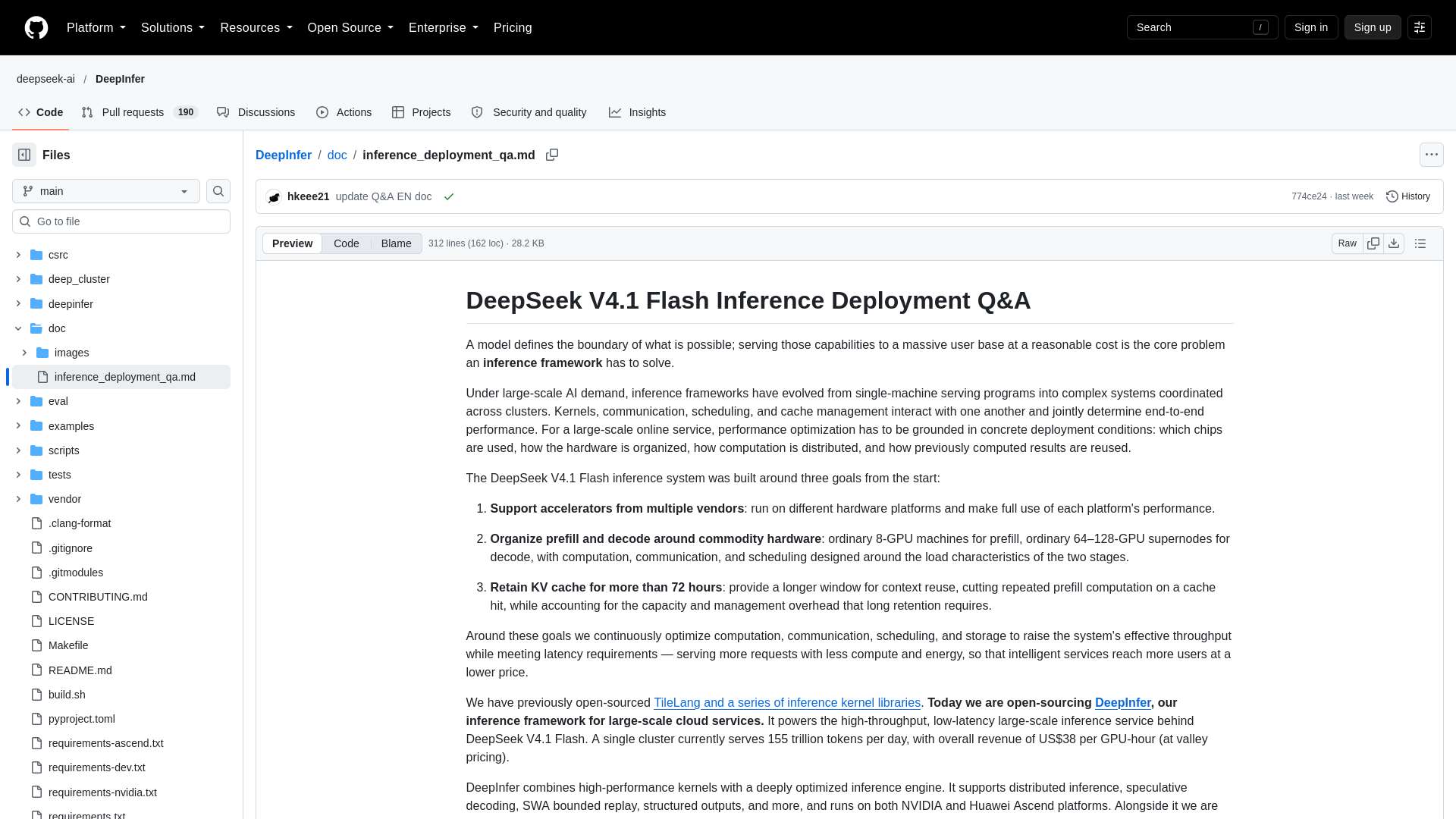
Courtesy of DeepInfer deployment Q&A; captured October 28, 2026.
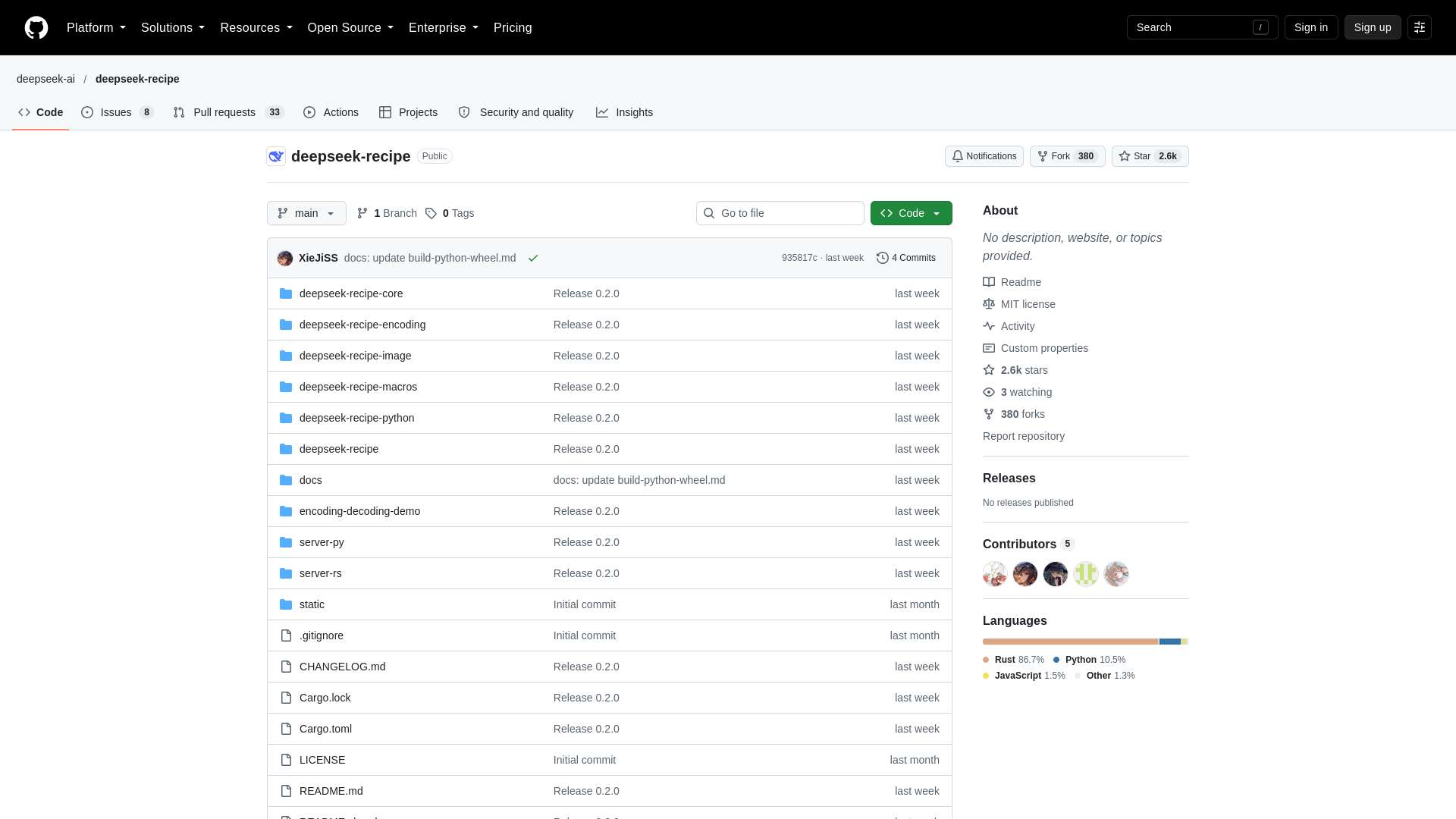
Courtesy of DeepSeek Recipe; captured October 28, 2026.
Sources and image references
- DeepSeek-AI/DeepInfer README — supported model/hardware, build requirements, capabilities, missing service components, and license.
- DeepInfer releases — release tags and current packaging status.
- DeepSeek V4.1 Flash Inference Deployment Q&A — prefill/decode separation, parallelism, cache architecture, and service boundaries.
- DeepInfer examples README — offline run, model path, and example parallelism options.
- DeepSeek Recipe repository — protocol and token encoding/decoding component.
- DeepSeek-V4.1-Flash model card — checkpoint files, model instructions, and weight-license details.
- NVIDIA NCCL setup guide — GPU communication and network setup considerations.
- DeepInfer license — Apache-2.0 for the repository code; check model licensing separately.
The hero illustration and two explanatory diagrams were created for this article. They are conceptual editorial visuals, not screenshots, measurements, or DeepSeek-authored artwork. The three credited Trawl screenshots are point-in-time captures from October 28, 2026. Hardware support, setup requirements, release packaging, benchmark presentation, and the deployment Q&A were rechecked against DeepSeek’s official sources on November 6, 2026; they may change as the project evolves.
Keep reading
Related reading
⚡ AI Engineering Briefing
AI model releases, practical tutorials, developer tools, and engineering research. Unsubscribe anytime.
Comments
Comments are temporarily unavailable while the public discussion space is being configured.