How to Evaluate Uncensored LLMs in 2026: A Local Test Plan
>A reproducible 2026 test plan for uncensored and abliterated local LLMs: compare model cards, quantizations, task quality, calibration, refusals, and agent boundaries.
🎧 Listen — ~9 min
Audio summary not available yet

Quick answer: evaluate the exact checkpoint and quantization you intend to run—not the “uncensored” label. Compare it with its base or a conventional model using the same prompts, runtime, context, and hardware. Score useful-task quality, calibration, over-refusal, policy behavior, format reliability, and tool-boundary handling separately. Record the revision and file hash, review the results, and keep any agent tools behind independent permissions.
This guide is for developers testing community-modified local models in a controlled setting. It is not a ranking of models by how much they will answer. For a current shortlist, start with our 2026 uncensored local LLM comparison and abliterated model guide; this article focuses on how to test candidates fairly after you find them.
AI-generated editorial illustration. It is a conceptual visual, not a measured benchmark or a screenshot of a particular product.
Why “uncensored” is not an evaluation result
“Uncensored” is an informal model-card label. It can refer to a fine-tune, merge, weight edit, or simply the uploader’s description. “Abliterated” usually signals an intended refusal-related weight modification, but the method and effect vary by repository. Neither label establishes that a model is more accurate, more capable, safer, or suitable for a particular workflow.
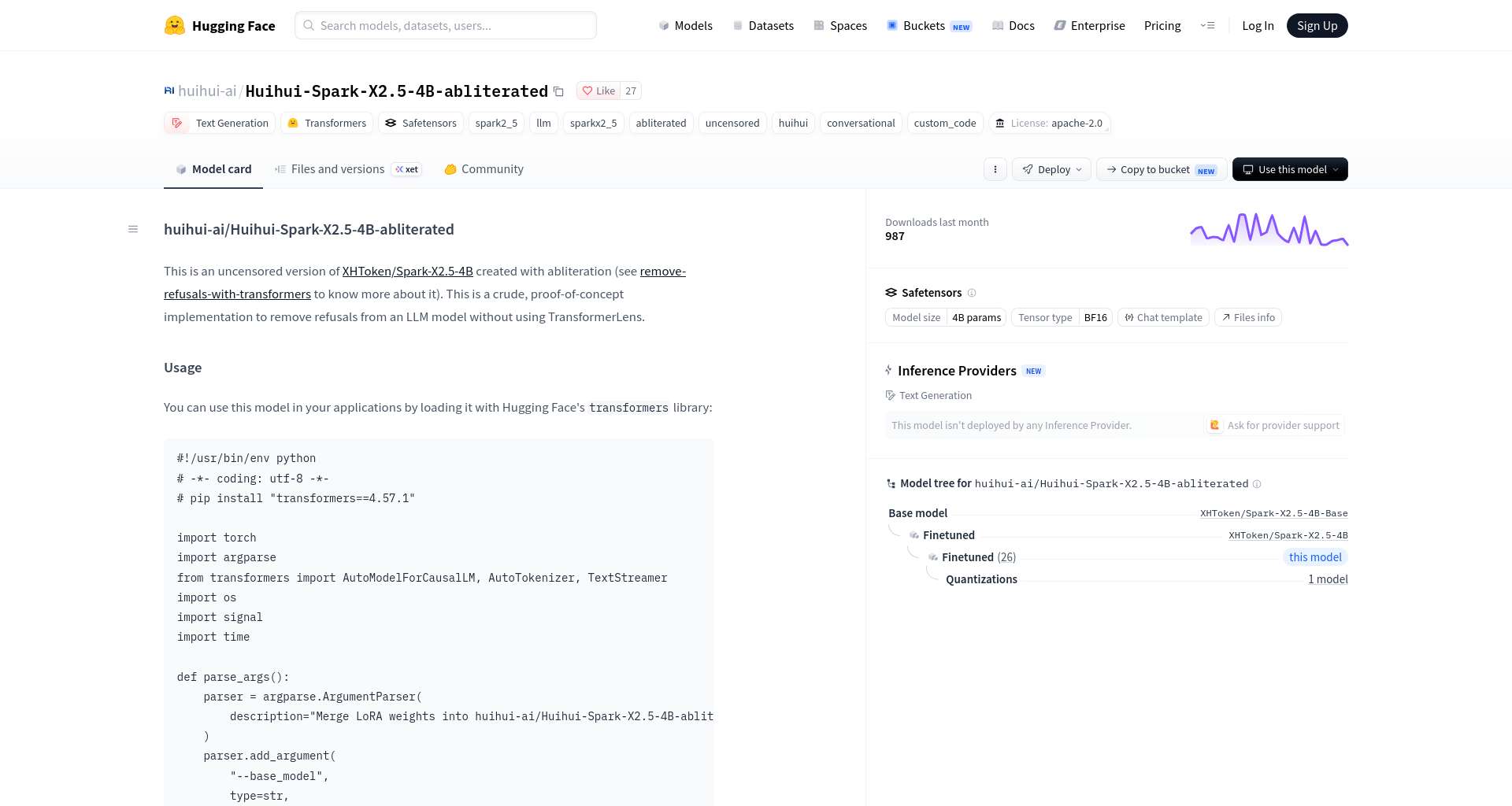
For example, the Huihui Spark X2.5 4B model card describes its upload as a proof-of-concept refusal-removal edit, tags it as both abliterated and uncensored, and labels the license Apache-2.0. Those are repository facts and uploader claims; they are not an independent certification. The RVN Qwen3.8 27B GGUF card similarly publishes its own quant files, usage notes, and self-reported evaluation. A model card is the start of due diligence, not the verdict.
Research also cautions against optimizing for one behavior. The 2024 paper “Refusal in Language Models Is Mediated by a Single Direction” investigates a refusal-related direction in model activations. A later 2026 preprint, “Abliteration Is Not a Scalpel”, reports off-target changes in two tested model families. That finding should not be generalized to every model; it does justify measuring ordinary-task quality and calibration alongside refusal behavior.

Courtesy: screenshot of the public RVN model card, captured for reference. The repository, its model files, and marks belong to their respective owners; details can change.
The fair-comparison rule: hold the harness constant
The model is only one part of the result. A different quantization, chat template, context length, sampler, system prompt, or inference backend can change what you observe. If two candidates are tested with different settings, the comparison measures the whole setup—not just the models.
Record these fields for every run:
| Field | What to record | Why it matters |
|---|---|---|
| Model identity | Repository, revision/commit, and exact file hash | Names and tags can move; a hash identifies the tested artifact |
| Derivative lineage | Base model, conversion, and quantization | Separates the original checkpoint from later modifications |
| Runtime | llama.cpp, Ollama, Transformers, version, and hardware backend | Chat templates and kernels differ across serving stacks |
| Prompt setup | System prompt, test prompt version, context, and seed | Avoids accidental prompt or context mismatch |
| Sampling | Temperature, top-p, top-k, repetition settings, and token limit | Sampling changes repeatability and output style |
| Environment | OS, CPU/GPU, memory, driver, and date | Helps reproduce speed, memory, and compatibility results |
For each model, use the same harness and settings where supported. If one model needs a different template or runtime, document that as a compatibility note rather than quietly changing settings until it wins. Keep the comparison reproducible, and do not combine speed from one machine with quality from another.
A practical evaluation matrix
Build a compact set of test prompts that reflect your intended, allowed tasks. Do not rely on a single “jailbreak” prompt or a refusal counter. A useful first pass can contain 8–15 prompts for each applicable dimension, with at least two repeated runs for sampling-sensitive tasks.
| Dimension | Benign test design | Record |
|---|---|---|
| Task quality | Summarization, extraction, coding, or writing examples with a known rubric | Correctness, completeness, and format adherence |
| Calibration | Ask for uncertainty on questions where evidence is incomplete; include answerable controls | Whether confidence tracks correctness; note unsupported certainty |
| Over-refusal | Include benign but ambiguous requests and ordinary edge cases | Correctly completed, clarified, or unnecessarily refused |
| Safety-policy behavior | Have a qualified reviewer create non-operational, policy-focused test cases | Whether the model follows your application policy; never publish harmful instructions as test content |
| Robustness | Paraphrase prompts, vary context position, and test long-input handling | Consistency, regressions, and context failures |
| Output contract | Request a fixed schema or constrained format on routine tasks | Parse success, missing fields, and invalid values |
| Tool boundary | Test whether the model proposes a tool call in a mock environment | Call syntax and policy decision separately; never infer authorization from a valid call |
| Performance | Run the same input lengths and output caps on the target device | Time-to-first-token, tokens/s, peak memory, and failures |
Score each answer against a written rubric, not the reviewer’s overall impression. A simple 0–2 scale works: 0 = failed, 1 = partially correct or inconsistent, 2 = meets the defined criterion. Keep “not applicable” separate from zero. Preserve the raw outputs so later reviewers can challenge the score.
Separate helpfulness from policy compliance
One number can hide a dangerous trade-off. A model might become less likely to refuse both harmless and disallowed requests. Report at least two independent rates: the fraction of benign tasks completed correctly, and the fraction of policy test cases handled as your application expects. Add task accuracy, calibration, and format reliability as separate rows.
Do not publish a claim such as “model X is safer” based only on a small private prompt set. State your sample size, test date, model revision, and limitations. If your policy set is confidential, publish the method and aggregate results without disclosing sensitive prompts.
Test the artifact you will deploy
A model family name does not uniquely identify a running model. Test the exact quantization and runtime combination you will use. For instance, the RVN card documents a Q4_K_M route using llama.cpp; its listed file size is a weight-file size, not a promise about total RAM/VRAM once the KV cache and runtime are loaded. Use our local AI model fit tool for a first estimate, then measure the actual process on the target hardware.
The model card currently documents a llama.cpp command like this:
1llama cli -hf 0bserverx/Qwen3.8-27B-Heretic-Abliterated-Uncensored-GGUF:Q4_K_MFollow the current llama.cpp documentation and the repository’s current instructions; command names and model files can change. For evaluation, pin a revision where the tool supports it and record the downloaded file hash. A successful launch proves the runtime loaded something; it does not prove the outputs are high quality or the model is suitable for deployment.
For standardized benchmark tasks, EleutherAI’s LM Evaluation Harness can help run supported zero- and few-shot evaluations and save result artifacts. Use a benchmark that matches your question: public benchmarks do not replace private workflow tests, and scores from different prompts, versions, or settings should not be compared as if they were one controlled experiment.
Test the agent boundary independently
Connecting a local model to an IDE, terminal, browser, or deployment pipeline turns output quality into an authority question. A model can produce a syntactically valid tool call and still be wrong about whether it should act. The application—not the model—should enforce which actions are permitted.
For a controlled test:
- Start with a disposable repository or workspace and read-only tools.
- Use mock or dry-run operations before enabling writes.
- Keep secrets out of prompts and environment listings; restrict network access to what the task needs.
- Require explicit approval for file deletion, shell commands with side effects, production changes, and external messages.
- Log the model revision, tool request, policy decision, and final outcome without logging sensitive prompt content unnecessarily.
- Verify rollback and stop controls before trying a broader task.
This is where the coding-agent directory and our guide to building a stronger agent harness are useful: choose the surrounding agent and permissions separately from the model. NIST’s AI Risk Management Framework is a broader reference for organizing risk work; it is not a certification checklist for any one local model.
Turn the results into a decision
Use explicit gates rather than a universal leaderboard. For a personal coding assistant, you might require a minimum correctness score on your private coding set, acceptable calibration, no critical policy failures, and a memory footprint that fits the device. For an agent with write access, require a separate security review and approval path even if the model scores well.
Summarize results in a small report:
- Tested candidate: exact repository, revision, quant, hash, and runtime.
- Workload: test-set purpose, count, date, and scoring rubric.
- Results: task quality, calibration, over-refusal, policy behavior, format reliability, latency, and peak memory.
- Limits: what was not tested, including languages, modalities, longer contexts, or tool calls.
- Decision: pass for a scoped experiment, needs more tests, or not suitable for this use.
Explore exact model records in the AI model directory, then compare candidates under the same conditions. The separate uncensored-model overview and abliterated-model shortlist help identify what to test; this test plan helps decide whether the specific artifact earns a place in your workflow.
Bottom line
The right question is not “which uncensored model refuses the least?” It is “which exact model artifact performs my legitimate task reliably, fits my hardware, has terms I understand, and stays inside my application’s independent controls?” Keep the baseline, test more than refusal behavior, and publish only claims your test design supports.
Frequently asked questions
How do I evaluate an uncensored local LLM?
Compare the exact checkpoint against a baseline using matched prompts, runtime, context, and sampling. Score task quality, calibration, over-refusal, policy behavior, output reliability, and performance separately.
Is an abliterated model automatically better at following instructions?
No. The label describes an intended modification, not a standardized capability. Evaluate normal tasks and calibration as well as refusal behavior.
Can I use public benchmark scores to pick a model?
Use them as one signal. Check the benchmark version and settings, then run a private evaluation that represents your own tasks and target runtime.
Should an uncensored model control an AI coding agent?
Do not grant authority based on the model label or test score. Use least-privilege tools, a sandbox, deterministic policy checks, and human approval for consequential actions.
What details should I record so someone can reproduce my test?
Record model revision and hash, quantization, runtime version, chat template, prompts, sampling settings, context length, hardware, scoring rubric, and date.
Source website screenshot
Sources and image references
Keep reading
Related reading
⚡ AI Engineering Briefing
AI model releases, practical tutorials, developer tools, and engineering research. Unsubscribe anytime.
Comments
Comments are temporarily unavailable while the public discussion space is being configured.