Evaluating AI Features: Latency, Cost, and Reliability Gates
>A practical engineering guide to evaluating product AI features, setting up CI/CD quality gates, managing p95 latency, and controlling inference costs in production.
🎧 Listen — ~8 min
Audio summary not available yet

Shipping an AI-enabled feature into production often feels straightforward during prototyping, but maintaining product-level reliability requires strict engineering discipline. When teams move from sandbox demos to multi-tenant workloads, non-deterministic outputs, latency spikes at high percentiles, and unpredictable token bills quickly degrade product margins and user trust.
To ship safely, engineering teams must replace ad-hoc prompt tweaking with continuous evaluation pipelines that measure task completion rates, tail latency, unit economics, and fallback resilience before code reaches production.
Key takeaways
- Gate deployments with automated evals: Treat model prompts, agent harnesses, and orchestration logic like unit test suites using deterministic assertions and reference-calibrated semantic judges.
- Isolate p95 and p99 latency regressions: Break down end-to-end user latency into time-to-first-token (TTFT), inter-token latency (ITL), retrieval overhead, and validation cycles.
- Model unit economics per user flow: Calculate costs down to input/output token ratios and API retry budgets rather than relying on aggregated monthly billing dashboards.
- Enforce progressive rollouts and circuit breakers: Deploy behind feature flags with programmatic degradation rules that fall back to deterministic templates or lightweight models when SLAs breach thresholds.
- [Token Cost]
1
2To resolve this tension, production systems require measurable quality gates integrated directly into continuous deployment workflows, rather than post-launch incident forensics.
3
4---
5
6## 2. Architecting Automated Evaluation Gates
7
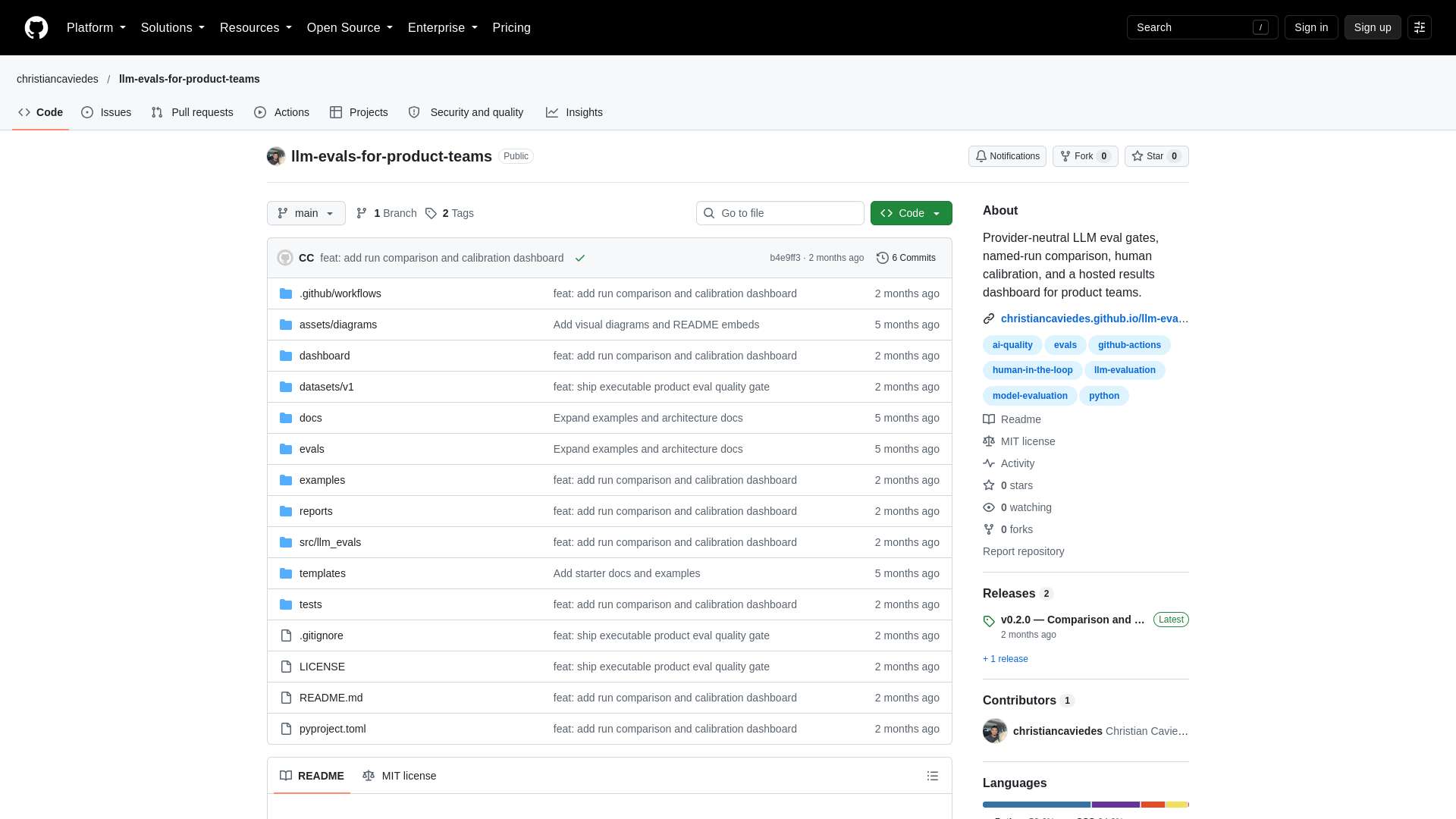
8Treating prompts, context retrievers, and tool definitions as code requires an automated CI/CD evaluation harness. Open-source initiatives like [christiancaviedes/llm-evals-for-product-teams](https://github.com/christiancaviedes/llm-evals-for-product-teams) and enterprise toolkits such as [FuturOneAI/ai-agent-evaluation-framework](https://github.com/FuturOneAI/ai-agent-evaluation-framework) show that sustainable eval infrastructure combines synthetic assertion gates with human-in-the-loop calibration.
9
10### The Multi-Tier Evaluation Funnel
11
12A resilient evaluation architecture separates verification into three discrete execution tiers:
13
141. **Deterministic Assertions (Fast, Zero Cost):** Validate JSON schema compliance, regex constraints, prohibited tokens, and status codes. Run on 100% of pull requests.
152. **Heuristic & Embedding Similarity (Medium Speed, Low Cost):** Compute semantic drift, BLEU/ROUGE against golden reference sets, or cosine similarity on vector embeddings to flag major content drift.
163. **LLM-as-a-Judge with Reference Calibration (Slower, Managed Cost):** Use a larger, deterministic evaluation model to score reasoning chains, factual consistency, and task completion based on strict rubric rubrics.
171+--------------------------------------------------------+
2| PR Trigger / Code Change |
3+--------------------------------------------------------+
4 | v
1+--------------------------------------------------------+
2| Tier 1: Deterministic Syntax & Schema Checks (CI Gate) |
3| - JSON Valid? Missing required fields? Regex passes?    |
4+--------------------------------------------------------+
5                           | Passed
v
1+--------------------------------------------------------+
2| Tier 2: Benchmark Golden Set & Similarity Metrics      |
3| - Fast embedding distance vs curated baseline answers   |
4+--------------------------------------------------------+
5                           | Passed
v
1+--------------------------------------------------------+
2| Tier 3: LLM Judge & Cost/Latency Simulation           |
3| - Scored against rubric; Cost & TTFT SLAs verified     |
4+--------------------------------------------------------+
5                           | Passed
v
1+--------------------------------------------------------+
2| Merge & Canary Staged Rollout                          |
3+--------------------------------------------------------+
Integrating continuous verification mirrors patterns discussed in our analysis of continuous AI evaluation architecture and production evals.
3. Implementing a Minimal Eval Gate in Python
The following implementation demonstrates a production-grade eval runner that evaluates candidate prompts against a golden dataset, tracking schema accuracy, latency budgets, and token cost thresholds:
1import time
2import json
3import os
4from typing import Dict, Any, List
5from dataclasses import dataclass
6
7@dataclass
8class EvalResult:
9    test_id: str
10    passed: bool
11    latency_ms: float
12    cost_usd: float
13    failure_reason: str = ""
14
15class FeatureEvalGate:
16    def __init__(self, max_p95_latency_ms: float, max_cost_per_call: float):
17        self.max_p95_latency_ms = max_p95_latency_ms
18        self.max_cost_per_call = max_cost_per_call
19        self.input_cost_per_token = 1.50 / 1_000_000
20        self.output_cost_per_token = 6.00 / 1_000_000
21
22    def calculate_cost(self, prompt_tokens: int, completion_tokens: int) -> float:
23        return (prompt_tokens * self.input_cost_per_token) + (completion_tokens * self.output_cost_per_token)
24
25    def execute_evaluation(self, test_case: Dict[str, Any], runner_fn) -> EvalResult:
26        start_time = time.perf_counter()
27
28        try:
29            response, token_usage = runner_fn(test_case["input"])
30            latency = (time.perf_counter() - start_time) * 1000.0
31
32            cost = self.calculate_cost(
33                token_usage.get("prompt_tokens", 0),
34                token_usage.get("completion_tokens", 0)
35            )
36            parsed = json.loads(response)
37            for field in test_case["expected_fields"]:
38                if field not in parsed:
39                    return EvalResult(test_case["id"], False, latency, cost, f"Missing field: {field}")
40            if cost > self.max_cost_per_call:
41                return EvalResult(test_case["id"], False, latency, cost, f"Cost budget exceeded: ${cost:.5f}")
42
43            return EvalResult(test_case["id"], True, latency, cost)
44
45        except json.JSONDecodeError:
46            latency = (time.perf_counter() - start_time) * 1000.0
47            return EvalResult(test_case["id"], False, latency, 0.0, "JSON parsing error")
48        except Exception as e:
49            latency = (time.perf_counter() - start_time) * 1000.0
50            return EvalResult(test_case["id"], False, latency, 0.0, str(e))
51
52    def evaluate_suite(self, suite: List[Dict[str, Any]], runner_fn) -> bool:
53        results = [self.execute_evaluation(tc, runner_fn) for tc in suite]
54        latencies = sorted([r.latency_ms for r in results])
55        p95_idx = int(len(latencies) * 0.95)
56        p95_latency = latencies[p95_idx] if latencies else 0.0
57
58        all_passed = all(r.passed for r in results)
59        latency_passed = p95_latency <= self.max_p95_latency_ms
60
61        print(f"Suite Results: {sum(r.passed for r in results)}/{len(results)} assertions passed.")
62        print(f"p95 Latency: {p95_latency:.2f}ms (Budget: {self.max_p95_latency_ms}ms)")
63
64        return all_passed and latency_passed
Teams deploying autonomous agents or multi-step tool callers can extend this runner to score intermediate tool selections against established benchmarks, reinforcing patterns explored in hardening agentic DevOps guardrails and observability.
4. Latency Engineering: Profiling and Mitigation
In production environments, mean latency is vanity; p95 and p99 latencies determine feature retention. A generative feature running at an average latency of 1.2 seconds can easily degrade to 8 seconds during hyperscaler queue saturation or large context generation.
Latency Component Analysis
| Latency Vector | Source | Optimization Lever |
|---|---|---|
| Time to First Token (TTFT) | Context ingestion, vector retrieval, prompt compilation | Prompt prefix caching, parallel semantic retrieval, streaming responses |
| Inter-Token Latency (ITL) | Autoregressive model generation, memory bandwidth | Speculative decoding, selecting smaller quantized parameter sizes |
| Tool Execution Round-Trips | Sequential function calls, network hops | Parallel tool invocation, compact JSON payloads, local cache layers |
| Guardrail & Validation Overhead | Pre-input prompt checks, secondary LLM moderation | Regex / WASM classifiers, deterministic schema validators |
Mitigating Tail Latency with Streaming and Caching
To keep interfaces responsive:
- Leverage Native Prompt Caching: Providers like Anthropic, OpenAI, and self-hosted vLLM/DeepInfer instances cache shared prefix tokens. Structure prompts so static elements (system guidelines, schemas, base context) appear first.
- Stream Early Tokens: Render UI states immediately using server-sent events (SSE) while the model completes downstream fields asynchronously.
- Impose Strict Per-Turn Token Caps: Limit
max_tokensdefensively to prevent runaway token outputs during repetitive failure loops.
5. Controlling Token Costs and Unit Economics
Uncapped AI features introduce linear or superlinear margin degradation as customer usage scales. Building predictable unit economics requires modeling worst-case consumption scenarios.
1Total Flow Cost = (Base Prompt Tokens * Cost_in)
2                + (Retrieved Context Tokens * Cost_in)
3                + (Output Tokens * Cost_out)
4                + (Retry Rate * Turn Cost)
Strategic Levers for Cost Reduction
- Context Window Pruning: Truncate or summarize auxiliary conversational history instead of appending unbounded chat transcripts.
- Model Tiering and Fallback Routing: Direct high-complexity tasks (e.g., code analysis, multi-hop reasoning) to premier flagship models, while routing transactional tasks (e.g., categorization, standard extraction) to compact, highly cost-effective models.
- Aggressive Semantic Caching: Store resolved outputs in Redis keyed by the embedding hash of the input query. For repeat queries, bypass model generation entirely.
For organizations monitoring compute allocation and backend infrastructure costs, aligning feature-level tokens with high-level compute planning remains essential, as highlighted in our look at AI infrastructure capex and compute planning.
6. Rollout Strategies and Production Reliability
Deploying an AI feature directly to 100% of traffic without canary stages invites systemic outages. Non-deterministic software requires robust progressive rollout techniques.
1Traffic Split:
2  |-- 90% -> Baseline (V1 or Deterministic Fallback)
3  |-- 10% -> Canary (V2 Candidate Model / Prompt)
4              |
5              |--> Monitor Error Rates, Hallucination Flags, p95 Latency
6              |
7              +--> Breach SLA? Automatically Trigger Circuit Breaker
Production Reliability Checklist
- Canary Gates: Route 5% to 10% of real user traffic to the candidate prompt or model version, measuring real-world completion before full release.
- Automated Circuit Breakers: If the upstream model provider returns 5xx errors or p95 latency exceeds 4,000ms over a 2-minute rolling window, trip the circuit breaker and serve a static fallback response.
- Instrumentation with OpenTelemetry: Export distributed spans capturing prompt tokens, completion tokens, cold-start latency, and downstream tool execution timings. See our implementation reference on OpenTelemetry GenAI agent tracing and continuous evals.
- Shadow Deployments: Mirror production traffic asynchronously to candidate models to evaluate performance under actual production load distributions without impacting the user interface.
Practical Engineering Verdict
Do not ship LLM features based on subjective manual inspections in an interactive playground. Reliable product engineering demands automated CI/CD eval gates that measure deterministic schema validity, semantic drift, and p95 latency on every commit. By standardizing on tiered evaluation funnels, caching static prompt prefixes, enforcing fallback circuit breakers, and measuring unit costs per user flow, engineering teams can deliver AI features that remain robust, scalable, and economically sustainable.
Source website screenshots
Frequently asked questions
What is the most critical metric to monitor when evaluating AI features?
While accuracy and schema adherence are table stakes, p95 latency and cost per successful user outcome are the most critical production metrics. An accurate feature that breaches user latency expectations or destroys gross margins will inevitably fail in real-world deployment.
How do you prevent LLM-as-a-judge from introducing bias into evals?
Calibrate the judge model using golden test sets scored by human engineers. Provide the judge with explicit rubrics, discrete scoring scales (e.g., pass/fail rather than 1-10), and require step-by-step reasoning before outputting a verdict. Additionally, validate that the judge's scoring correlates strongly with deterministic checks.
Should we run full evaluation suites on every git push?
No. Run Tier 1 deterministic checks (JSON schemas, regex, formatting) on every commit. Reserve comprehensive, high-coverage LLM-judged evaluation suites and canary benchmark simulations for merge requests to the staging or main branches to control CI execution times and API testing budgets.
What is the best way to handle upstream model provider outages?
Implement a graceful degradation architecture. When your monitoring layer detects elevated latency or 5xx responses, a circuit breaker should switch traffic to an alternative provider or drop back to a deterministic heuristic template to ensure continuous feature availability.
Sources and image references
- Caviedes, C. (2026). Provider-neutral LLM eval gates, named-run comparison, human calibration, and a hosted results dashboard for product teams. GitHub Repository: https://github.com/christiancaviedes/llm-evals-for-product-teams
- FuturOneAI. (2026). Open-source framework for evaluating AI agent performance: task completion rate, accuracy, latency, cost efficiency, and reliability metrics. GitHub Repository: https://github.com/FuturOneAI/ai-agent-evaluation-framework
- GitHub. (2026). The AI-Powered Developer Platform. Reference: https://github.com
⚡ AI Engineering Briefing
AI model releases, practical tutorials, developer tools, and engineering research. Unsubscribe anytime.
Comments
Comments are temporarily unavailable while the public discussion space is being configured.