Gemma 4 12B QAT Uncensored Review: Local Setup & Limits
>Review HauhauCS’s Gemma 4 12B QAT uncensored GGUF: 256K context, Q4_K_M size, MTP and vision files, local setup, licensing caveats, and behavior limits.
🎧 Listen — ~12 min
Audio summary not available yet

Quick answer: HauhauCS’s Gemma4-12B-QAT-Uncensored-HauhauCS-Balanced is a community GGUF derivative based on Google’s instruction-tuned Gemma 4 12B, not a new Google foundation model. The card offers one main Q4_K_M model file, a separate vision projector, and an MTP draft file. Its publisher reports “0/465 refusals” and roughly 60% faster generation with MTP; neither claim is an independent benchmark or a guarantee. If you want a local 12B model with a more permissive response profile, it is worth evaluating—but compare it with the untouched base, check the exact license files, and test your own prompts before trusting it in an agent.
Original AI-generated editorial artwork created for this review. It is conceptual art—not a screenshot, benchmark result, architecture diagram, or endorsement.
At a glance
| Question | What the current sources show | What to keep in mind |
|---|---|---|
| What is it? | HauhauCS’s GGUF derivative based on google/gemma-4-12B-it | Community derivative; do not attribute its behavior claims to Google |
| Main file | Q4_K_M, listed as 6.9 GB on the card; Hugging Face’s file panel shows about 7.38 GB | Different GB/GiB display conventions explain much of the gap; runtime memory is higher than the weight file alone |
| Context | 256K tokens stated on the derivative card and by Google for upstream Gemma 4 12B | Maximum context is not a practical promise that your machine can serve 256K cheaply or quickly |
| Vision | A separate BF16 mmproj file is listed | Load and test it with a compatible GGUF runtime; upstream capability alone does not validate every derivative build |
| MTP | A separate mtp-gemma-4-12B-it.gguf draft head is included | “About 60% faster” is the maintainer’s own test result, not an independently reproduced speed claim |
| Refusals | The publisher reports 0/465 on its test set | A small, publisher-run evaluation cannot establish that the model never refuses or is safe for unattended use |
| Directory listing | No exact record was present in our AI model directory when this article was prepared | Browse the directory for alternatives; this article does not invent a single-model page URL |
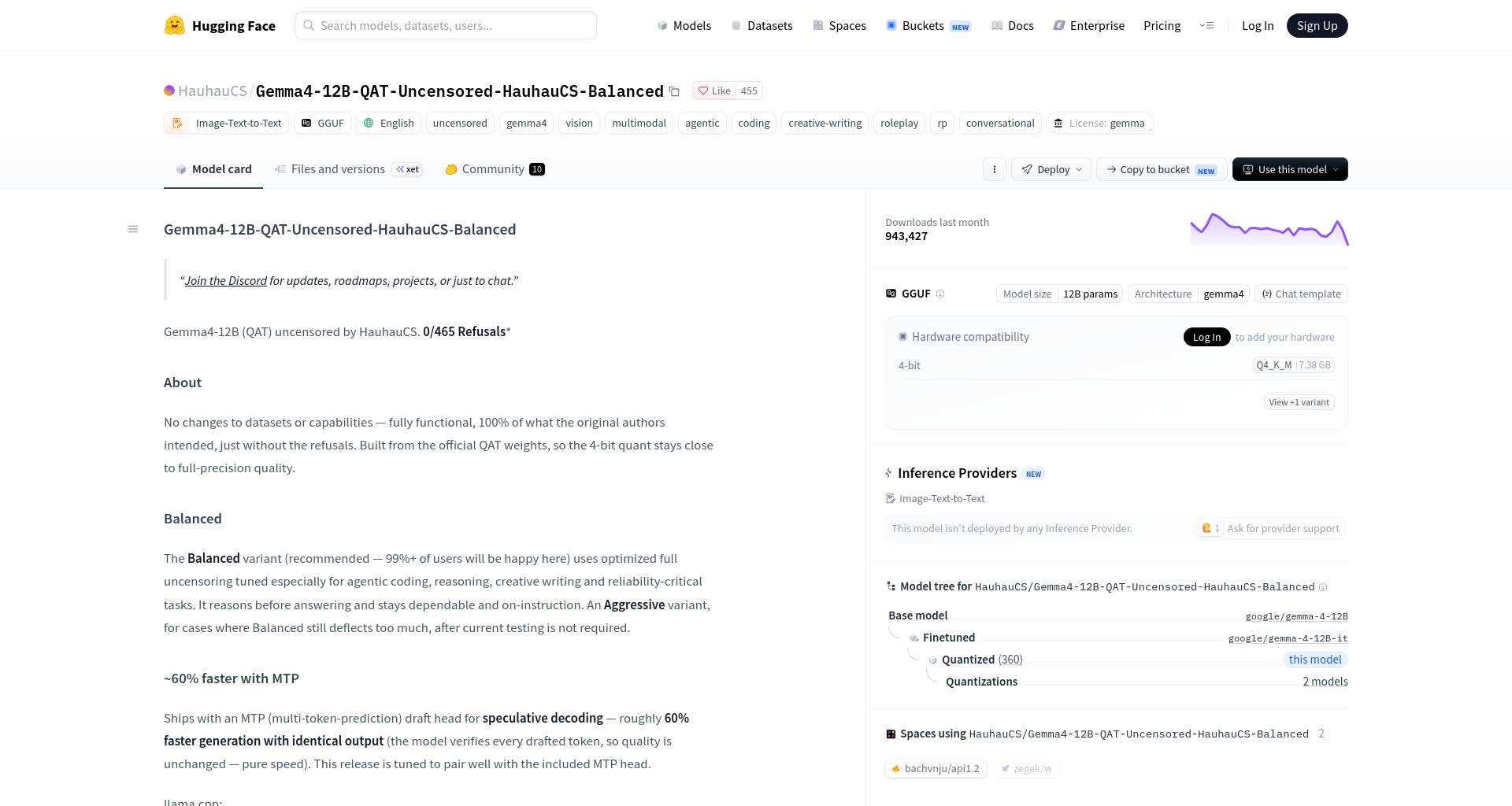
Courtesy: point-in-time viewport screenshot of the HauhauCS model card, captured through Trawl on October 18, 2026. The page and model files belong to their respective publishers; this reference is not an endorsement.
What “QAT uncensored” means—and what it does not
The name combines two different ideas. QAT means quantization-aware training: the upstream Gemma 4 QAT checkpoint was prepared with low-bit deployment in mind. Google describes QAT as training that accounts for quantization effects, rather than simply compressing a finished high-precision checkpoint afterward. That can help retain quality at a smaller representation, but it does not mean quantization has zero cost or that every downstream conversion is lossless. Read Google’s Gemma 4 QAT overview for the distinction between QAT and post-training quantization.
“Uncensored” is the community publisher’s behavior label. HauhauCS says the Balanced version was tuned to reduce refusals while retaining the base model’s general capabilities. The card does not provide an independently audited, reproducible description of every weight-level change. Therefore, the accurate wording is “a publisher-labeled uncensored derivative,” not “a model with all safety removed,” “a guaranteed non-refusing model,” or “abliterated” unless the maintainer documents that specific method.
The page reports 0/465 refusals*. Treat that as a maintainer-reported result on the maintainer’s test, not a universal property. A refusal score depends on what prompts were tested, how a refusal was classified, the system prompt, sampling settings, and whether the model was evaluated once or across multiple runs. The card itself notes that some edge cases can deflect initially and then answer after a re-ask. That is useful context, but it still is not an external safety, quality, or legal-compliance assessment.
HauhauCS’s model tree identifies google/gemma-4-12B-it as the upstream instruction-tuned checkpoint. Google’s own Gemma 4 model card describes the 12B Unified model as 11.95B parameters, 48 layers, a 256K context window, and an encoder-free text/image/audio architecture. Those are upstream family specifications; they are not independent measurements of every behavior in this modified GGUF.
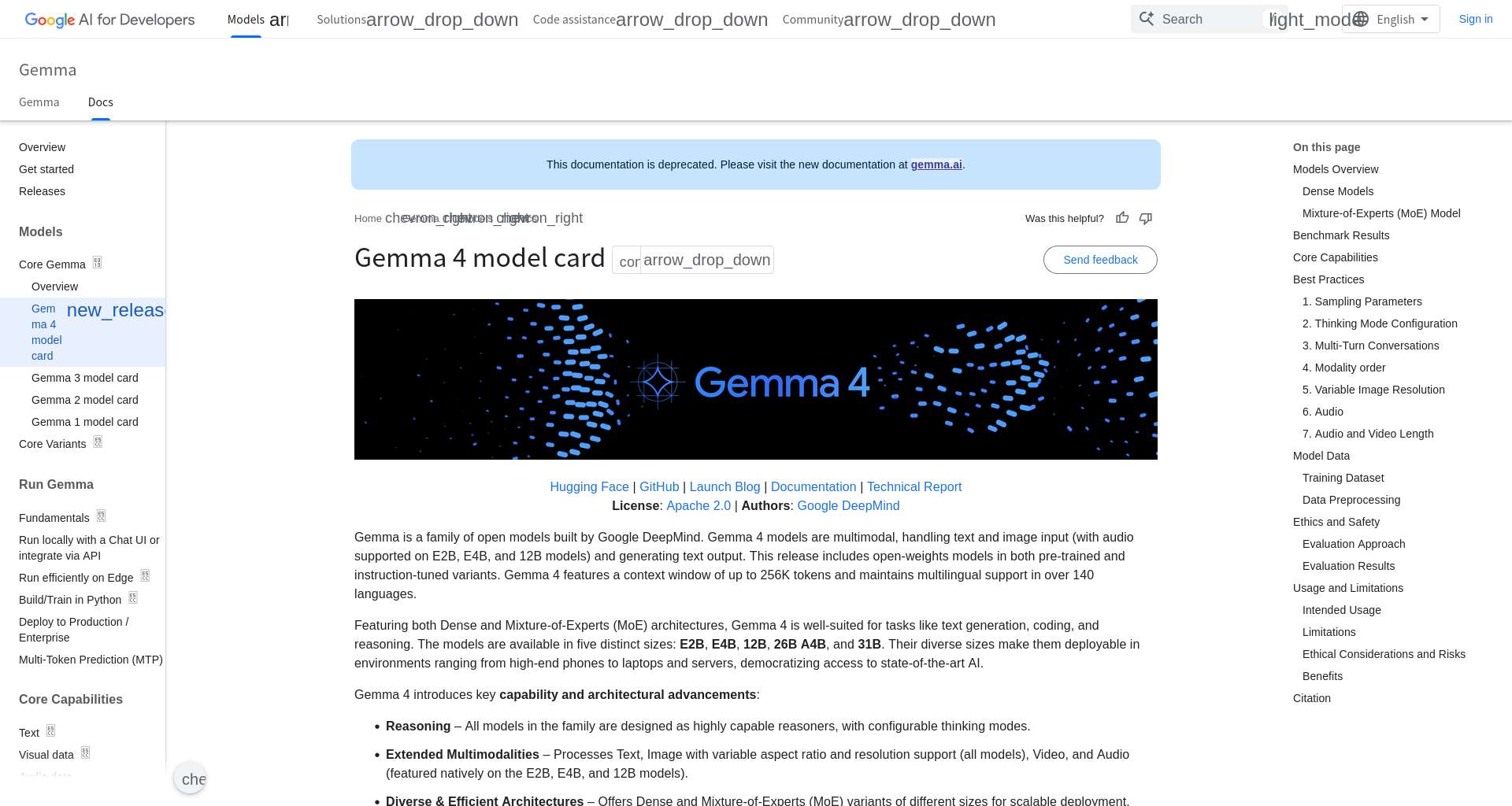
Courtesy: viewport screenshot of Google’s Gemma 4 model card, captured through Trawl on October 18, 2026. It documents the upstream family, not an independent evaluation of HauhauCS’s derivative.
What is actually in the repository?
The current HauhauCS repository presents a relatively simple download choice: the main Q4_K_M GGUF plus optional components. The main file is shown as 6.9 GB in the model-card table; the Hugging Face file widget reports 7.38 GB. That is consistent with approximately 6.9 GiB expressed as 7.38 decimal GB, not evidence that two different model builds are being compared. Check the exact file/version page before downloading because repositories can change.
| Repository component | Listed size | Purpose | When you need it |
|---|---|---|---|
Gemma4-12B-QAT-Uncensored-HauhauCS-Balanced-Q4_K_M.gguf | 6.9 GB in the card; about 7.38 GB in the file widget | Main 12B language-model weights | Required for ordinary text generation |
mmproj-Gemma4-12B-QAT-Uncensored-HauhauCS-Balanced-BF16.gguf | 168 MB in the card; download UI rounds to about 175 MB | Multimodal projector for image input | Only when your runtime and workflow use images |
mtp-gemma-4-12B-it.gguf | 242 MB | Multi-token-prediction draft component for speculative decoding | Optional; only when using a compatible llama.cpp build and validating speed locally |
Do not read “Q4” as “needs exactly 7.38 GB of RAM.” The weight file is only one part of the runtime footprint. Context length, KV cache, compute buffers, operating-system memory, GPU/CPU split, and optional projector or draft weights all add overhead. A 256K context is a model capability ceiling, not a sensible default on a consumer machine. Start with a moderate context (for example, 8K), measure memory and speed on your exact runtime, and increase it only when the task benefits.
Vision and audio need separate verification
The derivative repository includes a vision projector and explains how to load it with the main GGUF. That makes image input a plausible use case when using a compatible build. It does not prove that every front end, quant, or model-server version handles images correctly. Run a simple image-description test and check that the server actually reports or uses the projector.
Google documents native audio support for its upstream 12B Unified model. However, the HauhauCS GGUF card specifically documents the main file, a vision mmproj, and an MTP draft; it does not provide a similarly clear audio-file setup for this derivative. Do not promise audio or video support for this exact package merely because upstream Gemma 4 supports those modalities. Confirm that the exact repository files and your runtime expose the feature you plan to use.
Local setup with llama.cpp
The model card documents llama.cpp and GGUF-compatible apps, and provides a Hugging Face model selector. With a recent llama.cpp build that supports -hf, a basic text server can be started like this:
1llama-server \
2  -hf HauhauCS/Gemma4-12B-QAT-Uncensored-HauhauCS-Balanced:Q4_K_M \
3  --ctx-size 8192 \
4  --host 127.0.0.1 \
5  --port 8080
Binding to 127.0.0.1 keeps the test server local by default. If your build does not recognize the Hugging Face selector, download the named GGUF from the repository’s Files page and pass its local path with -m. The model card also lists LM Studio and Jan; check each app’s current GGUF and Gemma 4 compatibility before assuming its controls map to the same runtime flags.
For vision, download the matching mmproj file and follow the model card’s --mmproj example. For MTP, download the separately listed mtp-gemma-4-12B-it.gguf and follow the repository’s speculative-decoding example with a recent compatible llama.cpp build. The author reports around 60% faster generation in their own test. That number is not a guaranteed result: draft acceptance, prompt shape, output length, hardware, context, and runtime version can make the speedup smaller, absent, or negative. Benchmark ordinary text and multimodal requests separately; speculative decoding may not benefit every input path.
A practical evaluation plan before choosing it
Do not judge an “uncensored” model only by asking whether it gives an answer to a provocative prompt. Evaluate whether it is useful, predictable, and bounded in the specific workflow you want to run.
| Test | Compare against the unmodified Gemma 4 12B base | Record |
|---|---|---|
| Everyday coding | Same small bug fix, explanation, and test-generation tasks | Correctness, compile/test result, edits needed, latency |
| Refusal behavior | A balanced set of benign, ambiguous, and policy-sensitive prompts | Prompt set, system prompt, decoding settings, and exact outputs; do not reduce the result to “never refuses” |
| Instruction following | Multi-step tasks with constraints and a required output schema | Constraint adherence and malformed-output rate |
| Vision | A fixed set of screenshots or documents with known answers | OCR accuracy, hallucinated details, and whether the mmproj was loaded |
| Agent/tool use | Read-only tools first, then a disposable project with explicit approval gates | Tool-call validity, unintended actions, prompt-injection handling, and recovery behavior |
| Resource fit | Repeat at 4K and 8K context, then larger only if needed | Peak RAM/VRAM, tokens/sec, startup time, and crashes |
Keep the prompt set and inference settings identical between the derivative and base. Save the runtime version, model filenames, quantization, and checksums with the results. That turns “it feels more uncensored” into a comparison someone else can reproduce. Our guides on evaluating uncensored local models, uncensored model privacy and data flow, and abliterated versus uncensored model labels cover complementary testing, deployment, and terminology concerns.
Using it in a coding agent: keep the tool boundary tight
The model card describes the Balanced variant as aimed at agentic coding, reasoning, and creative writing. Treat that as the publisher’s target, not a verified capability score. Tool calling is a property of the model and the chat template, runtime, agent harness, and tool policy. A compatible API endpoint does not make shell or filesystem access safe.
For a first trial, connect the local server to an agent in a disposable repository, allow file reads and test commands only, and require approval before writes, network access, package installation, or destructive operations. Review the diff and test output before accepting changes. If you are comparing harnesses, browse our coding-agent directory; for models that can power those workflows, use the AI model directory. For more on the model/runtime boundary, see our guide to running uncensored coding models locally.
This is especially important for models advertised as less refusal-prone. A model’s willingness to attempt an action is not evidence that the action is correct, authorized, or safe. Put permissions in the harness, not in assumptions about the model’s tone.
Licensing: distinguish the base from this repository
The Google-hosted google/gemma-4-12B-it page lists Apache 2.0, and Google publishes the Gemma 4 license. The HauhauCS page, however, displays the Hugging Face license metadata as gemma. These labels are not identical. Before redistributing the derivative or using it in a commercial product, inspect the exact repository files, notices, and current upstream license terms; do not infer the derivative’s complete obligations from the base model alone or from a short metadata badge.
This is a practical source-checking note, not legal advice. Preserve upstream attribution and notices where required, document the changes you make, and get qualified review for a product distribution or hosted service.
Verdict: promising local experiment, not a no-refusal guarantee
HauhauCS’s Gemma 4 12B QAT Balanced GGUF is interesting because it combines a compact Q4_K_M download with optional vision and MTP components, while the maintainer targets a more permissive response profile. The cleanest reason to try it is to compare that behavior against the original Gemma 4 12B base on a controlled local task set.
The strongest caveats are equally clear: the refusal count and MTP speed figure are self-reported; the derivative’s exact behavior is not independently validated here; its license metadata deserves a closer read; and 256K context, image input, and tool use all need runtime-specific verification. Start with text-only Q4_K_M at a moderate context, benchmark it beside the base, then add the projector or draft component one at a time. Keep agent permissions outside the model.
Frequently asked questions
Is this an official Google Gemma 4 release?
No. It is a HauhauCS community GGUF derivative based on Google’s Gemma 4 12B instruction-tuned model. Google’s model card describes the upstream model; the derivative’s refusal and speed claims belong to its publisher.
Does “0/465 refusals” mean it never refuses?
No. That is the publisher’s result on its own 465-prompt evaluation. It is not independent, exhaustive, or a guarantee across prompts, settings, languages, or future versions.
Can the Q4_K_M version run on a 8 GB GPU?
The model file alone is about 6.9 GiB (the repository also displays roughly 7.38 decimal GB), before runtime buffers and KV cache. A short-context, partially offloaded test might be possible on some setups, but the card does not guarantee fit or performance. Measure your actual hardware; use our local model fit tool as a starting estimate.
Does the 12B derivative support vision and audio?
Its repository lists a separate vision projector and gives instructions for loading it. Google documents audio for the upstream 12B Unified model, but this derivative’s card does not provide a comparably clear audio setup. Verify each modality with the exact files and runtime you plan to use.
Is the MTP component guaranteed to make it 60% faster?
No. The approximately 60% figure is the publisher’s reported test. MTP speed depends on draft-token acceptance, hardware, runtime build, context, and workload; benchmark it locally and compare with standard decoding.
Is it listed in the AI model directory?
No exact source-linked record was returned when this article was prepared. The AI model directory is linked for browsing related records, but this article does not claim that this derivative already has its own directory page.
Source website screenshot
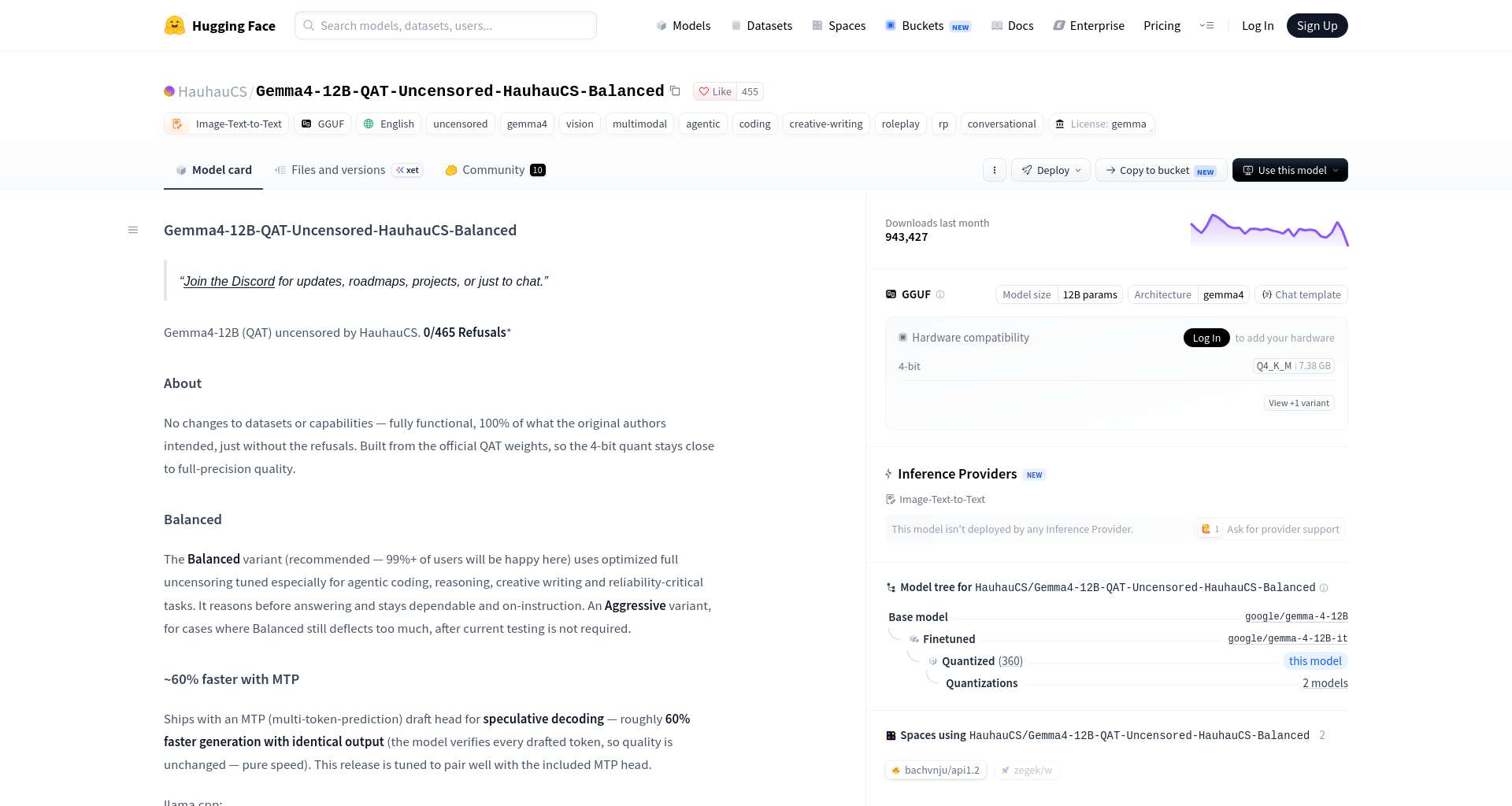
Image credits
- Courtesy: image hosted by cdn-thumbnails.huggingface.co; the creator retains rights and reuse permission was not independently verified.
Sources and image references
- HauhauCS Gemma 4 12B QAT Uncensored Balanced model card — derivative files, settings, compatibility, and maintainer claims.
- Google Gemma 4 model card — official upstream 12B specifications and capabilities.
- Google Gemma 4 overview and QAT explanation — QAT versus post-training quantization and deployment notes.
- Google Gemma 4 license — upstream Gemma 4 license text.
- Google’s
google/gemma-4-12B-itmodel record — upstream checkpoint and its displayed license metadata. - Hugging Face social thumbnail for the HauhauCS model — third-party image reference below; creator/reuse permission was not independently verified.
- llama.cpp project — local GGUF runtime; follow the model card’s current compatibility instructions.

Courtesy: social-preview image served by Hugging Face’s thumbnail CDN for the HauhauCS model page. It is included as a third-party source reference; the underlying creator retains rights and reuse permission was not independently verified.
Keep reading
Related reading
⚡ AI Engineering Briefing
AI model releases, practical tutorials, developer tools, and engineering research. Unsubscribe anytime.
Comments
Comments are temporarily unavailable while the public discussion space is being configured.