Huihui-Qwen3.8-27B-Abliterated Review: Model Card & VRAM
>Review the Huihui-Qwen3.8-27B-Abliterated model card: claimed layer edits, Apache-2.0 license, memory needs, vision caveats, and local setup.
🎧 Listen — ~10 min
Audio summary not available yet

Quick answer: Huihui’s Qwen3.8 27B Abliterated is a community-edited derivative of Qwen/Qwen3.8-27B. Its model card describes a proof-of-concept refusal-reduction edit, with the latest revision claiming that layers 18 through 51 were ablated while other layers, MTP, and visual components were left unchanged. That is useful provenance—not independent evidence that the model keeps the base model’s quality, vision accuracy, or safety behavior. Treat it as an experiment to evaluate, not a drop-in “better Qwen.”
This review checks the public model card and base-model record as of October 18, 2026. Repository metadata and files can change, so inspect the live card and exact revision before downloading. For a wider comparison, see our 2026 abliterated-model shortlist, uncensored local LLM guide, and abliteration research explainer.

Original AI-generated conceptual illustration. It is not a model diagram, benchmark, or screenshot.
What the model is—and what the label does not prove
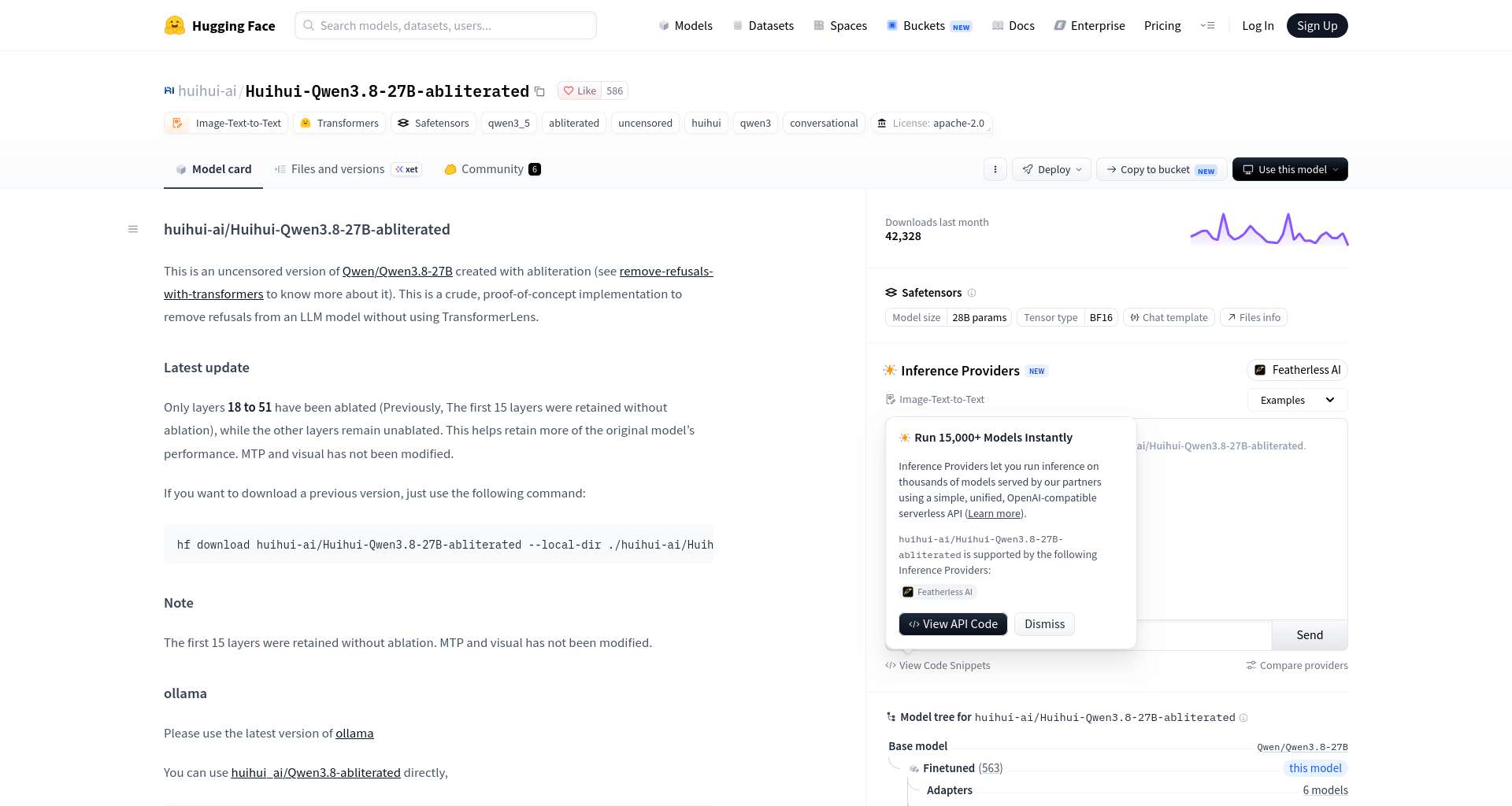
Hugging Face currently labels the repository Image-Text-to-Text, 28B parameters, BF16, and Apache-2.0. Its model tree identifies Qwen/Qwen3.8-27B as the base. The maintainer calls the derivative “uncensored” and says it was created with abliteration, while also explicitly describing the implementation as “crude” and “proof-of-concept.” Those words matter: the card is transparent that this is an experimental community conversion, not an official Qwen release or a third-party certification.
“Abliterated” is not a standardized quality tier. It describes an intended model modification, commonly aimed at reducing some refusal behavior. It does not tell you how often a model answers, whether its answers are correct, or whether it will follow a particular policy. A model card tag is a publisher-supplied label; measure the exact checkpoint you plan to use.
The distinction matters for searchers comparing “uncensored Qwen,” “abliterated Qwen,” and the original Qwen checkpoint: this repository is a derivative with its own revision history. Compare it against the unmodified base at matched quantization, runtime, prompt, and context—not against a different model or an unrelated benchmark headline.
The layer-edit claim: read it narrowly
The card’s latest update says only layers 18 to 51 have been ablated and that the other layers remain unablated. It also says this limited range is intended to retain more of the original model’s performance. Earlier text on the same page refers to the first 15 layers being retained without ablation; that older note should not be mistaken for the current change description. The model card also says the MTP and visual components were not modified.
That provides a useful, testable description of the maintainer’s edit scope. It does not establish that exactly the same quality is preserved outside the edited layers, nor that the remaining model is behaviorally identical to the base. The card does not provide a matched, independently audited benchmark suite in the model details reviewed here. Do not convert “only part of the network was edited” into “only refusal changed.” Neural components interact, and a targeted intervention can have off-target effects.
Research provides context, not a certificate for this specific checkpoint. The 2024 paper “Refusal in Language Models Is Mediated by a Single Direction” found a refusal-related direction in the tested models it studied. Later research, including “There Is More to Refusal in Large Language Models than a Single Direction” and the 2026 preprint “On the Steering Dimensionality of Refusal in Language Models”, investigates multiple and context-dependent refusal directions. Together, these papers caution against treating “refusal” as one universal switch. None of them independently evaluates Huihui’s Qwen3.8 derivative.
Vision: the weights may be untouched, but test the full path
The base model and derivative carry an Image-Text-to-Text label, and the maintainer says the visual part was not modified. That is a statement about the claimed edit—not a guarantee that every image workflow works in every quantization or runtime. Image inference can depend on the processor, chat template, image projector, file format, and backend support as well as the language weights.
If vision is important, run a small matched test before trusting it: use the same benign image set with the original base and derivative; verify that your selected Ollama, Transformers, vLLM, or GGUF package actually accepts images; and record the model revision, runtime version, and whether a separate projector file is required. Check OCR, image-grounded questions, and hallucinated visual details separately. A text-only prompt that mentions an image is not a vision test.

Courtesy screenshot of the public Huihui model card. The screenshot is a point-in-time reference; the repository and its contents belong to their respective owners. Confirm the live card before relying on it.
How much memory should you plan for?
The card identifies the original checkpoint as BF16 and 28B parameters. A simple weights-only estimate is about 56 GB decimal (roughly 52 GiB) for 28 billion parameters at two bytes each. A theoretical 4-bit representation starts around 14 GB decimal before quantization metadata and packaging overhead. Neither figure is a complete GPU-memory requirement: inference also needs runtime buffers, the KV cache, operating-system headroom, and potentially image-processing components.
| Format or setup | Approximate weights-only scale | Practical reading |
|---|---|---|
| BF16 source checkpoint | ~56 GB / ~52 GiB | Usually a multi-GPU or high-memory unified-memory experiment; leave room beyond the weights |
| 8-bit quantization | ~28 GB plus format overhead | May exceed a 24 GB card once runtime memory and context cache are included |
| 4-bit quantization | ~14 GB plus quantization metadata | A plausible first local trial on a 24 GB GPU, but context length and backend can still push memory higher |
| Lower-bit quantization | Smaller file, variable quality loss | Only choose after comparing it on your own tasks; smaller is not automatically usable or accurate |
These are arithmetic estimates, not measured file sizes or a guarantee of fit. Quantization recipes differ, and a long context can increase KV-cache memory substantially. The llama.cpp quantization documentation explains that quantization reduces model size but can reduce accuracy, especially at lower bit widths. The current model card links to community quantizations for local runtimes; check who published each derivative, what files it contains, and whether the vision path is included.
For Apple Silicon, “unified memory” is shared with macOS and other apps, so a 16 GB Mac does not offer 16 GB solely to model weights. Start with a smaller context and close memory-heavy applications. For a GPU workstation, leave several gigabytes for the runtime and KV cache instead of planning to fill all VRAM with the downloaded file. Use our local AI model fit tool for a first estimate, then validate with the exact quant and context you intend to run.
A careful local first run
The model card currently documents this Ollama shortcut:
1ollama run huihui_ai/Qwen3.8-abliteratedUse the latest Ollama version as the card requests, and confirm what exact model package and quantization that tag resolves to before using it for repeatable work. For reproducibility, record the model identifier, revision or digest, quantization, context length, runtime version, and sampling settings. A moving tag is convenient for a quick look, but it is not a pinned experimental artifact.
Our AI Model Directory has a separate Huihui Qwen3.8 27B Abliterated GGUF record. That record is specifically a GGUF listing; it should not be confused with the original BF16 Safetensors repository reviewed here. Browse the AI model directory to compare sources and hardware fields, and open the source card for the actual files and current instructions.
A practical evaluation plan before you keep it
Run the derivative and base model under the same conditions. Keep one small, private test set with normal prompts from your workload, plus cases designed to identify over-refusal and unwanted compliance. Avoid testing only with extreme prompts; that would measure a narrow behavior while missing everyday usefulness.
- Ordinary task quality: compare coding, explanation, summarization, or research tasks against the base. Score correctness with a rubric or known answers, not “it sounded confident.”
- Calibration: include questions whose answer is absent or uncertain. Check whether the model admits uncertainty or invents a plausible answer.
- Refusal behavior: separate allowed-but-sensitive requests from clearly disallowed requests using a policy reviewed for your use case. Measure both over-refusal and under-refusal.
- Vision and tools: test image inputs and structured tool calls independently. The image-text label does not prove tool calling, and the model’s name does not prove agent compatibility.
- Stability: repeat prompts across context lengths and sampling settings, then repeat on the exact quantized artifact. A result from BF16 does not automatically transfer to Q4.
- Operations: keep a rollback to the base model, restrict secrets and network access, and log the exact model revision for each test.
If the use case involves an IDE or a coding agent, keep the model and the tool permissions as separate controls. The model can suggest a command; the harness should decide whether that command is allowed. Start with read-only access or a disposable workspace, review patches, and require a human before deletion, production deployment, credential access, or external side effects. Explore the separate coding-agent directory for the agent layer; this model card does not establish that the derivative supports dependable tool calling.
Verdict
Huihui Qwen3.8 27B Abliterated is interesting because its card gives more edit detail than a bare “uncensored” tag: a named base model, BF16 metadata, an Apache-2.0 label, a stated layer range, and a note about untouched visual/MTP components. The same card also calls the work a proof of concept. That combination makes it a candidate for a controlled local comparison—not a proven upgrade, a safety bypass guarantee, or an automatically reliable agent brain.
If you have enough memory, compare it with the base at the same quantization and context. If you need image understanding, validate the complete image pipeline. If you need an agent, build authorization, sandboxing, and human approval into the harness rather than expecting the model’s training history to enforce those controls. For the broader selection, continue to our abliterated-model shortlist, uncensored model guide, and evaluation checklist.
Frequently asked questions
Is Huihui Qwen3.8 27B Abliterated an official Qwen release?
No. Its model card identifies Qwen/Qwen3.8-27B as the base, but this is a Huihui community derivative, not the original Qwen repository.
Which layers does the latest model-card note say were ablated?
The latest note says layers 18 through 51 were ablated and the other layers were not. Treat that as a maintainer statement about the repository, not an independent verification of the weights.
Does “visual not modified” prove that vision works unchanged?
No. It says the visual component was not changed by the maintainer’s edit. Test the image processor, runtime, projector, quantization, and visual accuracy on the exact artifact you plan to use.
Can I run the 28B checkpoint on a 24 GB GPU?
The full BF16 weights alone are estimated around 52 GiB, so not as a single ordinary 24 GB GPU load. A 4-bit quant may be a practical first experiment, but KV cache, runtime buffers, and context length still determine whether it fits.
Does abliterated mean it is safe for autonomous agents?
No. The label is not a safety or tool-use certification. Use least-privilege tools, a sandbox, output validation, and human approvals for consequential actions.
Source website screenshot
Sources and image references
- Huihui Qwen3.8 27B Abliterated model card
- Official Qwen3.8 27B base model card
- Ollama model entry linked by the maintainer
- Refusal in Language Models Is Mediated by a Single Direction
- There Is More to Refusal in Large Language Models than a Single Direction
- On the Steering Dimensionality of Refusal in Language Models
- llama.cpp quantization documentation
- Our AI directory record for a related Huihui Qwen3.8 GGUF listing
Keep reading
Related reading
⚡ AI Engineering Briefing
AI model releases, practical tutorials, developer tools, and engineering research. Unsubscribe anytime.
Comments
Comments are temporarily unavailable while the public discussion space is being configured.