Huihui Spark X2.5 4B Abliterated Review: Is It Ready?
>A source-checked review of Huihui Spark X2.5 4B Abliterated: what the proof-of-concept edit means, memory estimates, setup options, and how to evaluate it.
🎧 Listen — ~11 min
Audio summary not available yet

Quick answer: Huihui Spark X2.5 4B Abliterated is a compact, locally runnable experiment—not a verified “uncensored upgrade” to the original Spark model. Its Hugging Face card calls the refusal-removal implementation a crude proof of concept. The 4B size makes it a more approachable test than a 27B checkpoint, but the card does not establish that the edited model preserves the base model’s accuracy, coding ability, or safety behavior. Try it only with a pinned revision, matched baseline, and a task-specific evaluation.
This review checks the public cards and repository metadata on October 18, 2026. It does not report a benchmark run. For broader context, see our 2026 abliterated model shortlist, uncensored local LLM guide, and uncensored-model evaluation checklist.

Original AI-generated editorial illustration. It is conceptual artwork, not a model diagram, benchmark, or screenshot.
What is the Huihui Spark X2.5 4B checkpoint?
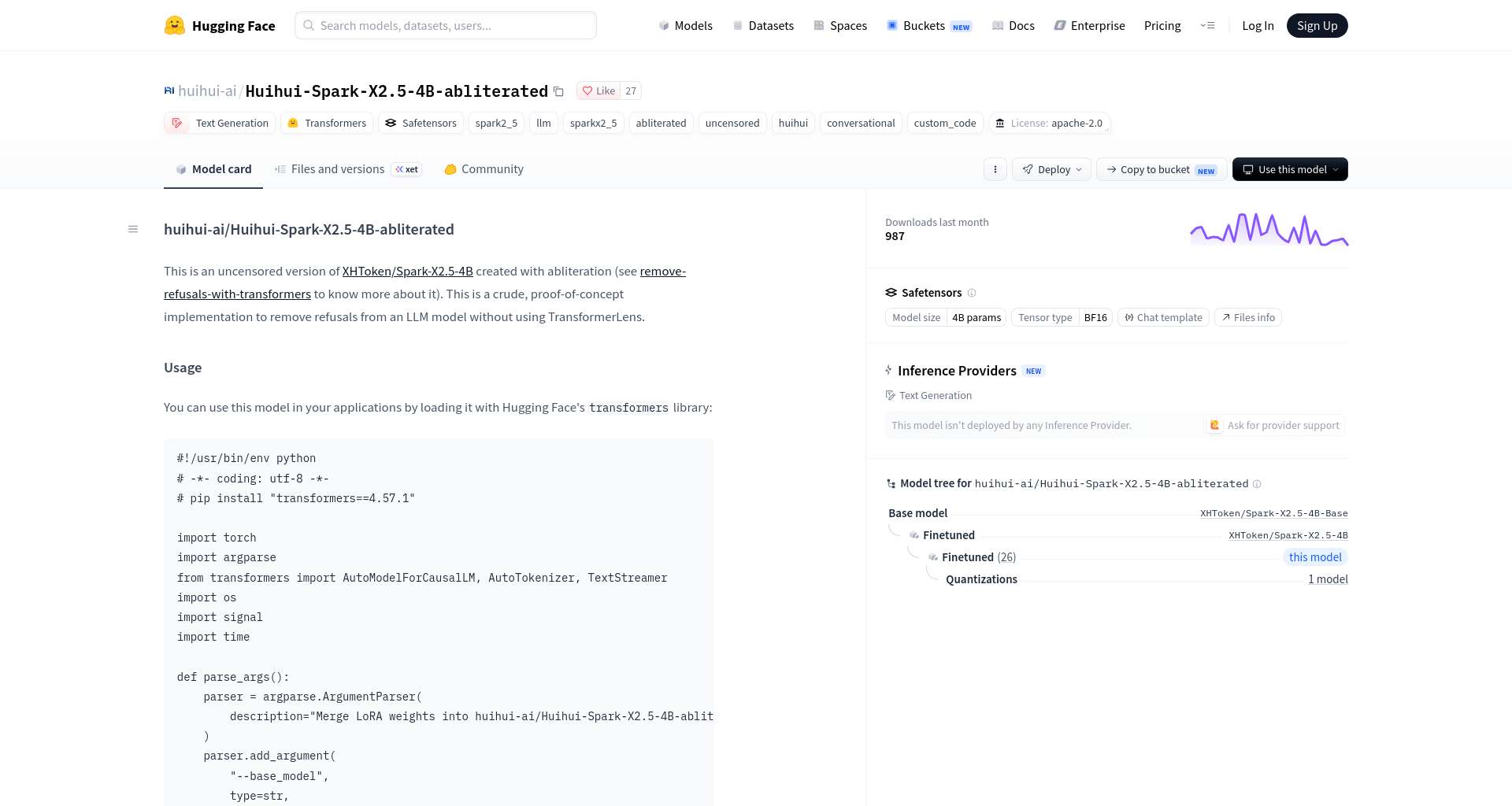
The repository huihui-ai/Huihui-Spark-X2.5-4B-abliterated is presented by its maintainer as an “uncensored” version of XHToken/Spark-X2.5-4B, made with an abliteration procedure. Hugging Face currently labels it Text Generation, 4B parameters, BF16, and Apache-2.0; the repository also carries abliterated, uncensored, and custom_code tags. Those labels describe repository metadata and the publisher’s intent. They are not independent quality or safety certifications.
The sentence that matters most is in the maintainer’s own model card: the implementation is described as a crude, proof-of-concept way to remove refusals without TransformerLens. That level of disclosure is useful, but it should also temper any “drop-in uncensored assistant” claims. The card does not provide a matched, independently audited evaluation of this exact derivative against the original Spark checkpoint.

Courtesy screenshot captured from the public Hugging Face model card on October 18, 2026. The repository and its contents belong to their respective owners; this is a point-in-time reference, not an endorsement.
“Abliterated” is a method label, not a score
Abliteration generally refers to editing model weights to reduce some refusal behavior, often by intervening on a refusal-related direction identified in activations. It is not one universal, standardized recipe. Different maintainers can choose different data, layers, scales, and evaluation procedures. The Hugging Face explainer on abliteration describes one workflow and notes that its example also degraded performance. That is background about the technique—not a test result for Spark X2.5.
For this particular checkpoint, the reliable statement is narrow: the maintainer says it was created with abliteration and calls the implementation proof-of-concept. The public card does not tell us exactly how often it refuses across a defined prompt set, whether its harmfulness boundaries changed in a predictable way, or whether capabilities were preserved. “Uncensored” does not mean more truthful, more capable, or safe for unattended use.
| Question | What the public source establishes | What still needs testing |
|---|---|---|
| Is it a separate community checkpoint? | Yes; the card identifies Huihui’s repository and links the Spark X2.5 4B source model | Exact revision and file hashes should be pinned before a reproducible comparison |
| What task is it listed for? | Text Generation | Whether your chosen runtime correctly applies its tokenizer and chat template |
| How large is it? | Hugging Face displays 4B parameters and BF16 | Actual download size, peak RAM/VRAM, tokens per second, and long-context fit on your machine |
| What does “abliterated” prove? | The maintainer says an experimental refusal-removal edit was applied | Refusal rate, answer quality, false compliance, and capability retention on your workload |
| Is it served by Hugging Face Inference Providers? | The card reported no provider deployment when checked | Availability may change; this does not rule out other hosting services |
| Is it ready for autonomous tools? | The base Spark family advertises agent-related capabilities | Tool-call correctness, prompt-injection resistance, permission safety, and recovery behavior |
The base model’s features do not automatically transfer as test results
The upstream Spark-X2.5 model card describes a family with 4B and 1.7B variants, a hybrid attention design, multilingual support, coding and tool-use goals, and a context length advertised up to one million tokens. Those are upstream model-family descriptions. They help explain what the base checkpoint is designed to do; they are not an independent benchmark of Huihui’s altered copy.
The upstream architecture image below shows one global-attention layer for every three sliding-window layers and lists the 4B model’s 36 layers and one-million-token context setting. It is a useful diagram of the base Spark architecture. It is not a diagram of the abliterated edit, and it should not be read as proof that a one-million-token prompt fits on a desktop GPU. The upstream quick-start explicitly says that such a context setting needs sufficient device memory and should be reduced when necessary.

Image courtesy of XHToken’s Spark-X2.5 model repository, file images/spark25-hybrid-architecture-light.png. It describes the upstream base family, not a benchmark or architecture audit of Huihui’s derivative.
The distinction matters for agentic use. A model can produce tool-call-shaped text without reliably choosing the right tool, respecting arguments, or resisting hostile content in retrieved files. Keep approval gates in the harness; do not grant broad shell, filesystem, browser, or deployment permissions just because a model card lists “agent” or “tool use.” Compare available options in our AI model directory and coding-agent directory, but evaluate the model and harness together.
How much memory does a 4B BF16 model need?
“4B” is the parameter count, not a promise that a 4 GB machine can run the checkpoint. The upstream card’s architecture image lists 4,112,079,360 total parameters for Spark-X2.5-4B. At two bytes per BF16 parameter, the raw weights alone are about 8.22 GB decimal, or 7.66 GiB. This is arithmetic from the published parameter count—not a measured download size. File headers, runtime buffers, allocator overhead, and the KV cache add memory on top.
| Local memory available to the model | Practical starting point | Important caveat |
|---|---|---|
| 8 GB VRAM | Usually too tight for the full BF16 weights plus runtime overhead; try a compatible quantized build instead | Check that the quantization is for this exact architecture and not a similarly named model |
| 12 GB VRAM | A reasonable first BF16 experiment with a short context may fit on some runtimes | Leave headroom; do not assume the advertised maximum context is practical |
| 16 GB or more VRAM | More room for runtime and a longer context, depending on backend and concurrency | Measure peak memory and latency on the exact revision and prompt length |
| Apple Silicon unified memory | A quantized variant can be a useful local trial if a compatible conversion exists | macOS, applications, and model share memory; unified memory is not all available to weights |
For a rough 4-bit calculation, the raw parameter payload would start near 2.06 GB decimal before quantization metadata and packaging. That estimate does not prove that a specific quant file exists, preserves quality, or runs in a given backend. The model card links to a community quantization; inspect its publisher, format, exact source revision, license, and runtime instructions before downloading. Our local AI model fit tool can help narrow hardware options, but it cannot substitute for a measured load test.
Treat the one-million-token context as a model-family ceiling, not a desktop recommendation. Context length affects KV-cache consumption and latency; a model may load successfully at 8K or 32K and fail at a much larger setting. Start short, record memory, then raise context gradually. For a fair test, keep quantization, runtime, context, and sampling settings identical between the base and edited checkpoints.
How to try it without confusing a load test with a quality test
The public Huihui card lists a Docker Model Runner entry:
1docker model run hf.co/huihui-ai/Huihui-Spark-X2.5-4B-abliteratedUse this only if Docker Model Runner and the model’s required runtime support are available in your installation. The card also shows a Transformers path and calls trust_remote_code=True. That flag permits loading repository-provided Python code. Review the repository and pin a commit before enabling it; for experiments, use an isolated environment rather than a machine with production credentials or sensitive files.
The upstream Spark card documents backend-specific support for the base Spark family across projects such as SGLang, vLLM, llama.cpp, MLX, Ollama, and LM Studio. Do not assume every backend supports this exact abliterated derivative simply because it supports the upstream architecture. Confirm that the derivative’s weight format, tokenizer, chat template, and any required custom code are supported by the exact version you install. The Huihui page offers a quantization link; use that exact listing rather than inventing an Ollama tag or model name.
A small evaluation plan before you keep it
Run the base Spark-X2.5-4B and Huihui derivative on the same hardware and a fixed, harmless test set. Save the model revision, file hashes, quantization, runtime version, context length, sampling settings, and outputs. A useful first pass can include:
- Everyday quality: summarization, translation, structured extraction, and instruction-following prompts with answer keys where possible.
- Coding: a handful of small code edits with unit tests; score whether tests pass, not whether the response sounds confident.
- Refusal behavior: a balanced set of benign boundary questions and policy-sensitive prompts, reviewed against your own safety requirements. Do not use harmful instructions as “proof” of quality.
- Tool behavior: if you use tools, start with read-only tools and synthetic data. Check argument validity, repeated calls, refusal to act on malicious retrieved text, and whether a human approval gate remains intact.
- Performance: measure cold-start time, peak memory, tokens per second, and quality at the context lengths you actually need.
Report the results as your own measurements, with the setup and limitations. Do not copy the upstream base model’s vendor-reported benchmark table into a claim about the abliterated derivative. A small community edit can be interesting and useful for controlled research while still needing more evidence before production use.
Verdict: an accessible experiment, not a proven daily driver
Spark X2.5 4B Abliterated is appealing because a 4B checkpoint is easier to test locally than a 27B model, and its public card is unusually direct about the experimental nature of the edit. That same card does not provide enough independent evidence to call it a quality-preserving, dependable agent, or a superior uncensored assistant.
If you want to learn about model editing, compare refusal behavior, or explore local inference on modest hardware, it is a reasonable research candidate—especially in a sandbox with limited permissions. If you need predictable coding, tool execution, or a public-facing assistant, start with a supported base model, retain the application’s own safety and review controls, and make promotion conditional on your evaluation results. For another checkpoint at a very different memory scale, see our Huihui Qwen3.8 27B abliterated review.
Frequently asked questions
Is Huihui Spark X2.5 4B Abliterated truly uncensored?
The maintainer labels it “uncensored” and says it was created with abliteration. The card calls its approach proof-of-concept, and does not publish a matched, independent refusal evaluation for this checkpoint. Treat the label as the publisher’s description and measure the exact revision yourself.
Does it have a one-million-token context window?
The upstream Spark-X2.5 family advertises a context length up to one million tokens. The upstream card warns that this setting requires sufficient memory. It is not evidence that the Huihui derivative will run at that context on your machine or runtime.
Can it run on an 8 GB GPU?
The raw BF16 weights are estimated at about 7.66 GiB from the published parameter count, before runtime and cache memory. That makes an 8 GB GPU a tight or impractical choice for BF16; a compatible quantized artifact may fit more easily, but should be tested directly.
Is this model already listed in the Essamamdani AI directory?
The exact Hugging Face repository did not have a matching record in the directory data checked for this review. Browse the AI model directory for related and newly synced models; use the Hugging Face source card above to verify this exact checkpoint until its own directory record is available.
Is it safe to use as an autonomous coding agent?
The model card does not establish agent safety. If you experiment with agent tools, keep permissions narrow, begin read-only, use synthetic data, and require human approval for changes to files, deployments, accounts, or external systems.
Source website screenshot
Sources and image references
- Huihui Spark X2.5 4B Abliterated model card — derivative description, task, license, size, runtime links, and maintainer caveats; checked October 18, 2026.
- XHToken Spark-X2.5-4B model card — upstream architecture, context, runtime documentation, and model overview; checked October 18, 2026.
- Spark-X2.5 upstream architecture image — courtesy image; describes the base model family.
- Maxime Labonne, “Uncensor any LLM with abliteration” — general technique background and an example where performance degraded; not an evaluation of Spark X2.5.
- Arditi et al., “Refusal in Language Models Is Mediated by a Single Direction” — research context for refusal-related directions, not a certification of this checkpoint.
- Essamamdani AI model directory and coding-agent directory — internal discovery links.
Keep reading
Related reading
⚡ AI Engineering Briefing
AI model releases, practical tutorials, developer tools, and engineering research. Unsubscribe anytime.
Comments
Comments are temporarily unavailable while the public discussion space is being configured.