Litmus Developer Edition Review: Industrial Edge AI for OT Data
>A technical review of Litmus Developer Edition: how the industrial edge data platform unifies OT telemetry, normalizes protocols, and prepares plant-floor data for AI inference.
🎧 Listen — ~10 min
Audio summary not available yet
1. What is Litmus Developer Edition?
Deploying artificial intelligence models in industrial environments rarely fails because of model architecture; it fails because industrial data pipelines are brittle, fragmented, and notoriously difficult to access. Factory floors run on legacy Operational Technology (OT) protocols—Modbus, Profinet, Siemens S7, and Allen-Bradley EtherNet/IP—while modern AI pipelines demand clean, normalized JSON streams or time-series dataframes delivered with deterministic latency.
To lower the barrier for systems engineers and data practitioners, Litmus announced the launch of a free Developer Edition of its Industrial Edge Data Platform. This edition aims to provide individual developers, automation engineers, and software architects with direct access to industrial protocol drivers, edge data transformation engines, and application container runtimes without requiring enterprise procurement contracts.
This review examines what the Litmus Developer Edition provides, how its underlying architecture bridges the OT-IT gap for edge AI, how to configure a telemetry-to-inference pipeline, where it compares against alternatives like EdgeX Foundry and AWS IoT Greengrass, and its technical limitations.
Key takeaways
- Purpose: Litmus Developer Edition is a software-defined industrial edge data layer engineered to collect, normalize, and contextualize telemetry from industrial machinery for edge processing and cloud ingestion.
- OT-to-IT Bridge: Includes pre-built driver integrations for common industrial PLCs, CNCs, robotic controllers, and industrial fieldbuses, eliminating the need to write custom protocol parsers.
- Edge AI Enablement: Provides an embedded runtime environment that normalizes raw PLC registers into structured formats suitable for local anomaly detection, predictive maintenance models, or upstream streaming to brokers like Apache Kafka.
- Access Model: Offers a free tier aimed at developers and edge architects prototyping deployments before committing to plant-wide, multi-node enterprise licenses.
- Primary Trade-off: While it dramatically simplifies industrial protocol connectivity, it remains a proprietary software platform with higher memory footprints than bare-metal micro-daemons.
2. Core architecture: How Litmus handles the industrial edge
Bridging shop-floor machinery with modern AI workloads involves three major hurdles: physical protocol diversity, register-level obscurity (lacking semantics or engineering units), and network isolation (Purdue Model security boundaries). Litmus solves this using a layered edge pipeline.
Protocol ingestion layer
At the foundation, the platform executes native drivers covering over 250+ industrial protocols, including:
- Siemens Industrial Ethernet: Native S7 protocol communication over TCP port 102.
- Rockwell Automation / Allen-Bradley: EtherNet/IP (CIP) encapsulation.
- Modbus: Modbus TCP and serial Modbus RTU/ASCII.
- Open Standards: OPC-UA client/server, MQTT Sparkplug B, and standard TCP/UDP raw sockets.
Data normalization and metadata contextualization
Industrial PLCs expose data as raw addresses (for example, DB100.DBD20 or register 40001). Raw registers lack engineering units, calibration offsets, and semantic meaning. Litmus applies a configuration schema that maps these raw addresses to contextual tags (e.g., spindle_bearing_vibration_rms with unit mm/s and float32 scaling).
Local compute and container integration
Rather than just functioning as an ingestion pipe, the platform embeds a container engine. This allows developers to mount the normalized local data bus directly into custom Docker containers running on the same physical gateway, enabling low-latency model inference without round-tripping to a cloud datacenter.
3. Hands-on workflow: Setting up an edge data pipeline
Setting up Litmus Developer Edition to feed an edge AI application involves four core operational phases: runtime deployment, device connection, tag transformation, and output routing.
Step 1: Provisioning the edge environment
The platform runs on modern 64-bit x86 or ARM64 industrial hardware, edge gateways, or hypervisors (VirtualBox, VMware ESXi, KVM). Hardware gateway platforms such as the Toradex Zinnia Gateway, powered by NXP i.MX application processors running Torizon OS, represent typical target hardware for deploying low-power industrial edge computing agents.
For development environments, the software is deployed as an image or container stack. Once booted, the local administration interface is accessed through a secure local web interface (defaulting to HTTPS on port 443).
Step 2: Defining the industrial device driver
Within the device management console, create a new device connection to capture machine states:
- Select the target driver (e.g., Modbus TCP or Siemens S7-1200/1500).
- Configure network parameters: Target IP address (e.g.,
192.168.1.50), port (502for Modbus,102for S7), rack/slot configuration, and polling intervals (typically 10ms to 1000ms depending on bus loading). - Test connectivity directly using built-in ping and register diagnostic utilities.
Step 3: Register mapping and payload schema
Define the tags to extract from the controller memory. A tag configuration translates binary machine data into structured application payloads:
1{
2  "device_id": "press_station_04",
3  "tags": [
4    {
5      "name": "hydraulic_pressure_psi",
6      "address": "40012",
7      "type": "FLOAT32",
8      "scaling_multiplier": 0.05,
9      "sampling_rate_ms": 100
10    },
11    {
12      "name": "motor_temperature_celsius",
13      "address": "40014",
14      "type": "INT16",
15      "scaling_multiplier": 0.1,
16      "sampling_rate_ms": 500
17    }
18  ]
19}
Step 4: Routing sanitized data to an inference model
Once transformed, data can be published to the internal message broker or piped to a co-located container. A Python inference script running in a parallel container on the edge node can subscribe to the normalized MQTT stream:
1import json
2import numpy as np
3import paho.mqtt.client as mqtt
4BROKER_ADDRESS = "127.0.0.1"
5BROKER_PORT = 1883
6TOPIC = "litmus/data/press_station_04"
7
8def on_message(client, userdata, message):
9    payload = json.loads(message.payload.decode("utf-8"))
10    pressure = payload["hydraulic_pressure_psi"]
11    temperature = payload["motor_temperature_celsius"]
12    feature_vector = np.array([[pressure, temperature]])
13    anomaly_score = run_inference(feature_vector)
14
15    if anomaly_score > 0.85:
16        print(f"ALERT: Structural anomaly detected! Score: {anomaly_score}")
17        trigger_safety_interlock(payload["device_id"])
18
19def run_inference(data_vector):
20    return 0.12
21
22client = mqtt.Client()
23client.on_message = on_message
24client.connect(BROKER_ADDRESS, BROKER_PORT)
25client.subscribe(TOPIC)
26client.loop_forever()
4. Deploying edge AI models onto normalized OT telemetry
Once normalized telemetry is accessible at the gateway level, developers can construct advanced inference and automated feedback architectures. Rather than streaming raw, high-frequency time-series data over constrained satellite or cellular backhauls to cloud datalakes, the machine learning workflow shifts entirely to the local edge.
For practitioners architecting these deployments, three core considerations apply:
- Local Inference Engines: Lightweight runtimes such as ONNX Runtime, TensorRT, or TensorFlow Lite run locally on the edge gateway alongside the ingestion pipeline. For an in-depth exploration of optimizing small models directly on local silicon, review our guide on the Google AI Edge Gallery for on-device GenAI architectures.
- Automated Remediation Agents: Detecting an anomaly is only valuable if an action is taken. Developers can bind inference alert outputs to automated supervisory loops or agentic workflows that trigger maintenance dispatches or write setpoint adjustments back to the PLC. To architect these execution chains securely, refer to our playbook on architecting resilient AI agent workflows for production.
- Edge Telemetry Evaluation: Sensor drift, recalibration errors, and machine mechanical wear will cause statistical drift in input features. Implementing telemetry validation pipelines at the edge ensures corrupted sensor feeds do not produce catastrophic false positives, using architectures documented in our analysis of continuous AI evaluation architecture from traces to production gates.
5. Litmus Developer Edition vs. alternatives
When building an industrial edge data pipeline, software engineers typically choose between specialized industrial platforms, hyperscaler edge stacks, and fully open-source frameworks. The table below details key differences across major deployment considerations.
| Feature / Metric | Litmus Developer Edition | AWS IoT Greengrass | EdgeX Foundry | Open-Source Node-RED + Custom Stack |
|---|---|---|---|---|
| Primary Focus | OT protocol integration & industrial edge processing | Cloud-to-edge container deployment & AWS orchestration | Vendor-neutral, modular microservices framework | Rapid graphical prototyping and lightweight integration |
| Native Industrial Drivers | 250+ out-of-the-box drivers (Siemens, Modbus, Rockwell, Fanuc) | Minimal native industrial drivers (relies on third-party OPC-UA connectors) | Supported via community Device Services (Modbus, OPC-UA, BACnet) | Relies on community-maintained node-red-contrib-* libraries |
| Edge Normalization | Built-in UI schema mapper & transformation engine | Lambda/Python component coding required | Application Services layer (e.g., App Service Configurable) | JSONata or custom Function nodes in JavaScript |
| Model Serving Support | Built-in container runtime / direct local data-bus bindings | Native AWS SageMaker edge integration & container orchestration | External application service integration via ZeroMQ/MQTT | External invocation via REST endpoints or Python sub-processes |
| Licensing / Model | Proprietary; Free Developer Edition with paid Enterprise tiers | Pay-per-active-device + cloud consumption costs | Open-source (Apache 2.0 license) | Open-source (Apache 2.0 / JS Foundation) |
| Resource Footprint | Moderate (recommended >= 4GB RAM, 2-4 CPU cores) | Low-to-moderate (starts around 256MB RAM minimum) | Modular (can run < 1GB RAM if deploying minimal services) | Very low (< 512MB RAM for base runtime) |
Analysis: When to pick Litmus vs. alternatives
- Choose Litmus when dealing with legacy factory machines with diverse, non-standard industrial protocols where writing custom Modbus/S7 driver wrappers would take months of development time.
- Choose AWS IoT Greengrass if your application is already deeply integrated into the AWS ecosystem (AWS IoT Core, SageMaker Edge, DynamoDB) and the machine telemetry has already been converted to standard OPC-UA or MQTT upstream.
- Choose EdgeX Foundry when developing open-source hardware gateways that require zero vendor lock-in and must run entirely on permissively licensed open-source code.
6. Practical limitations and anti-patterns
While the Developer Edition provides significant utility for industrial engineers, several constraints must be evaluated before building production roadmaps:
1. Resource footprint on embedded hardware
Litmus is an enterprise-derived platform. Unlike lightweight, single-purpose daemons written in C or Rust (such as Eclipse Mosquitto or custom libmodbus clients), the platform requires substantial compute. Running the platform along with container runtimes on low-end ARM Cortex-A53 or Cortex-M microcontrollers is not viable. A capable gateway running an x86_64 or high-performance ARM64 CPU with at least 4GB of RAM is generally required.
2. Proprietary driver ecosystem
Although the Developer Edition allows free prototyping, the underlying drivers and core normalization engine are proprietary. Organizations with strict open-source software compliance mandates cannot audit the binary driver internals or easily patch low-level fieldbus driver behavior.
3. Developer tier boundary vs. enterprise scaling
Developer editions in enterprise software are designed to seed adoption. When transitioning from a single gateway in a test lab to hundreds of production gateways spread across multiple manufacturing plants, organizations must transition to Litmus Edge Manager (their centralized management console), which requires commercial enterprise licensing.
7. The verdict: Is Litmus Developer Edition worth deploying?
For industrial software engineers and data scientists, Litmus Developer Edition delivers substantial real-world value by eliminating the most frustrating hurdle in smart manufacturing: obtaining contextualized, clean data out of closed PLC networks.
Writing custom software to poll Modbus coils, manage Siemens byte swapping, or decode proprietary robot controllers is an inefficient use of engineering resources. Litmus handles the industrial plumbing effectively, exposing structured interfaces that modern data science stacks expect.
If your project involves developing edge AI models for CNC machinery, stamping presses, or automated assembly lines, testing the Litmus Developer Edition in a local staging environment can save weeks of protocol-engineering effort. However, if your application runs on highly constrained embedded hardware with sub-gigabyte memory limits, an open-source modular stack like EdgeX Foundry remains the more suitable path.
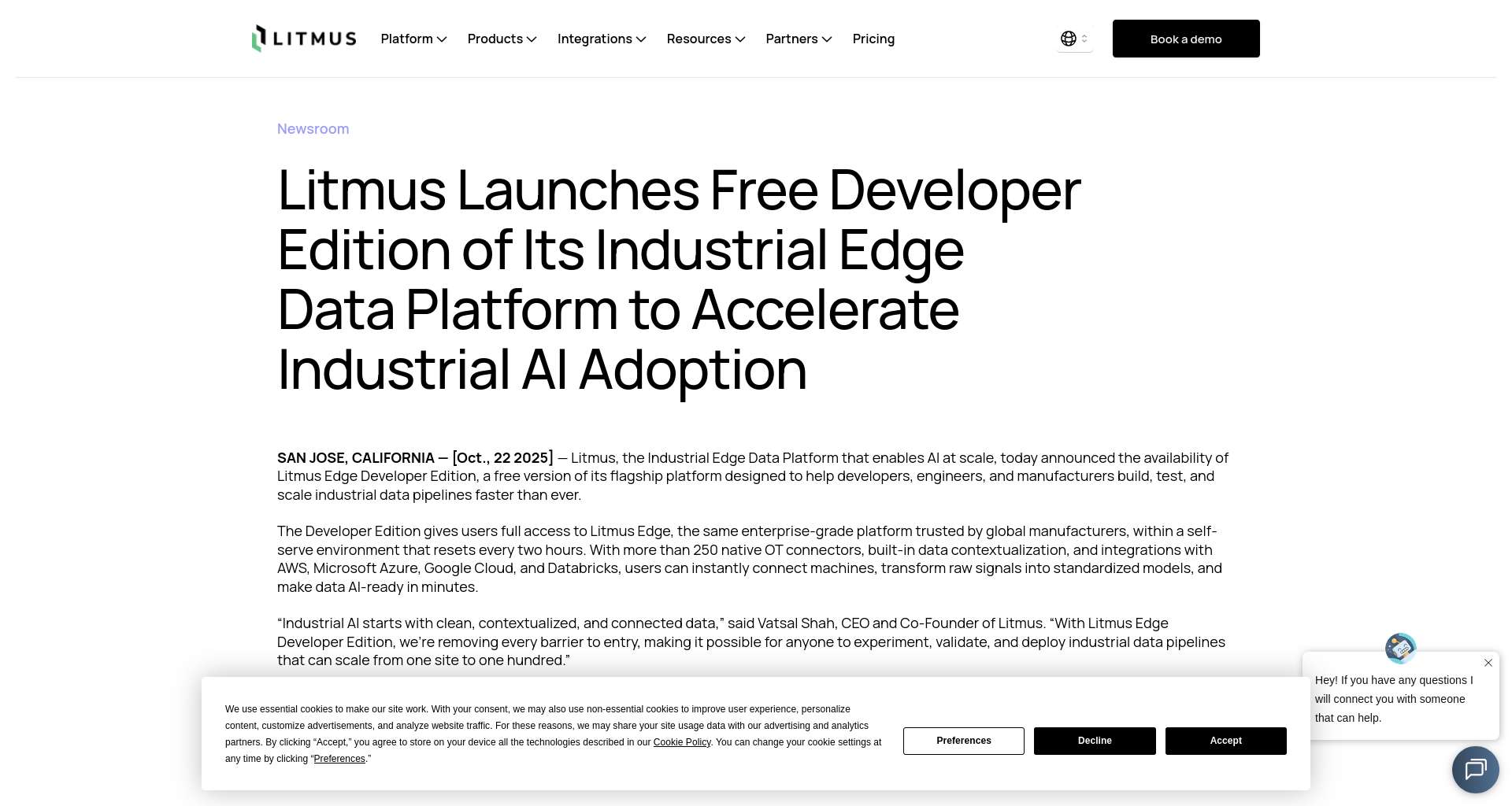
Source website screenshot
Frequently asked questions
What protocols does Litmus Developer Edition support out of the box?
Litmus includes pre-built drivers for major industrial communication standards, including Modbus TCP/RTU, Siemens Industrial Ethernet (S7), Rockwell Automation / Allen-Bradley EtherNet/IP (CIP), Mitsubishi MELSEC, Omron FINS, Fanuc Focas, OPC-UA, and MQTT Sparkplug B.
Can Litmus run custom machine learning models directly at the edge?
Yes. Litmus includes a local container runtime. Developers can deploy Docker containers running custom models (packaged via ONNX Runtime, Python, or C++) that consume normalized sensor telemetry directly from the gateway's local message bus with minimal latency.
How does Litmus differ from open-source tools like Node-RED?
Node-RED is a general-purpose, flow-based visual programming environment suited for lightweight integrations and rapid prototyping. Litmus is a purpose-built industrial data platform that provides hardened, enterprise-grade industrial drivers, structured data governance, tag normalization schemas, and native device diagnostic capabilities designed for high-reliability factory automation.
What hardware is required to run Litmus Developer Edition?
The platform requires an x86_64 or modern 64-bit ARM edge gateway or server. Typical production requirements recommend at least a quad-core processor, 4GB of RAM, and 32GB of SSD storage to handle local time-series data buffering and container workloads.
Sources and image references
- Litmus newsroom announcement: Litmus Launches Free Developer Edition of Its Industrial Edge Data Platform
- Hardware deployment reference: Toradex Zinnia Gateway Industrial Edge AI Platform
- Note: No official third-party screenshots or diagram assets were licensed in the primary source material. All architecture diagrams in this review are rendered natively using vector diagrams.
⚡ AI Engineering Briefing
AI model releases, practical tutorials, developer tools, and engineering research. Unsubscribe anytime.
Comments
Comments are temporarily unavailable while the public discussion space is being configured.