Meta Muse Spark Open: 816B Model, Hardware and Setup Guide
>Meta Muse Spark Open is an 816B/42B-active multimodal model. See its real hardware requirements, official runtimes, access terms and setup paths.
🎧 Listen — ~9 min
Audio summary not available yet

Meta released the weights for Muse Spark Open on October 15, 2026. It is an 816-billion-parameter mixture-of-experts model with 42 billion parameters active per token and a context window of up to one million tokens. Despite the 42B active figure, this is not a 42B model that fits on an ordinary 24GB GPU: the full weight set must be represented across the deployment, and Meta's model card lists at least 700GB of GPU memory for NVFP4 or 2TB for BF16 (Meta release; official Hugging Face model card).
Quick verdict: Treat Muse Spark Open as a large, distributed model for well-provisioned servers or the specific two-M5-Ultra-Mac-Studio configuration Meta describes. Do not plan a single RTX 4090/5090 or an ordinary dual-24GB workstation around it. If your hardware is smaller, use the AI model directory to find a suitable alternative or check a candidate with the local model fit tool.
Key takeaways
- The published model card specifies 816B total / 42B active parameters, not 64B / 14B (model card).
- Inputs include text, images, video and audio; generated output is text (model card).
- The context window is up to 1,048,576 tokens, subject to the runtime and deployment configuration (model card).
- The model card lists a minimum of 700GB GPU memory for NVFP4 and 2TB for BF16. Meta separately reports running it on two Mac Studio systems with M5 Ultra and up to 512GB unified memory each (model card; Meta release).
- Weights and hosted inference are available through different channels. Review the Muse Model License and model access conditions before commercial use.
1. What Meta released
Muse Spark Open is the open-weight version of Meta's Muse Spark model. The official release post dates it October 15, 2026 and describes it as an 816B-total, 42B-active multimodal model with a 1M-token context. Meta says the model targets coding, agentic work, long-horizon tasks and multi-step reasoning. These are the publisher's stated capabilities; they should not be treated as independent benchmark results. Meta's announcement describes the release and supported access channels, while the model card provides the more detailed architecture and inference information.
The model card describes a mixture-of-experts transformer with a perception encoder. Its language backbone routes tokens through 8 of 256 experts and the published overview lists 62 transformer layers (model card). The active parameter count describes the portion used for a token pass; it does not mean the complete weight set disappears from memory. The model weights still need to be stored or distributed across devices. The model card is explicit about the full-model memory requirements.
| Published property | What the source says | Practical meaning |
|---|---|---|
| Total / active parameters | 816B total / 42B active (model card) | Active parameters are not the same as total weight storage |
| Context | Up to 1,048,576 tokens (model card) | Available context depends on runtime, memory and serving configuration |
| Input / output | Text, image, video and audio input; text output (model card) | This is a multimodal input model, not a media-generation model |
| NVFP4 memory | At least 700GB GPU memory (model card) | Requires a multi-GPU/datacenter-scale setup |
| BF16 memory | At least 2TB (model card) | Not a standard workstation deployment |
| Desktop configuration described by Meta | Two Mac Studio systems with M5 Ultra; up to 512GB unified memory each (Meta release) | A specific high-memory, multi-machine setup; not a generic Mac compatibility promise |
2. Hardware: active parameters do not set the full memory budget
The main sizing trap is reading “42B active” and assuming the model can be loaded like a 42B dense checkpoint. MoE routing can reduce the computation performed per token, but the experts remain part of the model. The official model card lists at least 700GB of GPU memory for NVFP4 and 2TB for BF16 (model card hardware requirements). Those figures are the starting point from the publisher, not a guarantee of a complete production server configuration; KV cache, runtime buffers, batch size and context length add their own memory needs.
Meta also reports an Apple Silicon path using two Mac Studio systems with M5 Ultra, whose unified memory can reach 512GB per system. The announcement says the two-machine setup can hold the model and uses MLX (Meta's Apple Silicon section). This is a vendor-described configuration and should not be generalized to one M-series Mac, lower-memory Studio models, or an arbitrary MLX setup.
For a practical selection:
- Single consumer GPU: choose a model whose total quantized weights and runtime fit that card; Muse Spark Open is not a fit for a typical 24GB card.
- A large GPU server: verify the exact checkpoint format, memory per accelerator, parallelism support and serving-engine version against the model card before provisioning.
- Apple Silicon: follow Meta's two-M5-Ultra configuration and its MLX adapter instructions; do not infer support for every Mac from the word “MLX.”
- Cloud API: evaluate the hosted providers if you need to test the model without provisioning the multi-hundred-gigabyte weight footprint.
The local model fit tool estimates fit from hardware details, but estimates are not a substitute for runtime-specific memory tests. Compare with smaller models in the AI model directory when your machine cannot meet the published requirements.
3. Where the weights and hosted APIs are available
Meta lists model-weight distribution through Hugging Face, Amazon SageMaker AI, Google Cloud Model Garden and Microsoft Foundry Models (release announcement). The Hugging Face collection contains separate model variants, including BF16 and NVFP4 checkpoints (official model card). Check the precise repository and access terms before starting a large download; the model page may require sign-in and acceptance of the license.
Meta lists hosted inference through Baseten, Fireworks AI, Groq, Modal, Nebius, OpenRouter and Together AI. Availability, region, price, context limits and supported input modalities can differ by provider and can change independently of the weights. Confirm each provider's current model identifier and limits before building around it. The official release announcement lists the providers and weight distribution channels.
4. Supported inference engines and setup
Meta names SGLang, vLLM, TensorRT-LLM, Hugging Face Transformers, Apple MLX, llama.cpp and Unsloth as supported inference-engine paths (release announcement). That list does not mean every quantization and hardware combination works identically in every release. Pin the runtime version, model revision and checkpoint format, then validate loading and a short multimodal request before planning throughput.
The Hugging Face model card documents a vLLM quick start using the exact NVFP4 repository identifier:
1hf auth login
2pip install vllm
3vllm serve "meta-models/Muse-Spark-Open-816B-A42B-NVFP4"
This command is only a launch example. It does not make the hardware requirements disappear; the card's stated NVFP4 memory floor still applies. The older-looking meta-llama/muse-spark-open identifier and a generic AutoModelForVision2Seq/bitsandbytes recipe are not the documented path in the current model card. Use the exact model repository and loading class documented by the selected runtime. The Hugging Face card's vLLM instructions provide the command and checkpoint name.
For Transformers, Hugging Face's current model documentation uses AutoModelForMultimodalLM, AutoProcessor and distributed configuration. The smallest documented pattern is:
1import os
2from transformers import AutoModelForMultimodalLM, AutoProcessor, DistributedConfig
3
4distributed = DistributedConfig(
5    tp_size=int(os.environ["WORLD_SIZE"]),
6    ep_size=int(os.environ["WORLD_SIZE"]),
7)
8model_id = "meta-models/Muse-Spark-Open-816B-A42B"
9processor = AutoProcessor.from_pretrained(model_id)
10model = AutoModelForMultimodalLM.from_pretrained(
11    model_id,
12    distributed_config=distributed,
13)
WORLD_SIZE must match the processes/devices participating in the distributed run. This snippet demonstrates the documented loading interface; it is not a complete cluster launcher or a promise that a single process can load the checkpoint. Consult the Transformers Muse Spark documentation and the model card for the runtime-specific launch details.
5. License, access and operational cautions
“Open-weight” does not mean “no terms.” Meta publishes a Muse Model License and usage policy with the release. Read the exact license for the checkpoint you plan to use, including attribution, redistribution, acceptable-use and commercial conditions. Do not assume the terms are identical to the Apache 2.0 or MIT licenses commonly used by developer tools. Meta's license section links to the Muse Model License; the model card contains the model-specific access and policy details.
Before a production rollout, verify:
- You can access and download the exact checkpoint under its license.
- The accelerator memory meets the checkpoint's stated floor with room for cache and runtime overhead.
- Your inference engine supports that checkpoint format and the intended modalities.
- A representative prompt fits the context and latency budget you actually need.
- Tool calls and external actions have application-level authorization, logging and isolation; model capability alone is not a security control.
6. Who should evaluate Muse Spark Open?
It is worth evaluating if you need a high-capacity multimodal model for agentic or coding workflows, can provide a large distributed-memory deployment, or want to test Meta's documented two-M5-Ultra MLX route. If your aim is local experimentation on a single gaming GPU, the hardware mismatch is decisive: select a smaller model rather than relying on the 42B-active label or an unsupported VRAM estimate.
For teams comparing options, record the checkpoint, quantization, engine, hardware, context length and request workload together. A result from one provider or quantization should not be presented as a universal property of the model. Browse the AI model directory and use the local model fit tool to compare models against your own system.
Frequently asked questions
Is Muse Spark Open a 42B model?
It has 816B total parameters and 42B active parameters per token according to Meta's model card. The active count does not represent the complete weight-storage requirement.
Can I run it on a single RTX 4090 or RTX 5090?
Those cards do not meet the model card's stated 700GB GPU-memory floor for NVFP4 (model card). Use a provider-hosted API or a model that fits your hardware instead.
Does the model accept video and audio?
The model card lists text, image, video and audio as inputs and text as output. Supported payloads still depend on the runtime and serving endpoint.
Is it compatible with Apple Silicon?
Meta describes a specific setup using two M5 Ultra Mac Studio systems and MLX (release announcement). That should not be read as support for every Apple Silicon computer.
Which repository should I use for vLLM?
The current Hugging Face model card's vLLM example uses meta-models/Muse-Spark-Open-816B-A42B-NVFP4. Confirm access and hardware before downloading or serving it.
Source website screenshots
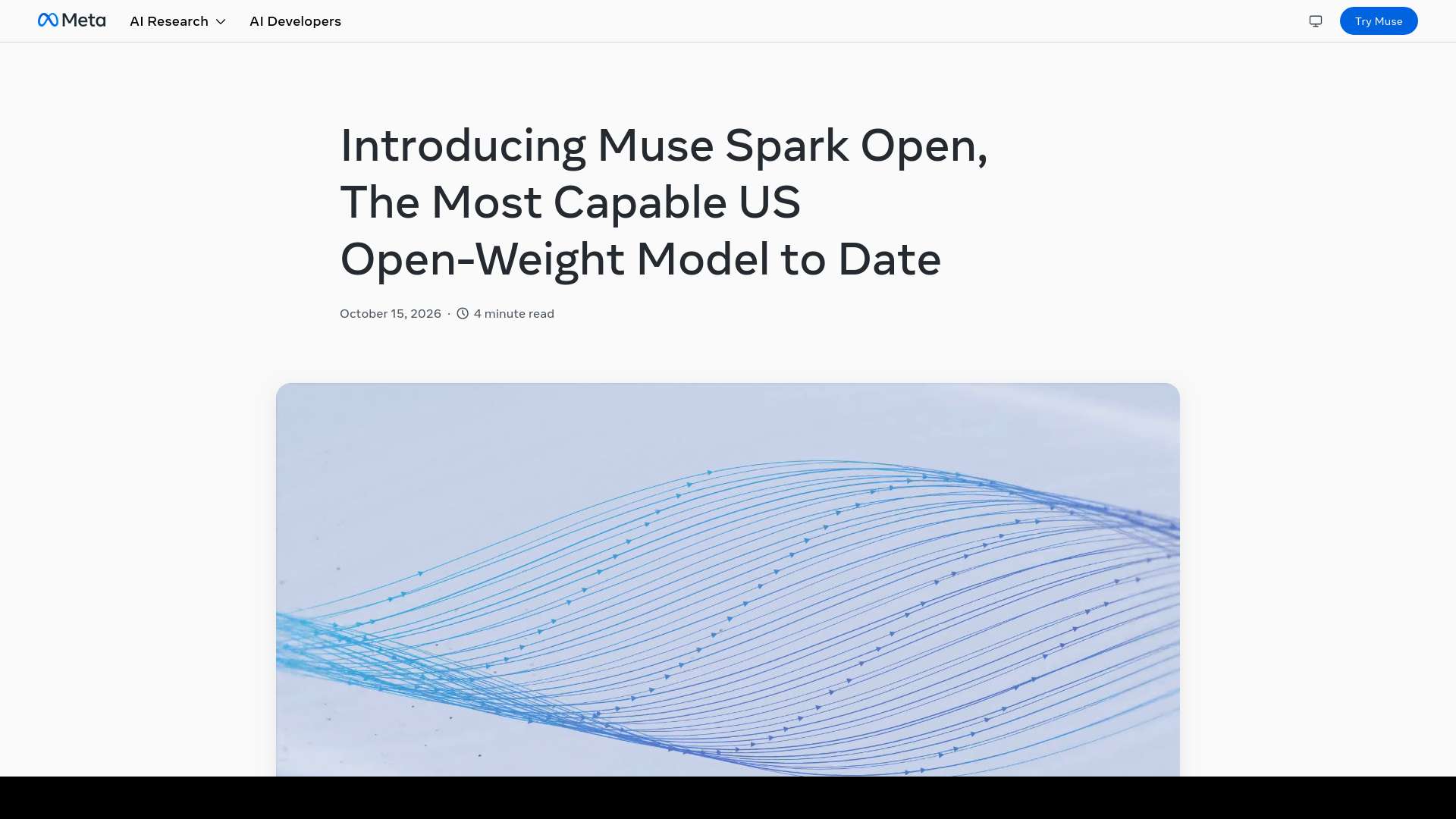
Courtesy: viewport screenshot of Meta's release announcement, captured through Trawl. The source page and its content belong to Meta.
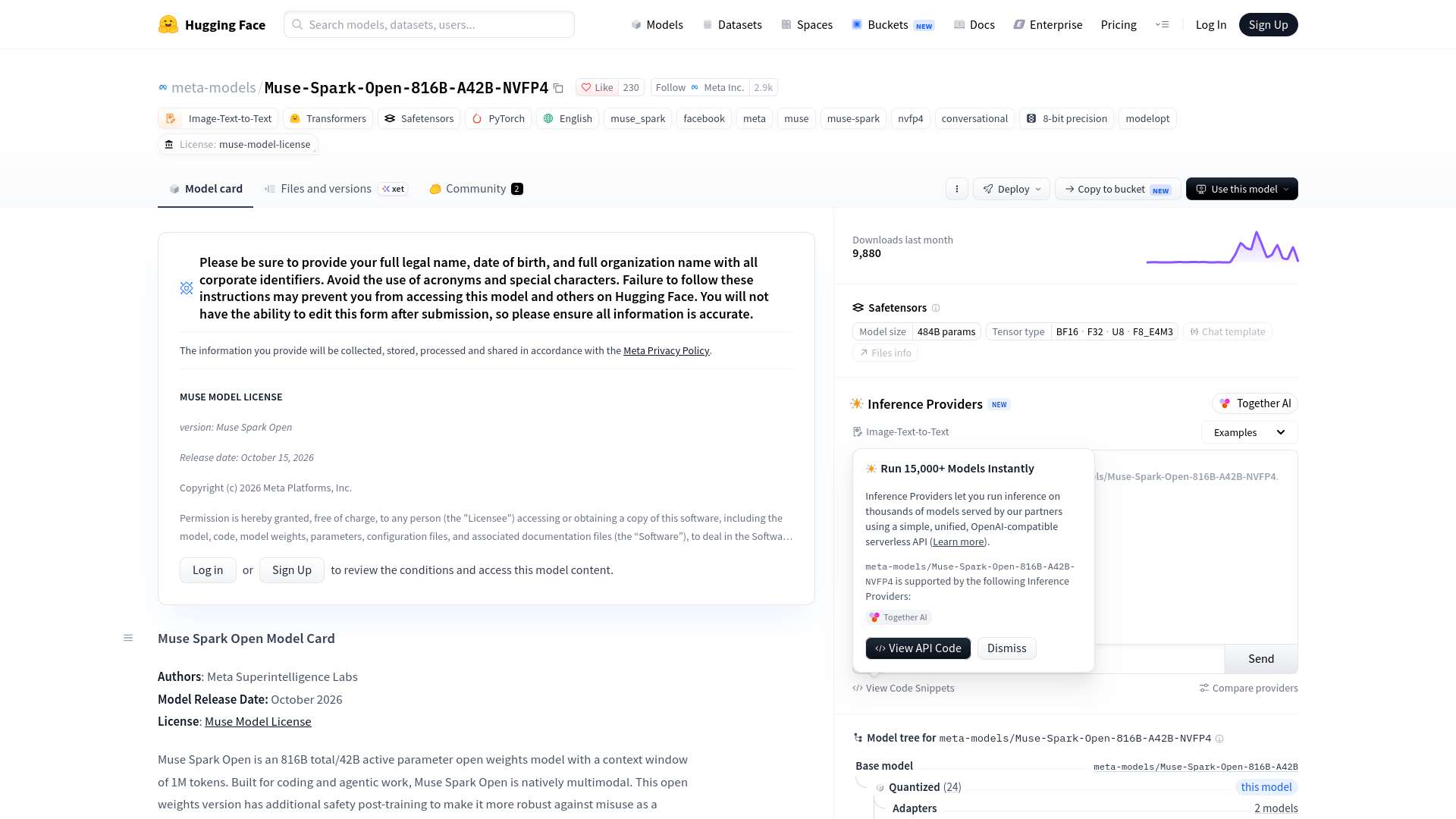
Courtesy: viewport screenshot of the official Hugging Face model card, captured through Trawl. The source page and its content belong to Meta and Hugging Face.
Sources and image references
Keep reading
Related reading
⚡ AI Engineering Briefing
AI model releases, practical tutorials, developer tools, and engineering research. Unsubscribe anytime.
Comments
Comments are temporarily unavailable while the public discussion space is being configured.