NVIDIA Jetson Foundation Models: Edge AI Robotics Guide
>Deploy LLMs, VLMs, and foundation models on NVIDIA Jetson edge hardware. Explore architecture, memory constraints, robotics workflows, and runtime tradeoffs.
🎧 Listen — ~10 min
Audio summary not available yet
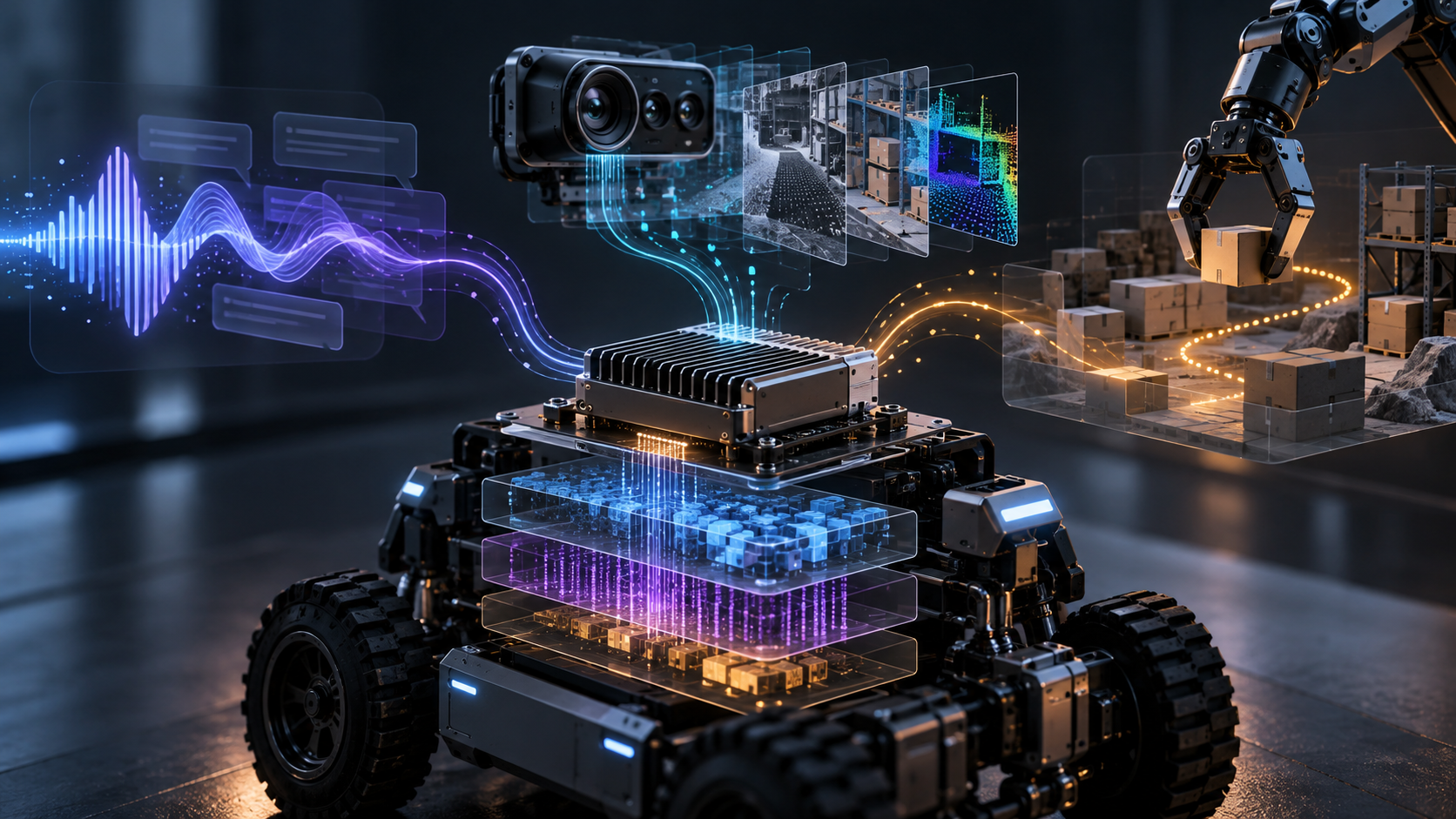
Deploying generative AI on embedded hardware has transitioned from experimental research into industrial reality. Robotics platforms, automated guided vehicles (AGVs), and smart inspection systems increasingly require low-latency visual reasoning and semantic planning without offloading video frames to remote cloud clusters. NVIDIA's Jetson ecosystem—anchored by Jetson Orin and next-generation architectures such as Jetson AGX Thor—provides the primary hardware and runtime layer for running Vision-Language Models (VLMs) and compact Large Language Models (LLMs) locally at low power.
This architectural guide breaks down how developers can evaluate, quantize, and execute foundation models directly on Jetson platforms, covering memory architectures, software runtimes, practical deployment steps, and hardware boundaries.
Key takeaways
- Unified memory constraints: Jetson system-on-chips (SoCs) share physical LPDDR5/LPDDR5X memory between CPU and GPU, making memory bandwidth and total capacity the primary bottlenecks for multimodal models.
- VLM pipeline efficiency: Deploying vision foundation models on-device requires separating heavy visual encoders from autoregressive text decoders, applying FP8 or INT4 quantization to fit strict thermal budgets (typically 15W to 75W).
- Robotics control loops: Foundation models on Jetson are suited for high-level semantic task decomposition (1–5 Hz) rather than low-level motor actuation (50–500 Hz), requiring a hybrid architecture alongside deterministic real-time controllers.
- Runtime acceleration: Native execution relies on JetPack, TensorRT-LLM, and optimized ONNX/TRT runtimes rather than standard desktop Python stacks to avoid out-of-memory (OOM) kernel panics.
1----------------------------------------------------------------+
2|                   Edge Application Layer                          |
3|         (ROS 2 Nodes, Spatial Navigation, Robotic Grippers)       |
4+---------------------------------+---------------------------------+
5                                  |
6+---------------------------------v---------------------------------+
7|                   High-Level Orchestration                        |
8|        Semantic Task Planning (Compact LLM / VLM @ 1-5 Hz)        |
9+---------------------------------+---------------------------------+
10                                  |
11+---------------------------------v---------------------------------+
12|                 Inference & Acceleration Engine                   |
13|       TensorRT / TensorRT-LLM / Jetson Platform Services (JPS)     |
14+---------------------------------+---------------------------------+
15|   CUDA Toolkit  |   cuDNN   |   Unified Memory Management (UMA)   |
16+---------------------------------+---------------------------------+
17|             Jetson Linux Kernel (L4T) / JetPack BSP               |
18+-------------------------------------------------------------------+
19|      Hardware: Jetson Orin Nano / Orin NX / AGX Orin / AGX Thor   |
20+-------------------------------------------------------------------+
Who is this platform for?
- Robotics engineers: Building autonomous mobile robots (AMRs) that require open-vocabulary object recognition, zero-shot spatial understanding, and high-level goal planning.
- Industrial automation teams: Running automated optical inspection (AOI) on manufacturing floors where network drops cannot disrupt line throughput.
- Embedded edge developers: Moving inference pipelines from cloud APIs to sovereign, on-premise hardware governed by deterministic latency.
For developers seeking lightweight browser or consumer client execution instead of embedded robotics boards, explore our analysis of Microsoft Edge built-in AI APIs and on-device prompt APIs.
2. Hardware architecture: The unified memory challenge
The critical architectural difference between server-grade AI inference and embedded edge inference is memory topology. On a standard server, an accelerator possesses dedicated high-bandwidth memory (HBM3e or GDDR6/7), communicating over PCIe buses with system RAM. On NVIDIA Jetson modules, the CPU and GPU share a single Unified Memory Architecture (UMA).
While UMA eliminates redundant host-to-device memory copies over PCIe, it introduces a severe constraint: the operating system, ROS 2 messaging stack, camera frame buffers, and neural network weights all compete for the same physical memory pool and memory bus bandwidth.
Hardware tier comparison
| Specification / Tier | Jetson Orin Nano (8GB) | Jetson Orin NX (16GB) | Jetson AGX Orin (64GB) | Jetson AGX Thor (Next-Gen) |
|---|---|---|---|---|
| GPU Architecture | Ampere (1024 CUDA cores) | Ampere (1024 CUDA cores) | Ampere (2048 CUDA cores) | Blackwell Architecture |
| Max AI Compute | Up to 40 INT8 TOPS | Up to 100 INT8 TOPS | Up to 275 INT8 TOPS | >1000 FP4/INT8 TOPS |
| Shared Memory | 8 GB LPDDR5 | 16 GB LPDDR5 | 64 GB LPDDR5 | Up to 128 GB LPDDR5X |
| Memory Bandwidth | 68 GB/s | 102.4 GB/s | 204.8 GB/s | >500 GB/s |
| Configurable TDP | 7W – 15W | 10W – 25W | 15W – 60W | 30W – 75W+ |
| Recommended Models | MobileNet, YOLOv11, NanoVLM | Gemma-2-2B, SmolVLM, Phi-4-mini | Llama-3.1-8B, Florence-2, PaliGemma | Llama-3.3-70B (FP4), Large VLMs |
Developers sizing models against available memory pools should reference our Open-weight LLM licensing and VRAM sizing guide and calculate requirements using the local AI model fit calculator.
3. Supported foundation model architectures
Running foundation models on Jetson requires choosing architectures whose visual backbones and context decoders can be executed within embedded thermal envelopes:
Small Language Models (SLMs)
Compact instruction-tuned models ranging between 1 billion and 4 billion parameters—such as Microsoft's Phi-3.5/Phi-4-mini, Google's Gemma-2-2B, or SmolLM—fit within the 8 GB to 16 GB memory bounds of Jetson Orin Nano and NX. When quantized with AWQ (Activation-aware Weight Quantization) or INT4 weight-only formats, these models operate at 15 to 35 tokens per second.
Vision-Language Models (VLMs)
VLMs combine a visual encoder (such as SigLIP, CLIP, or an efficient ViT) with an autoregressive language model. Leading models for Jetson edge robotics include:
- PaliGemma / PaliGemma 2: Highly effective for bounding-box detection, spatial labeling, and visual question answering (VQA).
- Florence-2: Excellent for zero-shot object detection and dense captioning due to unified sequence-to-sequence representations.
- SmolVLM: Designed specifically for resource-constrained edge systems, pairing lightweight vision encoders with small language backbones.
Embodied AI and Action Models
For robotic manipulation and trajectory prediction, architectures like OpenVLA or RT-2-style models translate visual and text instructions directly into end-effector Cartesian delta actions. While high-parameter action models require AGX Orin or AGX Thor modules, smaller distilled policy networks run alongside Jetson's real-time ROS 2 communication nodes.
4. Step-by-step: Setting up an edge VLM pipeline on Jetson
Executing foundation models natively on JetPack requires bypassing bloated desktop dependencies and relying on TensorRT-optimized execution graphs.
Step 1: Base system preparation
Flash the Jetson module with the latest JetPack release (JetPack 6.x or newer based on Ubuntu 22.04 LTS). Ensure Docker has access to the NVIDIA container runtime:
1sudo systemctl restart docker
2docker run --rm --runtime nvidia --gpus all nvcr.io/nvidia/cuda:12.6.0-base-ubuntu22.04 nvidia-smi
Step 2: Set memory swap and power profile
Because unified memory can run out quickly during initial model compilation, establish an NVMe-backed swap file and switch the SoC into maximum performance mode:
1sudo nvpmodel -m 0
2sudo jetson_clocks
3sudo fallocate -l 16G /mnt/nvme/swapfile
4sudo chmod 600 /mnt/nvme/swapfile
5sudo mkswap /mnt/nvme/swapfile
6sudo swapon /mnt/nvme/swapfile
Step 3: Launch containerized inference with Jetson Generative AI Lab
NVIDIA provides tuned Docker containers through dustynv's Jetson containers and NVIDIA Jetson Platform Services (JPS). Run an accelerated VLM container:
1jetson-containers run $(autotag vlm) \
2  python3 -m vlm.inference \
3    --model google/paligamma-3b-pt-224 \
4    --quantization q4f16_ft \
5    --image /data/camera_feed_sample.jpg \
6    --prompt "detect all defective solder joints in the frame"
Step 4: Python ROS 2 integration node
In an edge robotics pipeline, inference outputs must feed back into standard robotic communication buses. Here is an optimized Python node using PyCUDA and zero-copy shared buffers:
1import rclpy
2from rclpy.node import Node
3from sensor_msgs.msg import Image
4from std_msgs.msg import String
5import numpy as np
6
7class EdgeVisualTaskPlanner(Node):
8    def __init__(self):
9        super().__init__('edge_vlm_task_planner')
10        self.subscription = self.create_subscription(
11            Image,
12            '/robot/overhead_camera/image_raw',
13            self.image_callback,
14            10
15        )
16        self.publisher_ = self.create_publisher(String, '/robot/planner/intent', 10)
17        self.get_logger().info("Edge VLM Task Planner Initialized on Jetson")
18
19    def image_callback(self, msg: Image):
20        frame = np.frombuffer(msg.data, dtype=np.uint8).reshape((msg.height, msg.width, -1))
21        semantic_command = self.run_tensorrt_vlm(frame, "identify obstacles blocking the AMR path")
22
23        out_msg = String()
24        out_msg.data = semantic_command
25        self.publisher_.publish(out_msg)
26
27    def run_tensorrt_vlm(self, image_tensor: np.ndarray, query: str) -> str:
28        return "CLEAR_PATH_PROCEED"
29
30def main(args=None):
31    rclpy.init(args=args)
32    node = EdgeVisualTaskPlanner()
33    try:
34        rclpy.spin(node)
35    except KeyboardInterrupt:
36        pass
37    finally:
38        node.destroy_node()
39        rclpy.shutdown()
40
41if __name__ == '__main__':
42    main()
5. Architectural limits and failure modes
While Jetson modules allow running foundation models locally, embedded developers must avoid common architectural missteps:
- Treating foundation models as real-time motor controllers: A 3B parameter model quantized to INT4 typically achieves 200–500 ms latency per frame on a Jetson Orin NX. Attempting to run direct joint torque control or millisecond-level collision avoidance through a VLM will crash hardware or fail safety tolerances. Control architectures must decouple the VLM task planner from low-level PID/trajectory controllers.
- Thermal throttling during continuous inference: Sustained GPU and DLA utilization at maximum TDP (e.g., 60W on AGX Orin) will trigger thermal throttling if passive or low-profile heatsinks are used. Production enclosures must factor active forced-air cooling or conduction plate mounting.
- KV-cache memory exhaustion: Long context windows consume significant RAM. In a 16 GB Jetson Orin NX running a 3B model, expanding context past 4,096 tokens can consume several gigabytes purely for the KV-cache, triggering the Linux Out-Of-Memory (OOM) killer on core robot processes. Setting strict bounds on
--max-context-lenis mandatory.
For teams building autonomous operational agents around these hardware layers, review our guidance on Building IDPs for AI agents: Tools, data, and sandboxing.
6. Jetson alternatives for edge AI
Developers evaluating hardware for on-device AI have several architectural alternatives:
- Toradex Industrial Gateways (Torizon OS): Best for ruggedized industrial IoT scenarios that require containerized NPU workloads rather than raw CUDA acceleration. Compare details in our Toradex Zinnia Gateway review.
- Google Coral and Raspberry Pi 5 AI Kit: Ideal for extreme low-power budgets (<5W) and classical vision models (MobileNet, YOLO), but incapable of running multi-billion-parameter foundation models.
- Embedded x86 + Discrete Laptop GPUs: Pairing an Intel Core Ultra / AMD Ryzen SoC with an embedded RTX 4060/5000 GPU provides superior raw memory bandwidth and easier software packaging, but at the expense of 100W–180W power consumption and significantly larger physical dimensions.
7. Verdict and engineering recommendation
NVIDIA Jetson remains the undisputed performance leader for running multi-modal foundation models on physical robotic hardware. With the advent of JetPack 6 and TensorRT-LLM support for small vision backbones, deploying PaliGemma, SmolVLM, and compact SLMs on 16 GB to 64 GB edge hardware is thoroughly viable in production.
Our recommendation:
- For lightweight smart inspection, use Jetson Orin NX (16GB) running quantized 2B–3B models under FP8 or INT4 precision.
- For autonomous robotics with multi-camera inputs and SLAM, deploy Jetson AGX Orin (64GB) or prepare migration paths for Jetson AGX Thor.
- Keep foundation models strictly in the semantic supervision tier (1–5 Hz), routing low-latency sensor-actuator loops through deterministic microcontrollers or dedicated ROS 2 real-time executors.
Source website screenshots
Frequently asked questions
Can an 8 GB Jetson Orin Nano run modern Vision-Language Models?
Yes, but strictly under aggressive quantization. Models such as SmolVLM or PaliGemma-3B quantized to INT4 or INT8 can fit within 8 GB of shared memory, leaving roughly 2 GB to 3 GB for the operating system and video frame buffers. However, context window lengths must be strictly capped.
What is the difference between Jetson Orin and Jetson Thor?
Jetson Orin is built on NVIDIA's Ampere architecture and supports INT8 and FP16 compute up to 275 TOPS. Jetson AGX Thor transitions to the Blackwell GPU architecture, introducing native FP4 precision, generative AI transformer engines, and compute exceeding 1,000 TOPS, specifically engineered for humanoid and autonomous robotics.
Does Jetson support standard Hugging Face Transformers code directly?
While you can run Hugging Face Transformers natively in Python on Jetson, doing so leads to high latency and heavy memory overhead. Production deployments compile models using TensorRT, TensorRT-LLM, or ONNX Runtime with CUDA/TensorRT execution providers to achieve real-time frame rates.
How do I prevent Jetson from freezing when memory fills up?
Always configure an NVMe-backed swap partition (do not use slow MicroSD cards for swap). Additionally, set memory limits on inference Docker containers (--memory="12g") to ensure that critical operating system processes and ROS communication nodes are never killed by the kernel during OOM events.
Sources and image references
- NVIDIA Developer Blog: Getting Started with Edge AI on NVIDIA Jetson: LLMs, VLMs, and Foundation Models for Robotics
- NVIDIA Jetson Platform Services & Documentation: NVIDIA JetPack SDK and Jetson Hardware
- Toradex Embedded Linux Edge Guide: Toradex Zinnia Gateway Review
- Local Model Fit & Sizing: AI Model Directory and Local Model Fit Calculator
Keep reading
Related reading
⚡ AI Engineering Briefing
AI model releases, practical tutorials, developer tools, and engineering research. Unsubscribe anytime.
Comments
Comments are temporarily unavailable while the public discussion space is being configured.