Open-Source AI Tooling Briefing: Late September 2026
>A technical briefing on late September 2026 open-source AI releases, covering Ollama, vLLM, ComfyUI, MCP agent servers, OpenCode, and world foundation models.
🎧 Listen — ~9 min
Audio summary not available yet
Open-source artificial intelligence tooling is consolidating around standardized inference runners, modular pipelines, and uniform agent protocols. This briefing covers the reporting window from September 21, 2026, through September 29, 2026, tracking high-velocity releases across runtime engines, generative workflow graphs, and open agent harnesses.
Following our mid-September 2026 developer briefing, the late-September tooling cycle shows a distinct shift: developers are spending less time evaluating raw model parameter counts and more time hardening the infrastructure that connects local models to execution environments. Runtimes such as Ollama, llama.cpp, and vLLM continue to dominate deployment velocity, while the Model Context Protocol (MCP) ecosystem has expanded from experimental extensions into standardized tooling directories.
1. Local LLM runtimes: Ollama and llama.cpp context stability
What happened
Release trackers logged consistent updates across workstation inference runners through late September 2026, led by Ollama and llama.cpp. These maintenance updates targeted memory efficiency under large context windows (32k+ tokens), smoother quantized tensor loading across mixed-VRAM systems, and more predictable tool-call formatting in quantized GGUF models.
Primary source
- Community release logs indexed via olud.ai Releases.
- Project commit logs across the upstream llama.cpp and Ollama GitHub repositories.
Why it matters to builders
Workstation inference is no longer limited to short-prompt chat evaluations. Software engineers integrating models directly into IDE harnesses—such as a VS Code and Continue local LLM setup—require deterministic context management. When local runners drop tokens, leak VRAM during multi-turn chats, or improperly serialize function calls, downstream agents fail. The late-September patches reduce memory thrashing when switching between standard generation and structured JSON output.
What to watch next
Look for automated dynamic KV cache quantization (e.g., FP8 and INT4 cache paging) to become standard across desktop consumer GPUs, reducing the performance penalty of running multi-turn agent loops locally.
2. Production inference engines: vLLM batching and kernel optimizations
What happened
High-throughput inference frameworks, notably vLLM, recorded updates focused on continuous batching efficiency, speculative decoding stability, and expanded support for emerging model architectures. Production teams running internal clusters saw refined PagedAttention kernels that decrease latency for concurrent requests.
Primary source
- Tracked production engine updates on olud.ai Releases.
- Upstream vLLM open-source project releases and changelogs.
Why it matters to builders
While Ollama and llama.cpp handle developer workstations, vLLM remains the cornerstone of self-hosted enterprise inference. When assessing production LLM serving environments, execution throughput per dollar depends entirely on GPU utilization under concurrent load. The improvements shipping in late September optimize KV cache allocation when multiple client applications hit the same serving instance simultaneously.
1python3 -m vllm.entrypoints.openai.api_server \
2    --model mistralai/Mistral-7B-Instruct-v0.3 \
3    --speculative-model mistralai/Mistral-7B-Instruct-v0.3-quantized \
4    --num-speculative-tokens 4 \
5    --tensor-parallel-size 1 \
6    --gpu-memory-utilization 0.90 \
7    --max-model-len 32768 \
8    --port 8000
What to watch next
Watch for native integration of multi-tier KV caching (spilling inactive prefix caches to host RAM) to become stable in production builds, lowering the hardware cost for high-concurrency API gateways.
3. Visual and generative media: ComfyUI node ecosystem expansion
What happened
ComfyUI's core and custom node ecosystems registered significant star velocity and release activity during the week of September 28, 2026, according to findarepo's tooling analysis. Updates emphasize headless execution, state serialization, and decoupled pipeline scheduling for complex multi-stage image and video synthesis.
Primary source
- Release feed tracking on olud.ai Releases.
- GitHub repository velocity indexes on findarepo.com.
Why it matters to builders
ComfyUI has transitioned from an enthusiast interface into an enterprise-grade execution graph. Instead of running generation tasks through fragile web UI sessions, engineering teams are compiling ComfyUI workflows into serialized JSON files and invoking them through automated microservices. This allows developers to combine diffusion checkpoints, control adapters, and upscalers into programmatic CI/CD asset pipelines.
What to watch next
The emergence of strictly typed, version-controlled node registries that prevent breaking changes when deploying headless ComfyUI runners inside containerized production environments.
4. Agent interoperability: Model Context Protocol (MCP) directory velocity
What happened
Repository tracking from findarepo.com reveals that integrations centered on Anthropic’s Model Context Protocol (MCP) represent the fastest-growing category of developer tooling in late September 2026. The proliferation of standalone MCP server repositories has spurred community-maintained MCP directories and skill registries.
1{
2  "mcpServers": {
3    "filesystem-sandbox": {
4      "command": "npx",
5      "args": ["-y", "@modelcontextprotocol/server-filesystem", "/workspace/sandboxed_app"]
6    },
7    "postgres-read-replica": {
8      "command": "docker",
9      "args": ["run", "-i", "--rm", "mcp/postgres-server", "postgresql://readonly:[email protected]:5432/analytics"]
10    }
11  }
12}
Primary source
- MCP server and Claude skills tracking via findarepo.com.
- Cross-platform agent ecosystem documentation.
Why it matters to builders
Before MCP gained critical mass, connecting an LLM to a local SQL database, a file directory, or a Git repository required bespoke function-calling schemas for each client application. MCP standardizes client-server protocol negotiation for context injection. Because developers can implement an MCP server once and expose it interchangeably to Cursor, Continue, or custom autonomous agents, infrastructure friction has dropped significantly. This directly accelerates real-world agent workflow routing patterns.
What to watch next
The introduction of strict authentication, authorization scopes, and credential masking specifications within MCP servers to prevent prompt injection attacks from exfiltrating sensitive internal resources.
5. Autonomous coding tools: OpenCode and sandbox execution adoption
What happened
Terminal-based autonomous coding utilities such as OpenCode gained substantial star velocity in late September, ranking prominently on findarepo's open-source rankings. Developers are gravitating toward transparent, CLI-native coding frameworks over monolithic closed-source desktop applications.
Primary source
- Star velocity tracking on findarepo.com.
- Comparative tooling evaluation from our mid-September developer briefing.
Why it matters to builders
Early autonomous agents suffered from fragile prompt design and dangerous, unrestricted bash execution. Modern CLI tools emphasize constrained environment loops: read AST, generate unified diff, run test runner, evaluate exit code, and iterate. By decoupling the reasoning engine from the execution sandbox, developers can safely run autonomous coding tools against complex repositories without risking uncommitted file state.
What to watch next
Standardized schema specifications for repository instructions (such as AGENTS.md) becoming a baseline requirement across all terminal-based agent harnesses.
6. Open frontier weights: Downstream adoption of MiniMax M3 and Cosmos 3
What happened
Following the release of specialized foundational models like MiniMax M3 (multilingual reasoning) and NVIDIA Cosmos 3 (world foundation models for physical AI), runtime tooling in late September focused on downstream integration. Quantizers, serving templates, and tokenizer bindings across the open-source community updated to support these non-standard architectures.
Primary source
- Model ecosystem release tracker at olud.ai Releases.
- Project trackers and tooling discussions documented in findarepo.com.
Why it matters to builders
Releasing model weights is only half the battle; developers cannot build production systems until runtime maintainers publish stable CUDA kernels, quantization configurations, and serving runtimes. The rapid absorption of MiniMax M3 and Cosmos 3 indicates that the ecosystem lag between foundation model drops and runnable serving setups has compressed from months to days. Teams building physical robotics simulators or deep-reasoning pipelines can now deploy these checkpoints inside standard orchestrators.
What to watch next
Community-contributed 4-bit and 8-bit quantized weights for Cosmos 3, allowing robotics researchers to run physical AI simulations on standard enterprise workstations rather than dedicated GPU clusters.
Technical comparison: Late September 2026 open-source AI tooling stack
The following table summarizes the primary open-source AI tools driving developer adoption at the end of September 2026, comparing their operational scope, target infrastructure, and key strengths:
| Tool / Framework | Ecosystem Category | Primary Target Environment | Primary Quantization / Architecture | Key Architectural Strength |
|---|---|---|---|---|
| Ollama | Local Serving Engine | Developer Workstation, Local Edge | GGUF (4-bit, 8-bit, FP16) | Zero-config local model management and OpenAI-compatible API layer. |
| vLLM | Production Serving Engine | High-Concurrency Cloud Clusters | AWQ, GPTQ, FP8, Unquantized | PagedAttention memory management, speculative decoding, high throughput. |
| ComfyUI | Generative Pipeline Graph | Workstation & Cloud GPU Workers | Diffusion Checkpoints, Safetensors | Modular node graph architecture enabling headless, automated execution. |
| Model Context Protocol (MCP) | Agent Integration Standard | Cross-Platform Local & Remote | JSON-RPC Protocol Specification | Universal standard for connecting LLM clients to external tools and databases. |
| OpenCode | CLI Autonomous Coding Agent | Terminal / Container Sandbox | Agnostic (Client-Server Architecture) | Transparent, diff-driven code refactoring with isolated test validation loops. |
| llama.cpp | Low-Level Inference Backend | CPU, Apple Silicon, CUDA, Edge | GGUF Quantization Engine | Highly optimized C/C++ inference engine powering edge and local runtimes. |
Editorial analysis and implementation advice
The tooling changes tracked between September 21 and September 29, 2026, reflect an engineering ecosystem reaching architectural maturity. For teams building on open-source AI, two actionable recommendations stand out:
- Standardize on MCP for Internal Tooling: If your engineering team is writing custom glue code to connect LLMs to internal documentation, staging databases, or ticket trackers, stop building proprietary tool adapters. Implementing internal integrations as modular MCP servers ensures that your tooling remains compatible across IDEs, terminal agents, and internal API gateways without continuous refactoring.
- Decouple Edge Prototyping from Production Runtimes: Maintain a clean boundary between workstation development and production serving. Use Ollama or llama.cpp for local iteration, unit testing, and developer feedback loops, but standardize on vLLM or specialized microservices for production serving where continuous batching and PagedAttention are necessary to keep cloud inference costs under control.
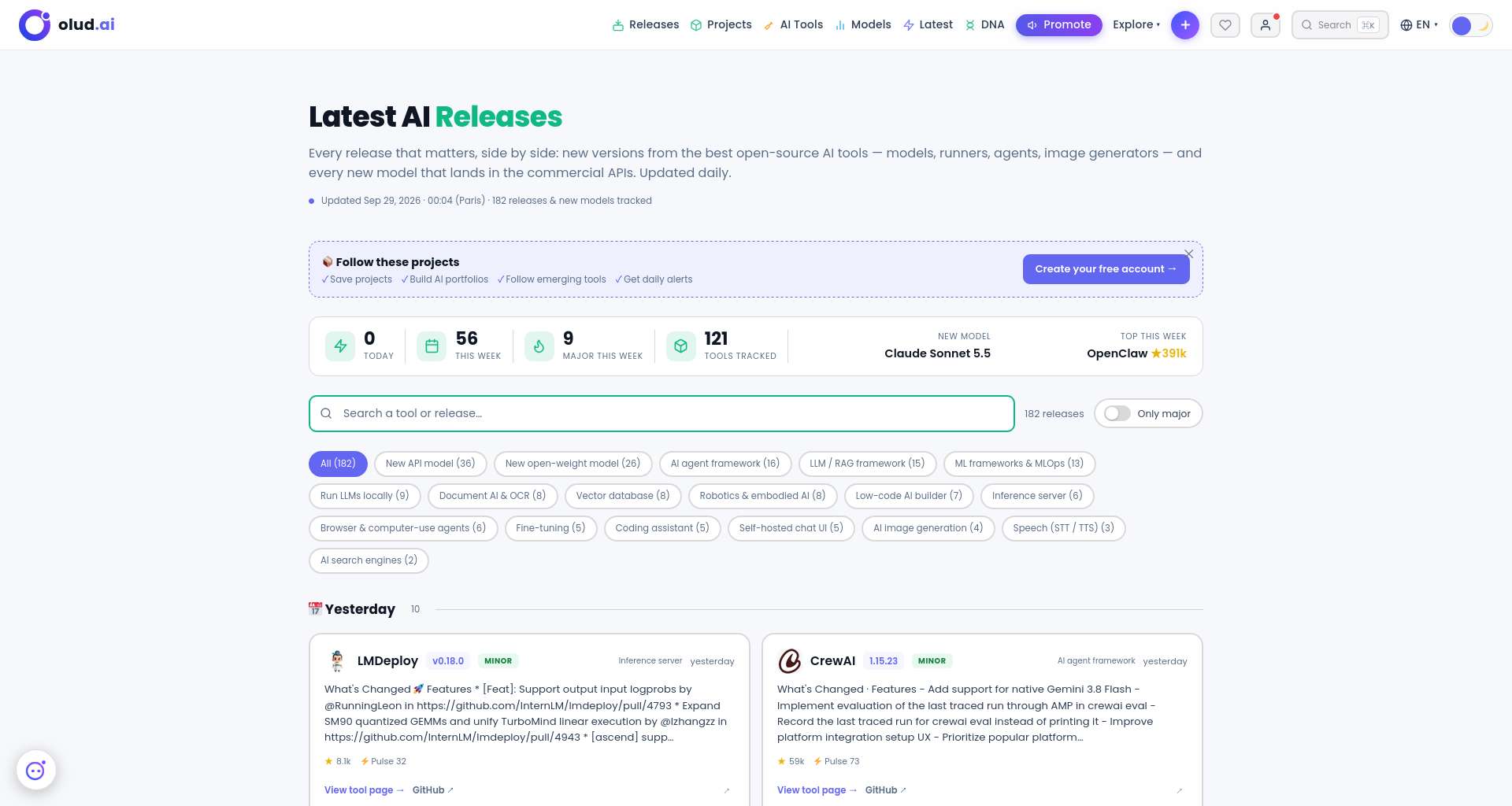
Source website screenshot
Frequently asked questions
What is driving the rapid adoption of the Model Context Protocol (MCP)?
MCP solves the integration fragmentation problem. Instead of every AI application (such as Cursor, Continue, or Claude Desktop) maintaining separate connectors for tools like GitHub, PostgreSQL, or local filesystems, MCP provides a uniform client-server protocol. Developers write an MCP server once, and any compatible client can immediately query and execute its capabilities.
Why should engineering teams run vLLM over Ollama in production?
While Ollama provides an exceptional developer experience for local machines, it is optimized for single-user workstation execution. In contrast, vLLM is architected specifically for high-concurrency production deployments. It uses PagedAttention to eliminate memory waste, supports continuous request batching, and provides advanced features like speculative decoding and tensor parallelism across multi-GPU nodes.
Can ComfyUI be deployed in headless production environments?
Yes. Although ComfyUI is widely known for its graphical web UI, workflows can be exported directly as serialized API prompt JSON files. These workflows can then be executed headlessly via HTTP or WebSocket endpoints running inside Docker containers, allowing teams to integrate complex diffusion pipelines into automated web services.
How do late-September runtime updates affect local long-context models?
Updates across Ollama and llama.cpp have addressed KV cache memory bloat when models ingest 32,000 tokens or more. By optimizing cache paging and supporting mixed-precision context storage, local inference engines prevent GPU out-of-memory (OOM) crashes during lengthy multi-turn agent interactions.
Sources and image references
- olud.ai Releases: Release tracking for open-source AI tools, runtimes, and commercial APIs, updated daily (September 29, 2026) — https://olud.ai/releases.html
- findarepo Open-Source AI Rankings: Daily star velocity and repository tracking across AI agents, LLM toolkits, and MCP server directories (September 28, 2026) — https://findarepo.com/best-open-source-ai-tools/
- Essa Mamdani Technical Briefing: Open-Source AI Developer Briefing: September 2026 Update — https://essamamdani.com/blog/open-source-ai-developer-briefing-september-2026
Keep reading
Related reading
⚡ AI Engineering Briefing
AI model releases, practical tutorials, developer tools, and engineering research. Unsubscribe anytime.
Comments
Comments are temporarily unavailable while the public discussion space is being configured.