Open-Source AI Tools in October 2026: vLLM, Ollama & llama.cpp
>An October 2026 guide to vLLM, llama.cpp, Ollama, ComfyUI, embedded RAG, and agent observability—trade-offs, use cases, and deployment choices.
🎧 Listen — ~8 min
Audio summary not available yet
The open-source artificial intelligence ecosystem in early October 2026 is consolidating around modularity, memory efficiency, and deterministic agent orchestration. As tracking indices like olud.ai record over 180 continuous model and engine updates and developer catalogs like OpenSourcesAI catalog shifts in production tooling, teams are standardizing how local runtimes, inference engines, and vector components interlock.
Following our late September open-source tooling briefing, this report examines the core releases, architectural shifts, and practical trade-offs defining the self-hosted AI software stack as of October 7, 2026.
Key takeaways
- Disaggregated runtime parity: Inference frameworks like vLLM and modular runtimes like llama.cpp have expanded memory management strategies, bridging the gap between consumer workstations and multi-node clusters.
- Agent-ready serving interfaces: Runtimes such as Ollama increasingly prioritize schema-enforced structured outputs and native tool-calling endpoints over raw chat interfaces.
- Decoupled generative media: ComfyUI continues to evolve from an interactive node canvas into a headless, scriptable microservice backend for production multimodal pipelines.
- Embedded-first retrieval: Vector stores and RAG toolchains are moving toward embedded, columnar engines (like LanceDB and embedded Chroma) that eliminate multi-process networking overhead in local workflows.
- Standardized runtime telemetry: OpenTelemetry conventions for local generative AI pipelines have matured from experimental prototypes to standard middleware.
1. Quantized Edge Runners: llama.cpp Multi-Backend Maturation
What happened
The llama.cpp repository remains the foundation for local, consumer-hardware inference. Early October release activity tracked by OpenSourcesAI and olud.ai underscores improved support for modern GGUF quantization formats (specifically fine-grained k-quants and importance-matrix quantizations) along with wider backend acceleration across Vulkan, Apple Metal, and SYCL targets.
Primary source context
Documented in open developer updates tracked across olud.ai and open-source system benchmarking boards.
Why it matters to builders
While enterprise clusters lean on vLLM or TensorRT-LLM, workstation-level development and embedded edge devices depend on llama.cpp’s minimal binary footprint and direct mmap memory mapping. The updated quantization paths minimize perplexity degradation on 7B to 30B class models down to 3-bit and 4-bit footprints.
Engineers evaluating memory footprints can reference our guide on building local AI agents and VRAM budgets to align quantization levels with local physical constraints.
What to watch next
The critical area to monitor is dynamic context shifting and memory-mapped paging that allows context windows to scale past 64k tokens on unified memory hardware without triggering full cache re-computation.
2. Local Developer Runtimes: Ollama Schema Enforcement and Tooling
What happened
Ollama has steadily evolved from a simplified local binary wrapper into a developer-facing daemon optimized for agentic workloads. Recent release increments documented across OpenSourcesAI emphasize stricter grammar-constrained decoding (forcing outputs to match arbitrary JSON schemas) and seamless multi-model lifecycle management on desktop environments.
Primary source context
Release streams tracked through OpenSourcesAI developer guides and olud.ai.
Why it matters to builders
Building autonomous agents that run entirely offline requires high-reliability tool dispatching. Earlier versions of local models frequently hallucinated JSON syntax or broke structural validation during schema generation. By enforcing context-free grammar constraints directly in the runner, Ollama ensures that agent loops receive validated payloads without requiring external post-processing retry logic.
Developers wiring local models into IDE environments can consult our setup tutorial on architecting Continue with local LLMs in VS Code to configure deterministic tool loops.
1import json
2import urllib.request
3
4payload = {
5    "model": "qwen2.5-coder:7b",
6    "prompt": "Extract user parameters: Jane Doe, age 29, system administrator",
7    "format": {
8        "type": "object",
9        "properties": {
10            "name": {"type": "string"},
11            "age": {"type": "integer"},
12            "role": {"type": "string"}
13        },
14        "required": ["name", "age", "role"]
15    },
16    "stream": False
17}
18
19req = urllib.request.Request(
20    "http://127.0.0.1:11434/api/generate",
21    data=json.dumps(payload).encode("utf-8"),
22    headers={"Content-Type": "application/json"}
23)
24
25with urllib.request.urlopen(req) as response:
26    result = json.loads(response.read().decode("utf-8"))
27    print(result["response"])
What to watch next
Expect deeper integration with the Model Context Protocol (MCP) standard, enabling Ollama instances to automatically declare and execute system-level tool definitions without manual client glue code.
3. Multimodal Pipeline Automation: ComfyUI Headless Workflows
What happened
ComfyUI's release cadence, monitored in the olud.ai directory, demonstrates a shift from a visual node graph canvas intended solely for creative experimentation into a robust microservice framework. Key structural changes include improved headless execution modes, isolated virtual environment execution for custom nodes, and streamlined model loading for large diffusion transformer architectures.
Primary source context
Tracked via olud.ai under open-source image and generative workflow releases.
Why it matters to builders
Early implementations of ComfyUI inside enterprise pipelines often struggled with dependency drift caused by unmanaged third-party node extensions polluting the global runtime environment. The introduction of standardized execution manifests and decoupled API endpoints allows software engineers to treat ComfyUI workflows as declarative, version-controlled build artifacts that run within automated CI/CD graphics pipelines.
What to watch next
Look for official REST/gRPC client generation libraries that translate ComfyUI node graphs directly into strongly typed SDK calls for automated service stacks.
4. Local Retrieval Architectures: Embedded Vector Engines
What happened
Developer documentation and tooling directories on OpenSourcesAI highlight an accelerating preference for embedded, file-based vector stores such as LanceDB and embedded Chroma over external client-server database clusters for single-node retrieval pipelines.
Primary source context
Tooling comparisons and RAG infrastructure categories documented on OpenSourcesAI.
Why it matters to builders
For local RAG agents, running a dedicated vector database daemon introduces unnecessary operational overhead, connection latency, and memory footprints. Columnar, disk-backed embedded vector stores leverage modern vector indexing formats (like IVF-PQ) that stream directly from NVMe drives, keeping resident memory usage minimal while delivering sub-millisecond retrieval times for local document sets.
What to watch next
Watch for tighter hybridization between dense vector retrieval and localized BM25 or semantic graph indexes, executed entirely within local Rust or C++ application runtimes.
5. Open-Source GenAI Observability: Standardized Agent Instrumentation
What happened
Observability frameworks in the open-source AI ecosystem are standardizing around OpenTelemetry-compatible semantic conventions. As tracked in OpenSourcesAI, tools designed to log model input tokens, generation latency, tool invocation arguments, and intermediate agent reasoning traces are moving away from proprietary SDKs toward vendor-neutral OpenTelemetry exporters.
Primary source context
Open-source developer guides and observability category tracking on OpenSourcesAI.
Why it matters to builders
Without standardized tracing, tracking tool failures, latency spikes, or infinite ReAct loops across complex agent chains requires custom log parsing. By utilizing unified spans, developers can inspect agent behavior across local and remote providers through any OpenTelemetry collector. For a deep implementation review, see our guide on OpenTelemetry GenAI agent observability.
What to watch next
Watch for native telemetry middleware embedded directly into local engines like vLLM and llama.cpp, outputting standardized trace spans at the C++ runtime level without requiring wrapper interception.
Explore the rest of the stack: Compare model options in our AI model directory, then find compatible IDE, CLI, and desktop assistants in the coding-agent directory.
Core Tooling Comparison
The following table evaluates how primary open-source AI runtime and infrastructure components compare in production deployments as of October 2026:
| Tool / Engine | Primary Domain | Memory Profile | Optimal Deployment Target | Current Ecosystem Role |
|---|---|---|---|---|
| vLLM | High-concurrency LLM serving | High (Pre-allocated KV cache) | Cloud GPU instances, multi-accelerator nodes | Standard engine for enterprise batching & multi-user serving |
| llama.cpp | Quantized CPU/GPU inference | Highly adaptable (mmap, low baseline) | Workstations, MacBooks, edge IoT devices | Standard engine for cross-platform portability & edge builds |
| Ollama | Developer CLI & application daemon | Low to Moderate (GGUF runner abstraction) | Local workstations, development environments | Standard interface for one-command local model orchestration |
| ComfyUI | Multimodal & diffusion generation | Moderate to High (VRAM-bound pipelines) | Workstations, dedicated media rendering workers | Standard graph architecture for modular generative image pipelines |
| LanceDB / Chroma | Embedded vector retrieval & RAG | Low to Moderate (Disk-backed columnar) | Local agent environments, embedded desktop apps | Standard engine for self-contained, low-overhead RAG workflows |
Engineering Verdict
The October 2026 tooling updates indicate that the open-source AI stack has moved past the phase of uncoordinated experimentation. Runtimes, runners, and storage layers are settling into specialized roles:
- Use vLLM if your deployment requirements involve serving multiple concurrent client requests over network sockets where batched prefill and dynamic PagedAttention maximize hardware utilization.
- Use llama.cpp if your constraints require zero external dependencies, ultra-low resource baselines, or support for heterogeneous compute hardware (such as Apple Silicon or CPU-only servers).
- Use Ollama when your primary need is ergonomic developer workflow integration, quick local testing, or structured agent tooling with minimal setup ceremony.
- Adopt embedded vector stores and OpenTelemetry instrumentation early to prevent architectural refactoring as your autonomous workflows scale in context size and operational complexity.
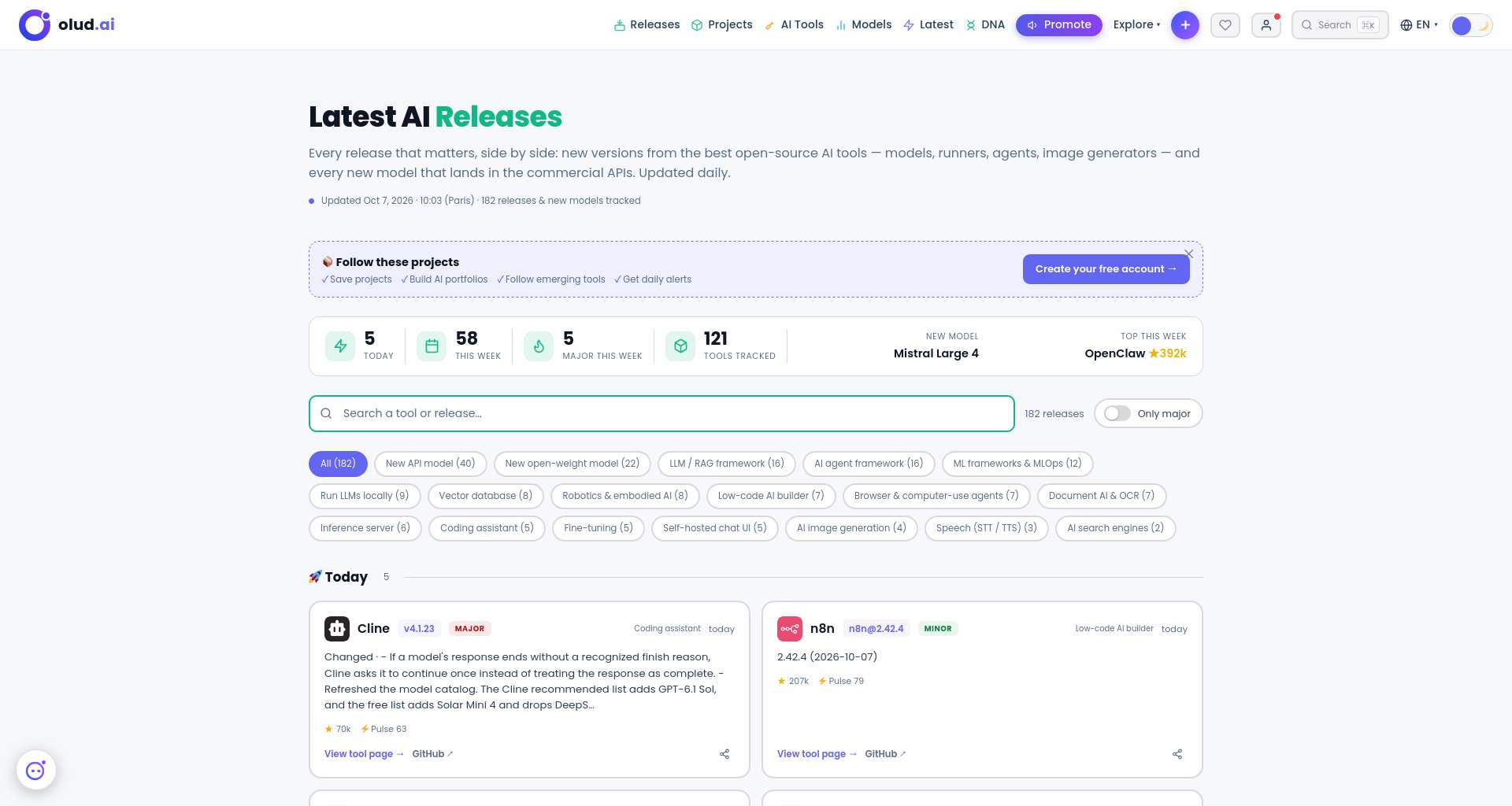
Source website screenshot
Frequently asked questions
What distinguishes Ollama from running llama.cpp directly?
llama.cpp is a low-level C/C++ inference engine providing minimal runtime overhead, direct GGUF parameter controls, and broad hardware backend support. Ollama is an orchestration daemon built around llama.cpp that packages model distribution, automatic hardware detection, REST API serving, and schema management into a unified command-line tool.
When should an engineering team migrate from Ollama to vLLM?
Migrate to vLLM when moving from single-user local development to multi-tenant production serving. vLLM implements advanced continuous batching, chunked prefill, and multi-GPU distributed tensor parallelism, yielding significantly higher throughput under simultaneous multi-user loads.
Can ComfyUI be deployed in headless production environments without a GUI?
Yes. ComfyUI supports programmatic execution by passing declarative workflow JSON files directly to its internal API endpoint. This allows development teams to run complex diffusion and multimodal pipelines inside headless Docker containers without rendering the web UI.
What is the advantage of embedded vector databases over cloud vector databases for local agents?
Embedded vector databases run in-process or read directly from local disk files without requiring network hops or separate daemon processes. This design eliminates inter-process network latency, reduces operational complexity, and ensures that sensitive document context remains strictly confined to the local host.
Sources and image references
- olud.ai Releases Tracker: https://olud.ai/releases.html
- OpenSourcesAI Directory: https://opensourcesai.com/best/open-source-ai-tools-2026/
- Essa Mamdani Developer Briefing Archive: https://essamamdani.com/blog/open-source-ai-developer-briefing-september-2026
Keep reading
Related reading
⚡ AI Engineering Briefing
AI model releases, practical tutorials, developer tools, and engineering research. Unsubscribe anytime.
Comments
Comments are temporarily unavailable while the public discussion space is being configured.