Production AI Reliability: Explicit State & Bounded Authority
>Implement dependable AI architectures using explicit state machines, bounded authority, deterministic evaluators, and pre-release gates from production systems.
🎧 Listen — ~9 min
Audio summary not available yet

Production AI systems fail not when models make mistakes, but when systems lack explicit state machines, fail to bound agent authority, and deploy without empirical evaluation gates. A voice or coding agent answering conversational prompts gracefully during a local demonstration often collapses under ambiguous user input, transient upstream latency, and cascading tool-calling faults.
Building durable production workflows requires moving past conversational evaluation toward concrete architectural guardrails: defining strict completion criteria, modeling transitions through deterministic finite state machines, enforcing execution boundaries on agent tooling, and validating pipelines against systematic offline test datasets before deployment.
Key takeaways
- Reliability Is Completion, Not Fluency: An agent system is dependable only when user intent reaches verified completion or transitions to a bounded, recoverable failure state.
- Explicit Over Implicit State: Autonomous reasoning loops should not manage control flow through free-form scratchpads; state must reside in typed database schemas or formal state machine definitions.
- Bounded Tool Authority: Autonomous agents must operate within explicit execution sandboxes, transaction limits, and deterministic validation layers that reject unauthorized side effects.
- Pre-Release Evidence Gates: Model deployments require pre-flight verification against golden evaluation suites measuring task completion and error boundaries before handling live user traffic.
1. Architectural Pillar: Explicit State Machines vs. Hidden Context
A widespread pattern in early agent architectures involves feeding the entire conversation history, tool outputs, and reasoning steps back into the prompt buffer as unstructured text. While this provides a flexible playground, it turns runtime execution into an opaque black box where transitions depend entirely on whether the model correctly interprets prior turns.
Replacing Scratchpads with State Machines
To achieve high reliability, systems must maintain explicit state external to the model. An explicit state machine guarantees that:
- Valid transitions are defined in code, not negotiated by token predictions.
- The current phase of execution is persisted deterministically in durable storage (such as PostgreSQL or Redis).
- The LLM acts solely as a transition decider or parameter extractor for the current step, constrained by typed schemas.
       [User Intent / Request]
                  │
                  ▼
         ┌─────────────────┐
         │  Intent State   │
         │   Validation    │
         └────────┬────────┘
                  │ Valid
                  ▼
         ┌─────────────────┐
         │ Task Execution  │◄────────┐ (Retry / Fallback)
         │   (Constrained) │         │
         └────────┬────────┘         │
                  │ Tool Output      │
                  ▼                  │
         ┌─────────────────┐         │
         │ Deterministic   ├─────────┘
         │ State Verifier  │ (Recoverable Exception)
         └────────┬────────┘
                  │
        Verified  ▼  Terminal Failure
       ┌─────────────────────┬─────────────────────┐
       ▼                                           ▼
┌──────────────┐                            ┌──────────────┐
│  Completion  │                            │ Human Esc /  │
│    State     │                            │ Bounded Halt │
└──────────────┘                            └──────────────┘
When building agentic services, teams can link continuous tracing into this structure. For an in-depth breakdown of standardizing span attributes and evaluation hooks across multi-agent steps, review our technical guide on OpenTelemetry GenAI conventions and continuous evals.
2. Bounding Agent Authority and Failure Modes
Reliability engineering requires assuming that models will generate malformed outputs, invoke incorrect functions, or experience prompt injection attacks. Consequently, the operational blast radius of any tool-calling component must be strictly bounded.
Architectural Rules for Bounded Authority
- Least-Privilege Tool Handlers: An agent must never possess raw database credentials, shell access without isolation, or unbounded write capabilities. If an agent executes an API action (such as booking a ticket or modifying an account record), the backend handler must enforce authorization independent of the agent prompt.
- Deterministic Pre-Execution Validation: Any payload emitted by an LLM must pass strict structural and business-logic verification before execution. If an argument fails type checks or violates logical thresholds, the execution layer intercepts the request without hitting core services.
- Preserving Developer and Runtime State: In automated code generation or developer workflow automation, systems must avoid catastrophic automated recovery patterns. When an agent enters an unexpected loop or fails a verification check, the system must halt cleanly, record the state, and request intervention; it must never execute automated, unconstrained rollbacks or destructive checkouts that compromise uncommitted working trees.
For teams building autonomous operational agents inside cloud infrastructure, architectural controls must extend to runtime isolation. See our analysis of enterprise isolation patterns in securing AI agent infrastructure with sandboxing and blast-radius control.
3. Evaluation and Observability Architecture
Deploying dependable AI systems requires a dual observability and evaluation architecture:
- Offline Evaluation (Pre-Release Gates): A deterministic test suite executed against static benchmark datasets to verify that regressions do not enter production.
- Online Observability (Runtime Telemetry): Real-time span tracking, token attribution, latency metrics, and automated anomaly detection across all agent execution phases.
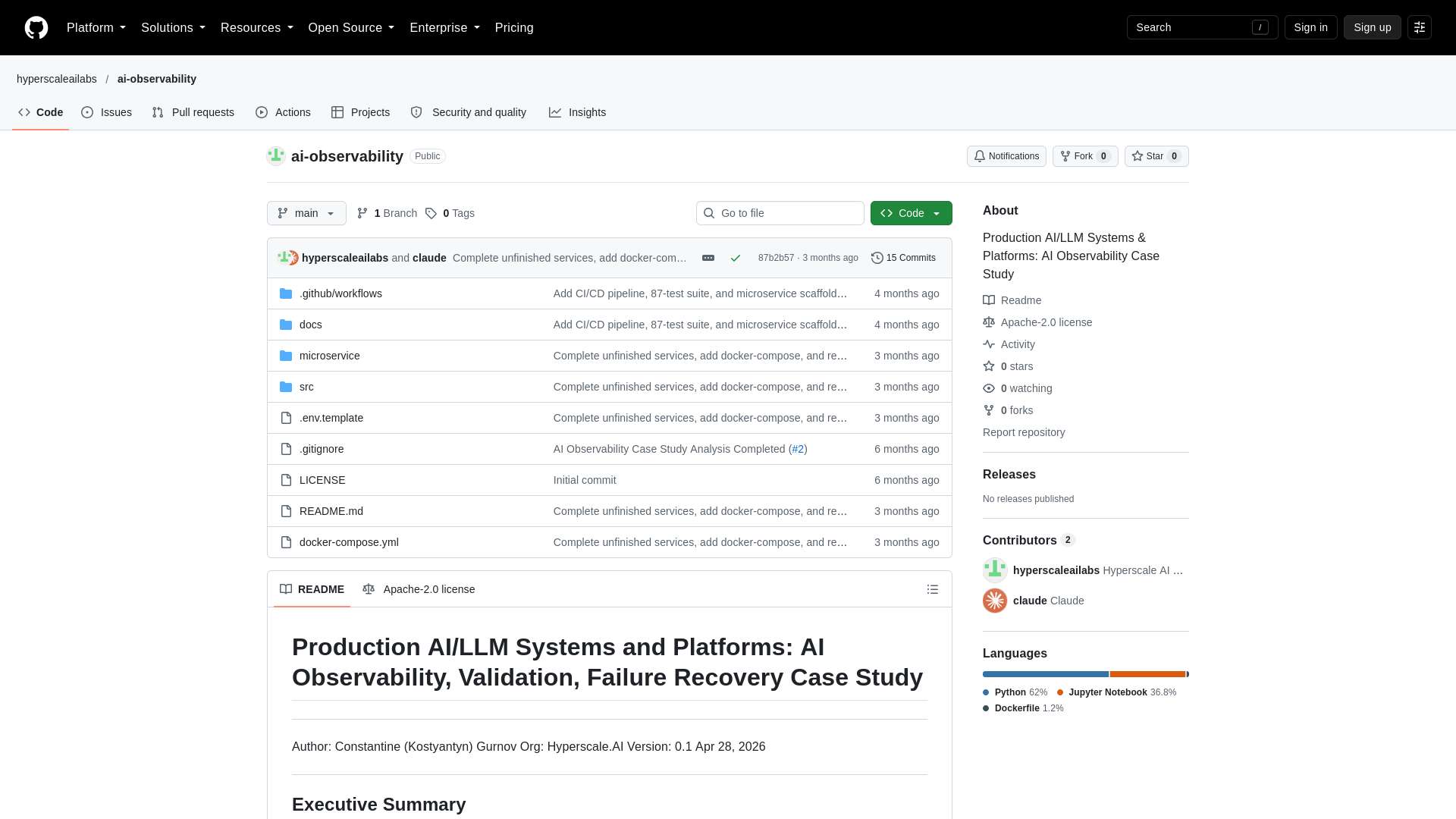
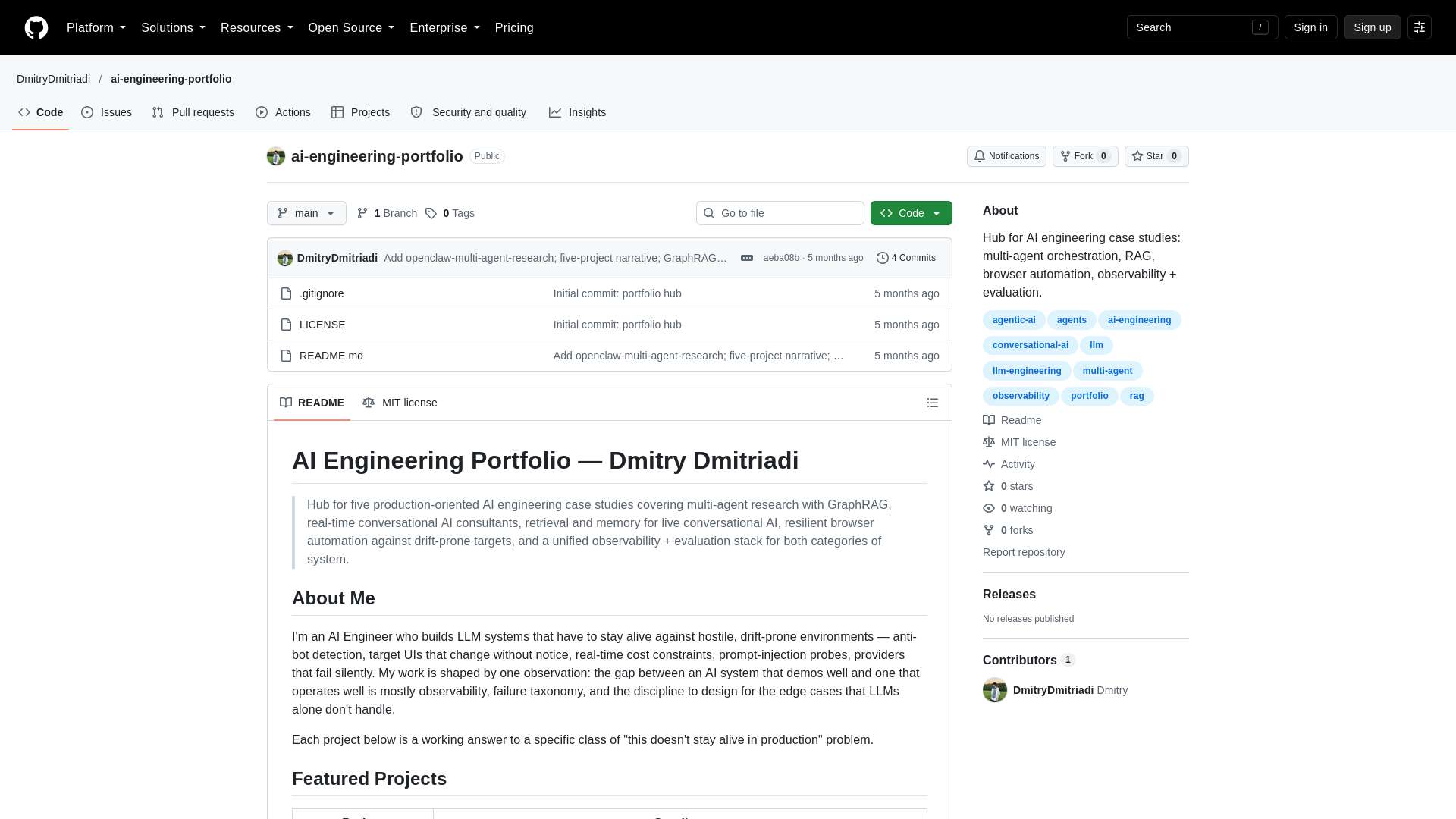
Teams building production platforms often catalog their implementations within dedicated architectural portfolios. For instance, the public repository hyperscaleailabs/ai-observability illustrates production AI and LLM system platforms through case study approaches targeting operational observability. Similarly, reference hubs such as DmitryDmitriadi/ai-engineering-portfolio track multi-agent orchestration, RAG architectures, browser automation, observability, and systematic evaluation suites across production case studies.
The table below contrasts conventional conversational software metrics with reliable production AI engineering telemetry:
| Metric Category | Conversational / Demo Metrics | Production Reliability Gates | Verification Method |
|---|---|---|---|
| Task Completion | Perceived conversational accuracy | Strict end-state transition verification | Asserting database terminal record state |
| Error Handling | Natural language apologies | Bounded escalation to human operators | Finite state machine halt trigger |
| Execution State | Hidden scratchpad text buffer | Explicit database schema with typed fields | PostgreSQL / Redis JSON schema validation |
| Tool Execution | Unchecked API caller access | Bounded transactional sandbox | Ephemeral token & least-privilege scoping |
| Release Gate | Ad-hoc manual chat evaluation | Golden evaluation test sets | CI/CD deterministic eval runner pass rate |
To explore gate criteria and latency-cost boundaries across complex enterprise features, see our operational framework in evaluating AI features: latency, cost, and reliability gates.
4. Implementation: Building a Resilient State Machine in Python
Below is an implementation of a production-oriented AI state machine. It uses Pydantic to enforce typed models, wraps tool execution with defensive parameter bounds, isolates the LLM invocation, and transitions deterministically based on verified operational outcomes.
1"""
2production_ai_runner.py
3Implements an explicit state machine for a production task agent,
4enforcing bounded authority, schema validation, and safe error transitions.
5"""
6
7from enum import Enum
8import json
9import logging
10from typing import Any, Callable, Dict, Optional
11from pydantic import BaseModel, Field, ValidationError
12
13logging.basicConfig(level=logging.INFO)
14logger = logging.getLogger("ProductionAIRunner")
15
16class AgentState(str, Enum):
17    INITIALIZED = "INITIALIZED"
18    GATHERING_INPUT = "GATHERING_INPUT"
19    EXECUTING_TASK = "EXECUTING_TASK"
20    VERIFYING = "VERIFYING"
21    COMPLETED = "COMPLETED"
22    FAILED_RECOVERABLE = "FAILED_RECOVERABLE"
23    TERMINAL_FAILURE = "TERMINAL_FAILURE"
24
25class TaskParameters(BaseModel):
26    account_id: str = Field(..., pattern=r"^ACC-[0-9]{4,8}$")
27    action_type: str = Field(..., pattern=r"^(REFUND|RETRY_CHARGE|SEND_ALERT)$")
28    amount_cents: int = Field(0, ge=0, le=100000)  # Bounded authority: Max $1,000.00
29
30class TransitionEvent(BaseModel):
31    next_state: AgentState
32    payload: Optional[Dict[str, Any]] = None
33    error_message: Optional[str] = None
34
35class ProductionTaskAgent:
36    def __init__(self, max_retries: int = 3):
37        self.state: AgentState = AgentState.INITIALIZED
38        self.max_retries: int = max_retries
39        self.retry_count: int = 0
40        self.context: Dict[str, Any] = {}
41
42    def run_step(self, mock_llm_output: str, executor: Callable[[TaskParameters], bool]) -> AgentState:
43        """
44        Executes a single step of the state machine, parsing the LLM output,
45        validating business boundaries, and executing safe transitions.
46        """
47        logger.info(f"Processing step. Current State: {self.state}")
48
49        if self.state in (AgentState.INITIALIZED, AgentState.GATHERING_INPUT):
50            self._handle_input_phase(mock_llm_output)
51        elif self.state == AgentState.EXECUTING_TASK:
52            self._handle_execution_phase(executor)
53        elif self.state == AgentState.FAILED_RECOVERABLE:
54            self._handle_retry_phase()
55
56        return self.state
57
58    def _handle_input_phase(self, raw_llm_json: str) -> None:
59        try:
60            parsed = json.loads(raw_llm_json)
61            validated_params = TaskParameters(**parsed)
62            self.context["params"] = validated_params
63            self.state = AgentState.EXECUTING_TASK
64            logger.info("Parameters validated. Transitioning to EXECUTING_TASK.")
65        except (json.JSONDecodeError, ValidationError) as e:
66            logger.warning(f"Parameter validation failed: {e}")
67            self.retry_count += 1
68            if self.retry_count >= self.max_retries:
69                self.state = AgentState.TERMINAL_FAILURE
70                logger.error("Max retries exceeded during input phase. Bounded halt.")
71            else:
72                self.state = AgentState.FAILED_RECOVERABLE
73
74    def _handle_execution_phase(self, executor: Callable[[TaskParameters], bool]) -> None:
75        params: TaskParameters = self.context.get("params")
76        if not params:
77            self.state = AgentState.TERMINAL_FAILURE
78            return
79
80        try:
81            logger.info(f"Invoking bounded tool for {params.account_id}")
82            success = executor(params)
83            if success:
84                self.state = AgentState.COMPLETED
85                logger.info("Task execution verified. Transitioning to COMPLETED.")
86            else:
87                raise RuntimeError("Executor returned unsuccessful status.")
88        except Exception as tool_err:
89            logger.error(f"Tool execution failed: {tool_err}")
90            self.retry_count += 1
91            if self.retry_count >= self.max_retries:
92                self.state = AgentState.TERMINAL_FAILURE
93            else:
94                self.state = AgentState.FAILED_RECOVERABLE
95
96    def _handle_retry_phase(self) -> None:
97        logger.info(f"Attempting recovery. Current retry count: {self.retry_count}")
98        self.context.pop("params", None)
99        self.state = AgentState.GATHERING_INPUT
100def mock_payment_tool(params: TaskParameters) -> bool:
101    if params.amount_cents > 50000:
102        raise ValueError("Amount exceeds automated approval threshold.")
103    return True
104
105if __name__ == "__main__":
106    agent = ProductionTaskAgent(max_retries=2)
107    llm_payload = '{"account_id": "ACC-12345", "action_type": "REFUND", "amount_cents": 2500}'
108    agent.run_step(llm_payload, mock_payment_tool)
109    final_state = agent.run_step("", mock_payment_tool)
110    print(f"Final Agent Lifecycle State: {final_state}")
This pattern isolates validation errors from core business tools. If an upstream model generates hallucinations or attempts unapproved actions, execution halts deterministically at the boundary layer.
5. Pre-Release Verification Checklist
Before releasing any generative AI or agent-driven workflow to live production environments, complete this verification checklist:
- Explicit End States: Verify that every path in the execution graph terminates in either a verified success state or a bounded failure state. Ensure no branch permits infinite conversational recursion.
- Schema and Authority Bounds: Confirm that all tool functions use strict schemas with explicit numerical, regex, and transactional limits. Verify that unauthorized parameters trigger validation rejections rather than unhandled exceptions.
- Recovery Limits: Ensure retry loops use strict upper bounds. When limits are exceeded, verify that the system preserves developer working trees or database snapshots rather than running destructive operations.
- Offline Golden Test Sets: Benchmark the pipeline against real-world ambiguous queries. Verify that performance and completion metrics meet deployment requirements across offline evaluation suites.
- Continuous Telemetry Hooks: Confirm that every invocation, tool step, and state transition emits structured OpenTelemetry-compatible spans capturing runtime latency, token consumption, and exit codes.
Source website screenshots
Frequently asked questions
What does "making state explicit" mean in production AI?
Making state explicit means capturing the execution phase of an agent in a structured, typed schema (such as a database record or state machine enum) rather than relying on unstructured text inside the prompt history. This ensures that valid state transitions are dictated by application logic instead of non-deterministic model completions.
How does bounded authority differ from prompt safety guardrails?
Prompt safety guardrails use text instructions or secondary classifier models to advise the LLM on acceptable behavior. Bounded authority is enforced strictly by deterministic software: input validation schemas, database authorization checks, transactional rate limits, and network firewalls that make it impossible for the agent to execute actions outside its defined scope, regardless of prompt output.
Why are golden evaluation datasets necessary if we already monitor production?
Production monitoring provides real-time alerts when issues occur, but offline golden datasets prevent regressions from ever reaching live users. Evaluating model updates, prompt revisions, and workflow changes against a standardized test set ensures that task completion rates and tool-calling boundaries remain stable before code merges.
Sources and image references
- Christian Yongwhan Lim: Production AI Reliability Framework
- Christian Yongwhan Lim: Engineering & Architecture Platform
- GitHub Repository: hyperscaleailabs/ai-observability
- GitHub Repository: DmitryDmitriadi/ai-engineering-portfolio
Keep reading
Related reading
⚡ AI Engineering Briefing
AI model releases, practical tutorials, developer tools, and engineering research. Unsubscribe anytime.
Comments
Comments are temporarily unavailable while the public discussion space is being configured.