Production AI Reliability: Architecture and Observability Case Study
>Transition AI systems from fragile prototypes to dependable production services with state machines, distributed observability, and concrete recovery gates.
🎧 Listen — ~9 min
Audio summary not available yet

Quick answer: How to build dependable production AI
Production AI systems fail not because models lack reasoning power, but because software engineers treat stochastic model calls as conventional, deterministic microservices. Achieving enterprise reliability requires four pillars: strict system boundaries with typed interfaces, transactional state persistence independent of model context, distributed telemetry linking prompts to operational metrics, and defensive recovery loops with strict execution budgets.
Key takeaways
- Isolate non-determinism behind deterministic contracts: Enforce JSON schema validation and deterministic parsers at the interface boundary before downstream processing.
- Decouple state from LLM context: Model context windows are transient caches, not state stores; rely on persistent databases (PostgreSQL, Redis) to track workflow execution.
- Trace the full execution lifecycle: Correlate API request IDs, model invocation parameters, token usage, tool latency, and final validation scores across distributed spans.
- Enforce deterministic retry policies: Treat model hallucinations and parsing failures as distributed systems errors with exponential backoff, circuit breaking, and degraded fallbacks.
+-----------------------------------------------------------------------------------+
|                           PRODUCTION AI BOUNDARY RUNTIME                         |
+-----------------------------------------------------------------------------------+
|  [ Inbound Client Request ]                                                       |
|         │                                                                         |
|         ▼                                                                         |
|  [ 1. Input Gate & Rate Limiter ] ───> Schema Validation & Auth                   |
|         │                                                                         |
|         ▼                                                                         |
|  [ 2. State Store (Postgres/Redis) ] <─── Audit Log & Workflow Checkpoint         |
|         │                                                                         |
|         ▼                                                                         |
|  [ 3. Model Orchestrator & OpenTelemetry Span ]                                   |
|         │                                                                         |
|         ├──> Inference API (LLM) ───────> Token Usage & Latency Metric            |
|         │                                                                         |
|         └──> External Tools / MCP ─────> Sandboxed Execution Spans                |
|         │                                                                         |
|         ▼                                                                         |
|  [ 4. Structural Validator / Gatekeeper ]                                         |
|         │                                                                         |
|         ├── [Pass] ────> Commit State & Return Response                           |
|         └── [Fail] ────> Bounded Recovery Loop (Max Retries: 2) -> Fallback Logic  |
+-----------------------------------------------------------------------------------+
2. Architecture: The four-layer production reliability pattern
To contain model unpredictability, enterprise engineering teams separate application infrastructure into four distinct architectural layers. This mirrors the pattern highlighted across modern case studies such as the ViaCatalyst enterprise AI evaluation control plane and agent reliability frameworks.
| Architectural Layer | Core Responsibility | Technologies & Implementation | Failure Mitigation |
|---|---|---|---|
| Ingress & Policy Gate | Validates inbound schema, enforces authentication, and applies token-bucket rate limiting. | Envoy, Kong, FastAPI, Rust reverse proxies | Prevents denial-of-wallet attacks and malformed payload injection. |
| State Machine Engine | Persists session history, execution phase, and idempotent transactional steps. | PostgreSQL, Redis, Temporal, durable workflow engines | Eliminates memory loss across multi-step agent actions. |
| Inference Orchestrator | Dispatches requests to foundation models, handles tool routing, and injects context. | Python, TypeScript, Ollama, LiteLLM, vLLM | Isolates API latency spikes with aggressive timeouts and circuit breakers. |
| Validation & Recovery Gate | Inspects outputs against structural contracts; triggers bounded retry or fallback paths. | Pydantic, Zod, TypeSafe validators | Prevents downstream data corruption from corrupted or truncated outputs. |
Layer Breakdown:

[ Client / API Consumer ]
            │
            ▼
┌────────────────────────────────────────────────────────┐
│ 1. INGRESS & POLICY GATE                               │
│    - Auth verification & Rate limiting (Redis tokens)   │
│    - Inbound payload schema enforcement                │
└───────────────────────────┬────────────────────────────┘
                            │
                            ▼
┌────────────────────────────────────────────────────────┐
│ 2. STATE MACHINE ENGINE                                │
│    - Transaction checkpointing (PostgreSQL ACID)       │
│    - Step idempotency key generation                   │
└───────────────────────────┬────────────────────────────┘
                            │
                            ▼
┌────────────────────────────────────────────────────────┐
│ 3. INFERENCE & TOOL ORCHESTRATION                      │
│    - Distributed tracing via OpenTelemetry GenAI       │
│    - Bounded tool execution & token budget caps        │
└───────────────────────────┬────────────────────────────┘
                            │
                            ▼
┌────────────────────────────────────────────────────────┐
│ 4. VALIDATION & RECOVERY GATE                          │
│    - Pydantic/Zod schema verification                  │
│    - Deterministic fallback routes on failure          │
└────────────────────────────────────────────────────────┘
By decoupling state persistence from model context, failures during inference become standard retryable exceptions rather than fatal application crashes. If an inference worker drops a connection or a provider throttles an endpoint, the state engine resumes the transaction from the last validated checkpoint without re-running earlier steps.
3. Distributed observability: Implementing OpenTelemetry GenAI spans
Effective AI observability requires more than capturing standard HTTP metrics. Teams need granular, distributed traces that capture the entire causal chain: client requests, vector database retrievals, prompt formatting, token consumption, model response latency, and downstream tool execution.
The PromptSphere TRACE framework emphasizes instrumenting model calls with standardized OpenTelemetry semantic attributes. The following Python implementation demonstrates how to instrument an inference and validation call using OpenTelemetry, capturing operational metrics alongside structural evaluation metadata:
1import time
2import json
3from typing import Dict, Any, Optional
4from pydantic import BaseModel, Field, ValidationError
5from opentelemetry import trace
6from opentelemetry.trace import Status, StatusCode
7
8tracer = trace.get_tracer("production.ai.observability", "1.0.0")
9
10class CustomerActionPlan(BaseModel):
11    action_type: str = Field(..., description="Action category: ESCALATE, REFUND, or RESOLVE")
12    priority_score: int = Field(..., ge=1, le=5, description="Priority rating from 1 to 5")
13    reasoning: str = Field(..., min_length=10, description="Brief justification for the decision")
14
15def execute_llm_inference(prompt: str) -> str:
16    return json.dumps({
17        "action_type": "ESCALATE",
18        "priority_score": 4,
19        "reasoning": "High-tier client reporting sustained service downtime."
20    })
21
22def resilient_ai_pipeline(user_id: str, prompt: str) -> Optional[CustomerActionPlan]:
23    with tracer.start_as_current_span("ai_workflow_execution") as parent_span:
24        parent_span.set_attribute("ai.user_id", user_id)
25        parent_span.set_attribute("ai.pipeline.version", "2026.10")
26        start_time = time.time()
27        with tracer.start_as_current_span("llm_inference_call") as llm_span:
28            llm_span.set_attribute("gen_ai.system", "anthropic")
29            llm_span.set_attribute("gen_ai.request.model", "claude-3-5-sonnet")
30            llm_span.set_attribute("gen_ai.request.temperature", 0.1)
31
32            try:
33                raw_response = execute_llm_inference(prompt)
34                latency = time.time() - start_time
35                prompt_tokens = len(prompt.split()) * 2
36                completion_tokens = len(raw_response.split()) * 2
37
38                llm_span.set_attribute("gen_ai.usage.input_tokens", prompt_tokens)
39                llm_span.set_attribute("gen_ai.usage.output_tokens", completion_tokens)
40                llm_span.set_attribute("gen_ai.response.latency_seconds", latency)
41                llm_span.set_status(Status(StatusCode.OK))
42            except Exception as exc:
43                llm_span.record_exception(exc)
44                llm_span.set_status(Status(StatusCode.ERROR, str(exc)))
45                return None
46        with tracer.start_as_current_span("output_structural_validation") as val_span:
47            try:
48                parsed_data = json.loads(raw_response)
49                validated_model = CustomerActionPlan(**parsed_data)
50
51                val_span.set_attribute("validation.status", "success")
52                val_span.set_attribute("validation.action_type", validated_model.action_type)
53                val_span.set_status(Status(StatusCode.OK))
54                return validated_model
55            except (json.JSONDecodeError, ValidationError) as val_err:
56                val_span.record_exception(val_err)
57                val_span.set_attribute("validation.status", "failed")
58                val_span.set_status(Status(StatusCode.ERROR, f"Structural validation failed: {str(val_err)}"))
59                parent_span.set_attribute("ai.recovery.invoked", True)
60                return trigger_recovery_fallback(user_id, raw_response)
61
62def trigger_recovery_fallback(user_id: str, raw_output: str) -> CustomerActionPlan:
63    """Safe fallback returning deterministic defaults when validation fails."""
64    return CustomerActionPlan(
65        action_type="ESCALATE",
66        priority_score=3,
67        reasoning="Automated fallback triggered due to structural parser divergence."
68    )
Integrating OpenTelemetry semantic conventions across your runtime provides granular visibility into latency, cost attribution, and schema violation rates across all services. For continuous evaluation pipelines that hook into this telemetry, refer to our deep dive on continuous AI evaluation architecture: traces to production gates.
4. Failure modes and defensive recovery patterns
Building a dependable production system requires anticipating where AI components break under stress. The table below outlines key failure modes alongside proven engineering remediations:
Failure Mode Analysis & Remediation Strategy:

1. Schema Divergence
   ├── Symptom: Model returns unescaped control characters or skips required keys.
   ├── Engineering Guard: Strict Pydantic/Zod validation at the boundary.
   └── Recovery Action: Send error schema back to model with temperature=0.0 (max 1 retry).

2. Context Window Saturation
   ├── Symptom: Multi-turn agents exceed token caps, causing truncated output.
   ├── Engineering Guard: Track token usage strictly using tiktoken or model tokenizer.
   └── Recovery Action: Evict intermediate scratchpad reasoning; retain immutable system state.

3. External Tool Timeouts
   ├── Symptom: Downstream REST API hangs, locking agent worker threads.
   ├── Engineering Guard: Hard execution limits (e.g., 3000ms) with circuit breakers.
   └── Recovery Action: Return standardized timeout JSON mock to agent loop to allow re-planning.

4. Hallucinated Actions
   ├── Symptom: Agent invokes non-existent tools or invalid database IDs.
   ├── Engineering Guard: Whitelist allowable actions against active session state.
   └── Recovery Action: Abort execution; trigger immediate human-in-the-loop review queue.
Implementing bounded recovery loops
When model outputs fail structural validation, naive systems trigger generic retries that burn tokens and compound latency. A production recovery loop must enforce strict constraints:
- Single-Attempt Targeted Remediation: Append the specific validation error message to the conversational state and request a correction with
temperature=0.0. - Circuit Breaking: If the second attempt fails, exit the loop immediately and route the transaction to a deterministic fallback handler.
- Idempotency Guarantees: Ensure that tool calls executed prior to a validation failure do not execute a second time during retries. Tag every side-effecting operation with a unique client-generated UUID.
For detailed strategies on monitoring and securing agent operations, explore our guide on OpenTelemetry GenAI agent tracing and continuous evals.
5. Verification checklist for production deployment
Before clearing an AI service for production traffic, verify your implementation against these engineering requirements:
- Schema Enforcement: Every LLM response parses through a strict type-checked validator (Pydantic/Zod) before triggering business logic.
- Zero Unbounded Retries: Model invocation loops possess hard retry limits (maximum 1-2 attempts) with exponential backoff.
- State Machine Separation: Workflow execution state and conversation history persist in an external database rather than residing in volatile runtime memory.
- Distributed Span Tracing: OpenTelemetry spans capture model names, prompt tokens, completion tokens, execution latency, and error types across all network hops.
- Sandboxed Tool Invocation: External tools and database connectors enforce individual connection timeouts, query limits, and write-permission scopes.
- Deterministic Fallback Routes: The application maintains a predictable, non-AI degraded response path for every supported workflow in case upstream providers suffer outages.
- Cost and Quota Gating: Outbound requests are governed by per-user and per-organization token rate-limiters to prevent denial-of-wallet incidents.
Source website screenshots
Frequently asked questions
What is the difference between traditional APM and AI observability?
Traditional Application Performance Monitoring (APM) monitors system health through standard infrastructure metrics like CPU usage, memory consumption, HTTP error codes, and network latency. AI observability builds on APM by tracking non-deterministic characteristics: prompt and completion token counts, vector retrieval accuracy, schema validation failure rates, reasoning-step counts, and semantic output quality over time.
How do you handle schema parsing failures in high-throughput environments?
Avoid running recursive model calls to fix broken formatting. First, attempt deterministic correction using robust parsing utilities capable of stripping markdown delimiters and fixing trailing commas. If deterministic parsing fails, issue a single targeted correction request containing the exact validation error with temperature=0.0. If that also fails, drop directly to a predefined static fallback object to preserve overall system throughput.
Why shouldn't workflow state be stored in model context?
Model context windows are ephemeral and costly. Storing state purely within prompt history increases token expenses on every step, risks silent truncation when context limits are reached, and prevents other workers from picking up the job if a process crashes. Storing state in transactional databases like PostgreSQL ensures idempotency, auditability, and immediate resumption after infrastructure failures.
Sources and image references
- Yongwhan Lim Case Study: Christian Yongwhan Lim, From a promising AI demo to a dependable production system (September 20, 2026). https://www.yongwhan.io/production-ai-reliability-case-study
- PromptSphere Reliability Playbook: PromptSphere, AI Agent Observability: A Practical Guide to Production Reliability (August 2026). https://www.promptspherehub.com/2026/08/ai-agent-observability-2026-production-reliability-playbook.html
- ViaCatalyst Enterprise Pattern: ViaCatalyst Case Studies, Enterprise AI Observability & Evaluation Control Plane (2026). https://www.viacatalyst.com/case-studies/ai-observability-evaluation-control-plane
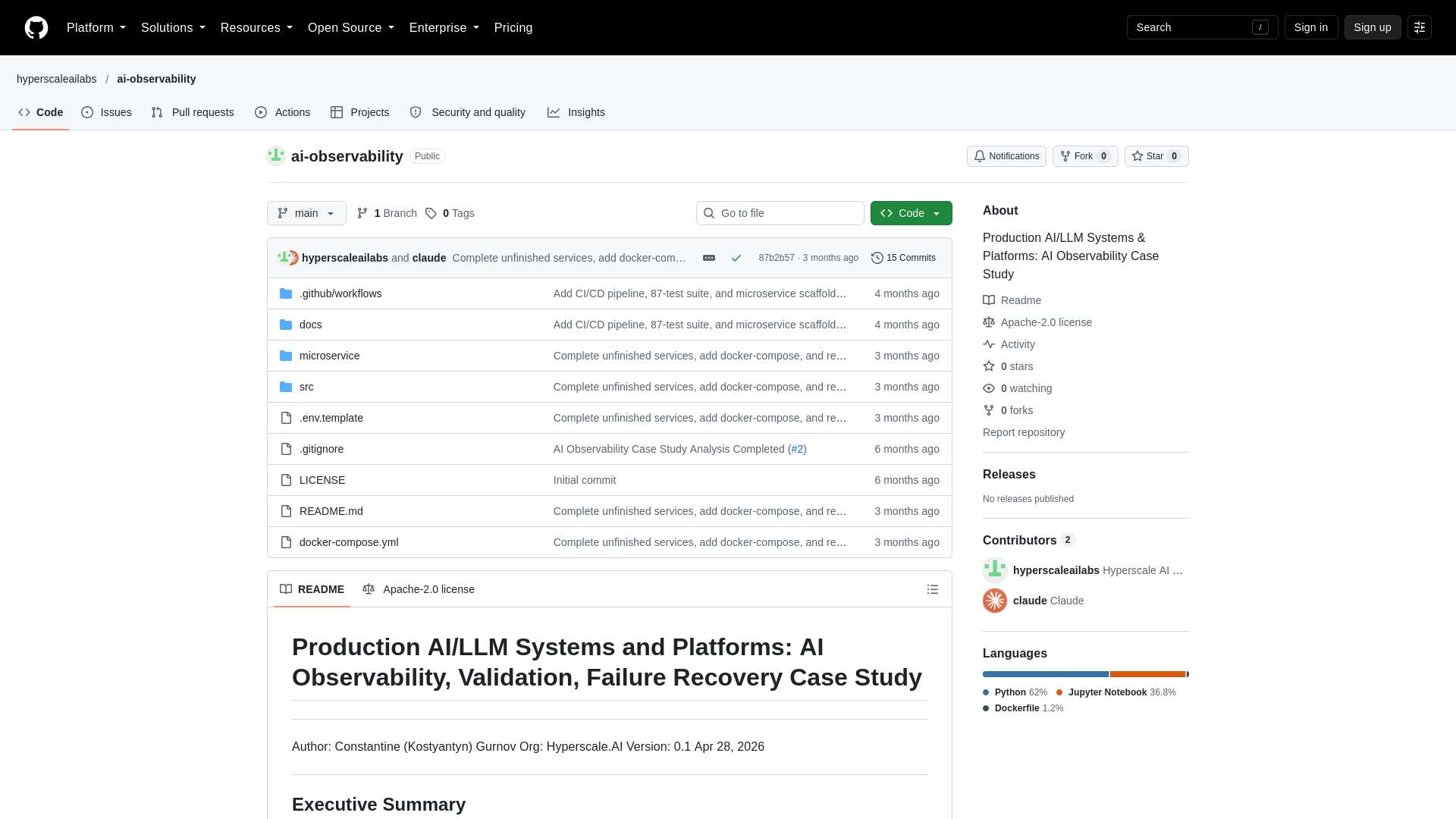
- Production AI Systems Repository: Hyperscale AI Labs, Production AI/LLM Systems & Platforms: AI Observability Case Study. https://github.com/hyperscaleailabs/ai-observability
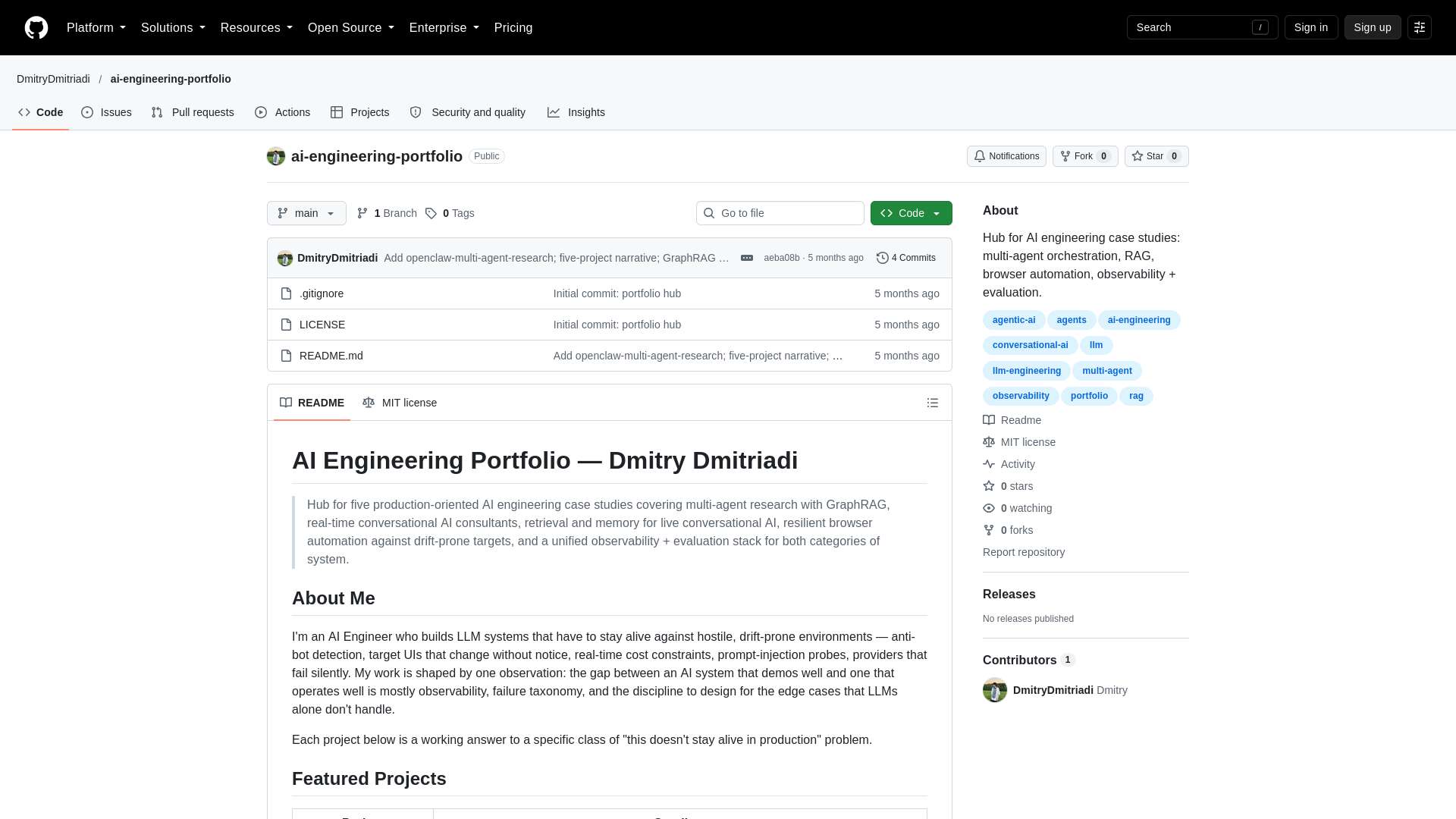
- AI Engineering Portfolio: Dmitry Dmitriadi, Hub for AI Engineering Case Studies: Multi-Agent Orchestration, Observability + Evaluation. https://github.com/DmitryDmitriadi/ai-engineering-portfolio
Keep reading
Related reading
⚡ AI Engineering Briefing
AI model releases, practical tutorials, developer tools, and engineering research. Unsubscribe anytime.
Comments
Comments are temporarily unavailable while the public discussion space is being configured.