5 Tiny Uncensored Local LLMs in 2026: 0.8B–3B Models
>Compare five small abliterated local LLMs by size, license, modality, Ollama support, memory, and evidence—without mistaking fewer refusals for better capability.
🎧 Listen — ~14 min
Audio summary not available yet

Quick answer: For a very small local experiment, start by comparing Huihui’s Qwen3.5 0.8B Abliterated with the original Qwen checkpoint. For a slightly larger text model, compare LFM2.5 1.2B Instruct Abliterated—but read its LFM Open License before reuse. Qwen3.5 2B adds a multimodal path; MiniCPM5 and Qwen3 1.7B v2 are other small checkpoints worth inspecting. These are community-edited experiments, not independently certified “uncensored” products, and their model-card labels do not prove quality, safe behavior, or tool reliability.
This guide compares five compact checkpoints whose public cards were checked on October 18, 2026. We did not run a benchmark or load-test these models. Parameter counts, licenses, and runtime instructions below are reported from each repository; memory figures are transparent BF16 weight-only arithmetic, not measured system requirements. For broader context, see our 2026 abliterated-model shortlist, uncensored local LLM guide, and model evaluation checklist.

Original AI-generated editorial illustration. It is conceptual artwork, not a benchmark, model architecture, or product screenshot.
At a glance: five small checkpoints to compare
“Best” here means a useful candidate for a particular experiment—not a claim that one model wins a benchmark. Read each linked card before you download: names can understate the parameter count, licenses differ, and the maintainers describe some edits as proof-of-concept work.
| Model repository | Hugging Face size shown | Task and notable metadata | License shown | Best reason to test it | Main caution |
|---|---|---|---|---|---|
| Huihui-Qwen3.5-0.8B-abliterated | 0.9B | Image-text-to-text; Qwen3.5 | Apache-2.0 | Smallest option in this comparison; card lists an Ollama variant | Maintainer calls the edit a crude proof of concept; reduced safety filtering |
| LFM2.5-1.2B-Instruct-Abliterated | 1B shown; about 1.17B in card | Text generation; hybrid LFM2.5 | LFM Open License v1.0 | A distinct small text-model family with a detailed maintainer-reported evaluation | Not Apache-2.0; tool-use and coding are not established by the card |
| Huihui-Qwen3-1.7B-abliterated-v2 | 2B | Text generation; Qwen3; v2 | Apache-2.0 | Small text-only alternative with a documented v2 change and Ollama tag | Still labeled proof-of-concept; HF rounds it to 2B |
| Huihui-Qwen3.5-2B-abliterated | 2B | Image-text-to-text; Qwen3.5 | Apache-2.0 | More headroom than the 0.8B card while retaining a multimodal task label | Card warns safety filtering is substantially reduced |
| Huihui-MiniCPM5-2B-abliterated | 3B | Text generation; tags include tool-calling and on-device | Apache-2.0 | A separate architecture and a useful card to inspect for edge experiments | Repository name says 2B, but HF displays 3B; maintainer says performance is still insufficient |
The “best reason to test it” column is an editorial fit, not a measured ranking. The repository’s task tag is also not a capability score. In particular, a tool-calling tag does not prove that the model reliably emits valid tool arguments or can safely operate an agent.
What “uncensored” and “abliterated” actually tell you
“Uncensored” is a loose community label. “Abliterated” usually refers to a weight-editing approach that attempts to reduce refusal behavior associated with internal directions in a model. The 2024 paper Refusal in Language Models Is Mediated by a Single Direction studied this mechanism across 13 open-source chat models. Later work, including There Is More to Refusal in Large Language Models than a Single Direction, argues that refusal behavior is more nuanced than one simple switch.
That research explains why these edits are technically interesting; it does not certify any checkpoint in this list. Removing or changing refusals is not the same thing as improving reasoning, factuality, coding, or instruction-following. It may also make a model less likely to pause when a prompt is risky or ambiguous. The practical question is not “does it refuse less?” alone. It is whether the exact revision remains useful on your legitimate workload, what failure modes it introduces, and what safeguards you keep around it.
For a deeper explanation of the method and its limits, read our abliteration and refusal-direction explainer.
1. Huihui Qwen3.5 0.8B Abliterated: the smallest starting point
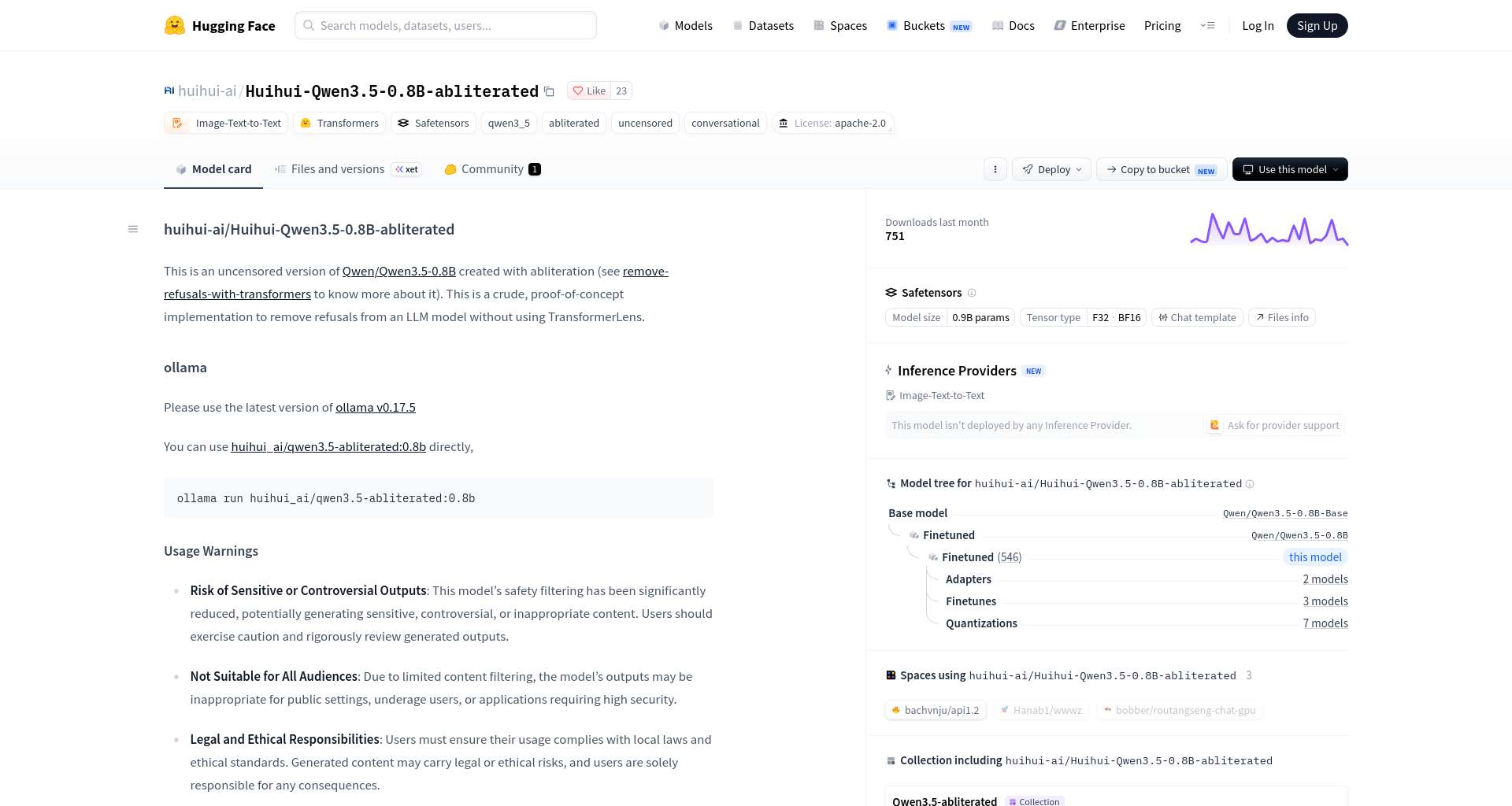
The Hugging Face repository is displayed as 0.9B parameters, despite “0.8B” in its name. Hugging Face labels the task Image-Text-to-Text and the license Apache-2.0. Its card describes the derivative as a crude proof of concept and lists an Ollama model tag. That combination makes it a practical first checkpoint to inspect if download size and local experimentation matter more than expecting frontier-level answers.
The card’s own quick-start is:
ollama run huihui_ai/qwen3.5-abliterated:0.8b
This command is copied from the model card; it is not a speed or quality result from our hardware. The same card says to use a recent Ollama version and warns that safety filtering has been significantly reduced. Treat its Image-Text-to-Text label as a reason to test image input—not proof that it will read small text, charts, or complex screenshots accurately.

Courtesy screenshot of the public Hugging Face model card, captured October 18, 2026. The repository and interface belong to their respective owners; this is a point-in-time reference, not an endorsement.
Who should test it: developers who want a compact multimodal experiment, a local prompt-prototyping model, or a baseline for measuring how a small checkpoint behaves after a community edit.
Who should not assume it fits: teams looking for a dependable vision model, a production assistant, or an autonomous agent without an evaluation and policy layer.
2. LFM2.5 1.2B Instruct Abliterated: read the license and the evaluation details
The PinoCookie LFM2.5 repository identifies its base as LiquidAI’s LFM2.5-1.2B-Instruct and describes a hybrid convolution-and-attention model. Its card reports about 1.17B parameters, a BF16 file around 2.34 GB, and a recommended context of 32,768 tokens. Hugging Face rounds the displayed model size to 1B.
Unlike the Qwen cards above, its license is LFM Open License v1.0, not Apache-2.0. That difference matters for redistribution, commercial use, or bundling it inside an application. Read the full license and the upstream model’s terms for your use case; a model appearing on a public model hub does not mean every downstream use is unrestricted.
This card is unusually specific about its method and evaluation. The maintainer reports a rank-1 SVD recovery from a published reference edit, gives held-out refusal measurements and benign-task results, and documents that coding, long-context, and tool-use evaluations were not performed. Those are maintainer-reported results, not an independent replication. Its own limitations say it is not recommended for programming or knowledge-intensive work and that tool-use capability is untested. So the interesting angle here is transparency and a distinct architecture—not a reason to select it as your coding or agent model.

Courtesy screenshot of the public Hugging Face model card, captured October 18, 2026. Claims visible in the card are attributable to its maintainer and have not been independently reproduced for this article.
The repository documents a Transformers and Docker Model Runner route. Follow the command on the current card and verify runtime compatibility rather than assuming a generic Ollama name exists. The fact that the model’s card includes agentic use cases for the base family must not be read as evidence that this edited version has passed agent or tool-call tests.
3. Huihui Qwen3 1.7B Abliterated v2: an older, text-first option
The Qwen3 1.7B v2 card is listed for Text Generation and Apache-2.0. Although its repository name says 1.7B, Hugging Face’s model metadata displays 2B parameters. The card calls it a proof of concept, says v2 changes layer zero to address garbled output, and lists this Ollama command:
ollama run huihui_ai/qwen3-abliterated:1.7b-v2
The practical attraction is straightforward: a small text-generation checkpoint with a clear v2 label and an easy-to-try Ollama tag. Its age relative to Qwen3.5 is not automatically disqualifying; older models can still be useful for reproducible tests or lightweight local tasks. But don’t infer that v2 fixes all output-quality issues. Compare it with the original Qwen3 1.7B base using the same runtime, tokenizer, context length, and sampling settings.
4. Huihui Qwen3.5 2B Abliterated: a larger multimodal sibling
The Qwen3.5 2B model card displays 2B parameters, Image-Text-to-Text, and Apache-2.0. Its card points to the Ollama tag:
ollama run huihui_ai/qwen3.5-abliterated:2b
This is a reasonable second experiment after the 0.8B version if you want to compare whether a larger checkpoint better handles your prompts or images. That is a hypothesis to test—not a promise that the 2B model is twice as capable. The card itself uses “crude, proof-of-concept” wording and warns about reduced safety filtering. A model being multimodal also does not establish that image understanding will match a dedicated vision system.
For an apples-to-apples comparison, keep the prompt set and generation settings fixed; record the exact model revision and quantization. Include tasks where you know the expected answer, such as short text extraction from a clean image, and label uncertain outputs for manual review.
5. Huihui MiniCPM5 “2B” Abliterated: the name is not the size
The MiniCPM5 repository is a useful reminder to check metadata, not just a repository slug. Its name says 2B, but Hugging Face displays 3B parameters. The page shows Apache-2.0 and tags such as on-device, edge-AI, and tool-calling. Those tags make it relevant to a shortlist, but they are not independent evidence of edge latency or reliable tool use.
The caution is explicit in the model card: the maintainer says this is a proof-of-concept edit, notes that layers 6–37 and 40 were ablated in the described experiment, and says performance is still insufficient because the model is too small. That makes it an experimental comparison candidate—not the pick I would put behind an unattended coding agent. The base architecture, tool-call tag, and community edit each need to be checked separately.

Courtesy screenshot of the public Hugging Face model card, captured October 18, 2026. The screenshot records the card at capture time and is not an endorsement.
Memory: estimate weights separately from the full runtime
Parameter count is a useful first filter, but it does not tell you the complete RAM or VRAM needed. At BF16, a simple lower-bound estimate is parameter count × two bytes. That estimates the raw weight payload only; it excludes tokenizer files, quantization metadata, runtime buffers, the KV cache, operating-system use, and application overhead.
| Model | Hugging Face count used here | Approximate BF16 weight payload only | What that number excludes |
|---|---|---|---|
| Qwen3.5 0.8B Abliterated | 0.9B | 1.8 GB | Runtime, KV cache, OS, image-processing buffers |
| LFM2.5 1.2B Instruct Abliterated | About 1.17B | 2.34 GB | Runtime, KV cache, OS, tokenizer and other files |
| Qwen3 1.7B Abliterated v2 | 2B shown | 4 GB | Runtime and generation overhead |
| Qwen3.5 2B Abliterated | 2B | 4 GB | Runtime, cache, multimodal input buffers |
| MiniCPM5 “2B” Abliterated | 3B shown | 6 GB | Runtime, cache, OS, application overhead |
For a theoretical 4-bit representation, multiply the parameter count by roughly half a byte to estimate a lower-bound weight payload. Real quantized files are larger because formats store scales and other metadata, and different quantization schemes change quality and size. Do not turn this arithmetic into a “runs on any 2 GB device” promise.
Use our local AI model fit tool to narrow candidates by hardware, and browse our AI model directory for other model families and filters. The fit tool provides an estimate, not a measured benchmark of these particular checkpoints.
How to choose among them
- Want the smallest listed experiment? Start by checking Qwen3.5 0.8B. Compare it with the untouched base before deciding the edit is useful.
- Want a different small text-model family? Inspect LFM2.5 1.2B, but review its LFM Open License and note that the card does not establish coding or tool-use performance.
- Want the Qwen3 1.7B lineage? Try v2 only after checking the repository’s current instructions and match it against the base checkpoint.
- Want a small multimodal test? Compare Qwen3.5 0.8B and 2B on the exact images and questions you care about; the task label alone is not a vision benchmark.
- Interested in on-device or tool-calling metadata? MiniCPM5 is worth inspecting, but its own card flags insufficient performance. Do not treat its tags as agent-readiness proof.
If your real requirement is a reliable coding agent, use a model with a tool-calling evaluation and keep permissions in the harness, not in the marketing label. See the coding-agent directory for agent software; a model is only one component in that stack. For safe experiments, use read-only tools first, isolate model execution from private files and credentials, and require human approval for external side effects.
A practical comparison protocol
Before adopting any small abliterated model, record: the full repository ID, commit revision, file hashes, license, runtime version, quantization, prompt template, context length, and generation settings. Then run the original base and edited model through the same test set on the same machine.
Keep the test set focused on your legitimate use case: summarize a public document, extract fields from a known sample, answer questions with a verifiable key, or complete a harmless coding task with tests. Score factual correctness, formatting, latency, memory, and consistency separately. If you care about refusal behavior, use a reviewed, balanced evaluation set and document false refusals as well as unsafe compliance; do not use a single “it answered” screenshot as proof of quality.
Most importantly, run the quantized artifact you plan to deploy. A BF16 model-card result does not automatically transfer to a community GGUF or a different Ollama conversion. Likewise, a result from a short prompt does not establish long-context performance. Pin the exact artifact and keep a simple rollback path.
Frequently asked questions
What is the smallest model in this list?
Hugging Face displays Qwen3.5 0.8B Abliterated at 0.9B parameters. It is the smallest listed candidate here, but “smallest” does not mean best quality or lowest total runtime memory.
Does “uncensored” mean the model will answer every prompt?
No. It is an informal label, and behavior can still vary with prompt, template, quantization, and runtime. It also does not say anything reliable about truthfulness or capability.
Which one is best for local coding?
This article does not establish a coding winner. The LFM2.5 card explicitly says its coding evaluation was not performed and does not recommend the base model for programming. Evaluate any candidate with your own harmless code tasks and unit tests, or choose a coding model based on relevant benchmarks and evidence.
Is MiniCPM5 2B actually two billion parameters?
The repository name contains “2B,” but the Hugging Face page displays 3B parameters. Use the current metadata and actual file sizes rather than relying on the slug alone.
Are these models free for commercial use?
Do not assume that. Qwen and MiniCPM pages shown here list Apache-2.0, while LFM2.5 lists LFM Open License v1.0. Read the exact license, base-model terms, and any runtime or quantization distribution terms before commercial deployment.
Can I run them with Ollama?
The Qwen3.5 0.8B and 2B cards, and Qwen3 1.7B v2 card, each list an Ollama tag and command. Check the current model card and your installed Ollama version before pulling. For MiniCPM5 and LFM2.5, follow their repository’s documented runtime path; do not invent an Ollama tag.
Should I connect one to an autonomous agent?
Not without evaluation and safeguards. A small model’s tool-call tag is not proof of correct argument generation, prompt-injection resistance, or safe actions. Start with read-only tools, restrict permissions, log decisions, and require confirmation for side effects.
Bottom line
The best reason to explore tiny abliterated models is that they make local, controlled comparisons accessible on modest hardware. They are not shortcuts to more capable or more trustworthy assistants. Qwen3.5 0.8B is the smallest starting point in this shortlist; LFM2.5 is a distinct text-first experiment with a license you must review; Qwen3.5 2B is a larger multimodal comparison; Qwen3 1.7B v2 and MiniCPM5 add different model lineages and caveats.
Choose by measured task quality, runtime fit, and license—not by the word “uncensored.” Keep a base-model comparison, pin the exact files, and isolate anything whose refusal behavior has been deliberately changed.
Source website screenshot
Sources and image references
- Huihui-Qwen3.5-0.8B-abliterated model card
- Huihui-Qwen3.5-2B-abliterated model card
- Huihui-Qwen3-1.7B-abliterated-v2 model card
- Huihui-MiniCPM5-2B-abliterated model card
- PinoCookie LFM2.5-1.2B-Instruct-Abliterated model card and license
- Arditi et al., Refusal in Language Models Is Mediated by a Single Direction
- Joad et al., There Is More to Refusal in Large Language Models than a Single Direction
- The hero is an original AI-generated illustration. Model-card screenshots were captured from the linked public Hugging Face pages with Trawl on October 18, 2026; each is credited to its repository owner and is included as a point-in-time reference. Repository owners retain rights to their model-page content and interface.
Keep reading
Related reading
⚡ AI Engineering Briefing
AI model releases, practical tutorials, developer tools, and engineering research. Unsubscribe anytime.
Comments
Comments are temporarily unavailable while the public discussion space is being configured.