5 Uncensored Coding Models to Test Locally in 2026
>Compare five 7B–12B uncensored or abliterated coding-model candidates by base model, license, local size, evidence, and agent-workflow caveats.
🎧 Listen — ~12 min
Audio summary not available yet

Quick answer: If you want to experiment with an uncensored or abliterated model for ordinary local coding, start by comparing the Qwen2.5-Coder-7B abliterated derivative with its original coder checkpoint. For a newer base, test Gemma 4 12B Coder Abliterated, but first fix or verify its chat template. Qwen3.5 9B Abliterated is a compact general model rather than a coding fine-tune, while the LFM2.5 8B-A1B Uncensored card offers an Apple-MLX path and maintainer-reported evaluations—not independent coding proof.
This is a shortlist for evaluation, not a benchmark ranking. I checked public model cards and runtime pages on October 18, 2026. I did not download, run, or benchmark these checkpoints. The table separates what maintainers report from what a developer should test for themselves. For broader background, see the abliterated-model shortlist, uncensored local LLM guide, and model-evaluation checklist.
Original AI-generated editorial illustration. It is conceptual artwork—not a real benchmark, model architecture, product screenshot, or measured result.
What this comparison means by “best”
“Uncensored” is an informal label, and “abliterated” usually describes a community weight-editing experiment intended to reduce some refusal behavior. Neither word tells you whether a model writes correct code, understands your repository, follows a tool schema, or is safe to attach to a shell. A model that answers more prompts may also answer more prompts it should not.
I selected candidates because their public pages connect them to a coding-oriented base, a compact local deployment path, or both. The ranking is by fit and inspectability, not measured code quality. A model card’s own refusal table is a maintainer claim; it is not an independent coding benchmark. This distinction matters especially when using a model inside an IDE or agent loop, where the surrounding harness can apply changes, run commands, and access files.
At a glance: five candidates, with evidence limits
| Candidate | What the public page establishes | License shown | Useful first test | Main caveat |
|---|---|---|---|---|
| Qwen2.5-Coder-7B-Instruct-abliterated | Derivative of a coder-instruct checkpoint; card documents its layer-wise edit | Apache-2.0 on this card | Small, isolated Python or TypeScript issue against the base model | Card’s usage snippet names a different repository; verify the exact files and loading path before deployment |
| Gemma-4-12B-Coder-Abliterated | Community derivative of a Gemma 4 coder fine-tune; Ollama lists several GGUF sizes | Not stated on the linked Ollama page | Python code completion with template and output-format checks | Custom `<channel |
| Qwen3.5-9B-abliterated | Community proof-of-concept derivative; page labels it image-text-to-text | Apache-2.0 on this card | General coding prompts plus one image-input check if vision matters | Not a coder-specific fine-tune; the card calls the edit a crude proof of concept |
| Qwen3-8B-abliterated | 8B Qwen3 derivative; card describes an experimental abliteration method and inference routes | Apache-2.0 on this card | Compare code explanations and small repository changes with Qwen3 base | General model, not evidence of coding-specialist performance |
| LFM2.5-8B-A1B-Uncensored | LFM2.5 derivative; model card reports 8.3B total and 1.5B active parameters and provides MLX instructions | “Other” on this card—read the linked terms | Apple Silicon local serving, then a benign coding task set | Reported refusal results do not establish coding ability; license is not Apache-2.0 |
The listed license is the license string displayed on the specific derivative card, not a legal opinion. Where a page does not state a license, do not infer one from the upstream model. Re-check the current card and upstream terms before redistributing, hosting for customers, or embedding weights in a product.
1. Qwen2.5-Coder-7B-Instruct-abliterated: the most direct coder-base experiment
The sci4ai model card says the derivative starts from Qwen/Qwen2.5-Coder-7B-Instruct and describes activation-based weight surgery. It reports edits across 28 layers, using 200 harmful and 200 harmless prompts to calculate directions, with the listed BF16 precision and A100 hardware. Hugging Face shows 8B parameters for the repository whose name says 7B; preserve both facts rather than silently treating the name as the exact size.
Why put it first? It is the clearest like-for-like experiment for a developer who wants to ask whether reducing refusal behavior changes a coding-tuned base. Keep the original checkpoint as the control, use the same prompt template, decode settings, context, and runtime, and compare on an ordinary coding set: explain a function, add a unit test, fix a harmless bug, and make a small refactor.
There is a documentation wrinkle: the card title and repository URL use the sci4ai namespace, but its sample loader refers to ermer09/Qwen2.5-Coder-7B-Instruct-abliterated. That mismatch is a reason to verify the repository files and current revision before copying a command into an automated setup. The card also says no hosted inference provider deploys the model, so plan for local weights or your own compatible serving stack.
Verdict: Best starting experiment among these five if your question is specifically “what changes when I ablate a coder-instruct model?” That is not a claim that it is the strongest coder here.
2. Gemma 4 12B Coder Abliterated: promising base, important template check
The Ollama model page identifies a community build based on yuxinlu1/gemma-4-12B-coder-fable5-composer2.5-v1; it says Heretic was used to reduce refusals. Ollama lists a Q4_K_M/latest download around 7.4–7.5 GB, alongside smaller IQ3/IQ4 variants and larger Q5/Q8 options. Its page reports a maintainer evaluation of refusals changing from 100/100 to 7/100 and KL divergence 0.058. Treat those as the page’s reported results, not as results from this article.
The technical caveat is more actionable than the headline number: the page warns that this fine-tune uses a custom <channel|>-based output format while its packaged Modelfile uses the standard Gemma <start_of_turn> template. It suggests that users may need to adapt the template or use the model’s native format. If code blocks, reasoning channels, or tool calls look malformed, investigate the template before concluding that the weights are poor.
The upstream Google Gemma 4 model card describes a family that includes a 12B model and lists Apache 2.0 for the upstream Gemma 4 family. That does not by itself prove the linked derivative’s license; the specific Ollama page does not state one. Check the exact derivative’s current card and inherited terms before commercial use.
The page also shows launch paths for Ollama, OpenCode, Claude Code, Hermes Agent, and OpenClaw. That indicates integration examples, not certified compatibility or safe autonomous operation. If you connect it to a coding agent, begin with a disposable repository and read-only tools.
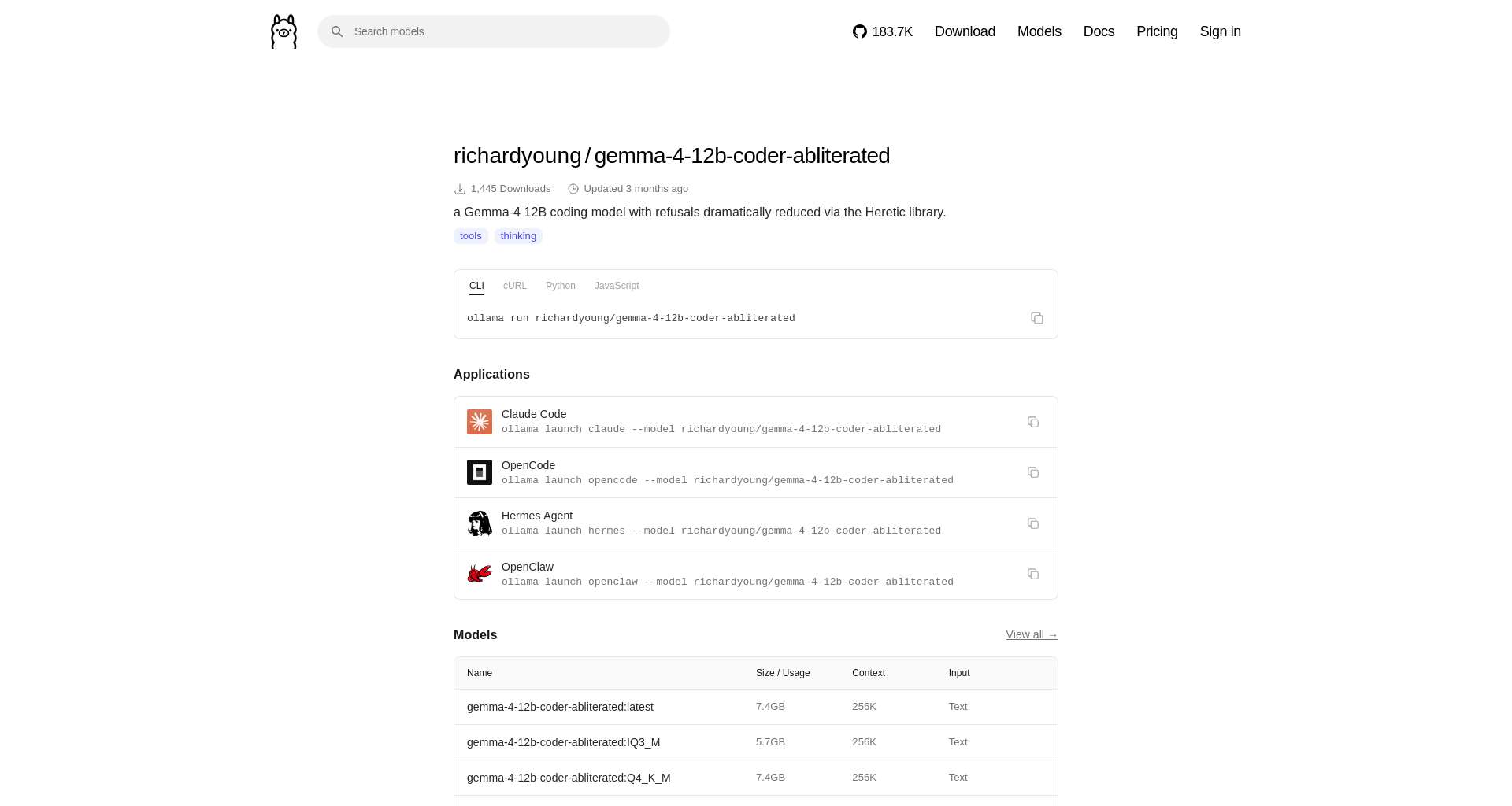
Courtesy screenshot of the public Ollama model page, captured October 18, 2026 using Trawl. The page and model belong to their respective owners; details may change.
Verdict: A good candidate when you want a newer 12B coder base and can validate the prompt format. Do not treat its unusually low refusal count as proof of better code.
3. Qwen3.5 9B Abliterated: a newer general model, not a specialist coder
The Huihui Qwen3.5 9B card labels the repository as Image-Text-to-Text and Apache-2.0, links it to Qwen/Qwen3.5-9B, and describes the edit as a crude proof-of-concept implementation. Its repository name says 9B while Hugging Face displays 10B parameters in its metadata. The page lists a current Ollama tag (huihui_ai/qwen3.5-abliterated:9b) and Transformers/vLLM routes.
That makes it relevant to a local developer who wants one general model for code discussion and occasional visual input, but do not call it a coder checkpoint: the cited card does not establish that it received code-specific fine-tuning or passed a coding benchmark. Compare it with the upstream Qwen3.5 model on your own tasks. If vision is part of the workflow, test screenshots independently; the model family’s modality tag does not prove accurate OCR or UI understanding.
Verdict: Worth a side-by-side test for general local assistance. Choose it for coding only if your own repository-level evaluation supports that choice.
4. Qwen3 8B Abliterated: experiment with a clear “research project” label
The mlabonne Qwen3-8B card shows 8B parameters and Apache-2.0, and explicitly says the project is experimental. It describes a refusal-direction approach and provides Transformers, vLLM, SGLang, and Docker Model Runner examples. The upstream Qwen3-8B card describes thinking and non-thinking modes and general capabilities including code generation; those upstream statements should not be promoted into measured claims about this derivative.
This is useful as a controlled comparison point if you already use the Qwen3 family: the lineage is legible and deployment examples are available. But it is not the same as a coder-specific checkpoint, and the model card itself warns that the result may not turn out as expected. Test normal code-edit tasks and exact output formatting, not only prompts that measure refusal.
Verdict: A reasonable general-model control for local experiments; not my first choice when the primary requirement is specialized coding quality.
5. LFM2.5 8B-A1B Uncensored: Apple MLX path, with license and evidence checks
The sahilchachra LFM2.5 card identifies an LFM2.5 derivative and includes an MLX quick start for Apple Silicon, plus local server examples that can connect to agents such as Pi. The card reports 8.3B total parameters and 1.5B active parameters for its MoE layout, while Hugging Face displays 8B. “Active” is not the same as total weight storage: do not assume the model occupies memory like a 1.5B dense model.
Its license field is “other,” so read the model’s actual terms rather than assuming permissive reuse. The maintainer reports a two-stage process and a refusal comparison on 100 harmful and 40 benign prompts. Those results are not an independent replication, and the card’s statement that coding is unaffected is not accompanied by a coding benchmark in the details shown. A separate GGUF conversion lists Q4_K_M around 4.9 GB and warns that recent llama.cpp builds are needed for its lfm2moe architecture. Verify runtime support before downloading a large file.
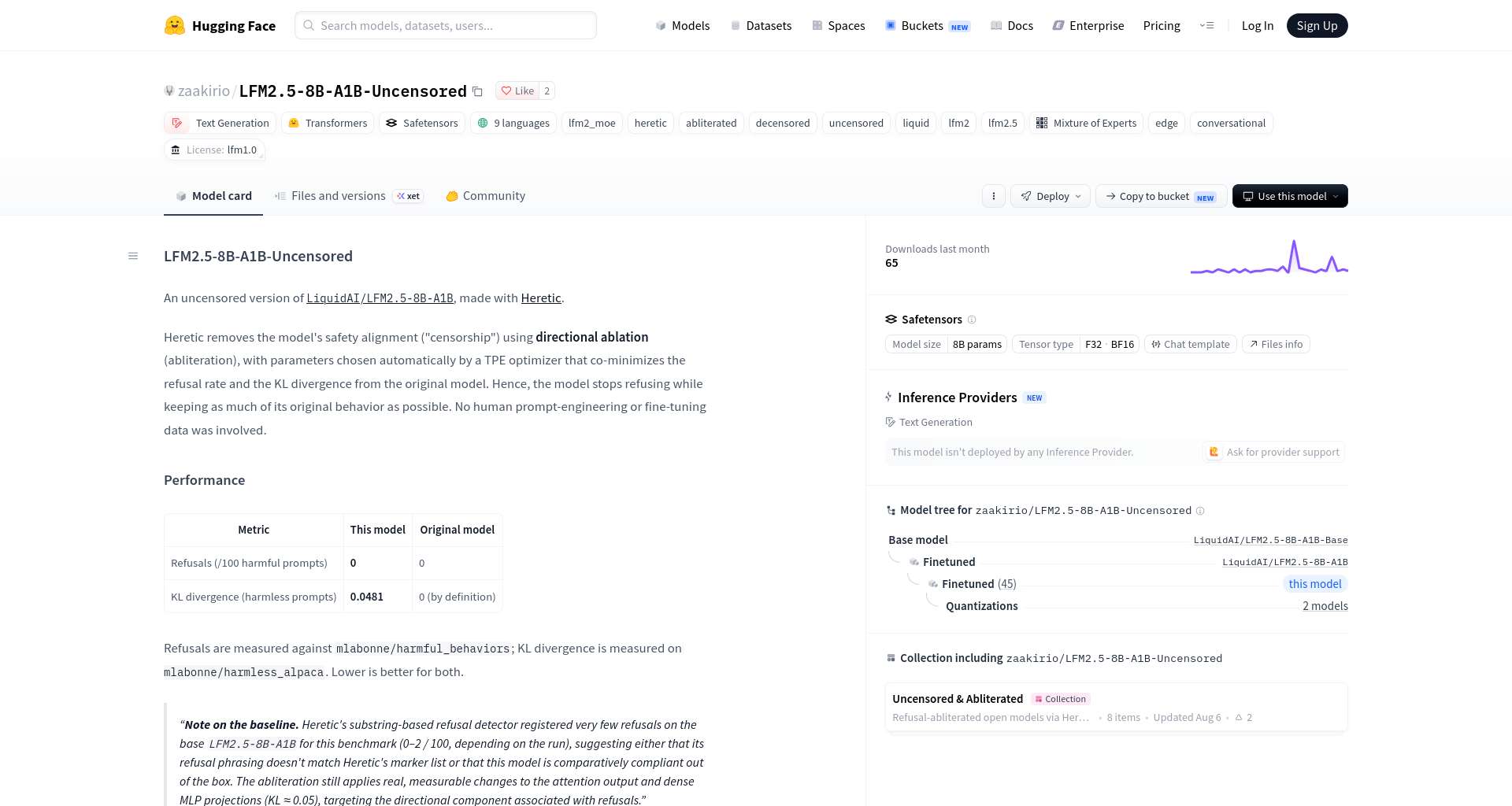
Courtesy screenshot of the public Hugging Face model card, captured October 18, 2026 using Trawl. Benchmark numbers visible on the page are claims by the model maintainer, not measurements performed for this article.
Verdict: The most interesting Apple-native route in this shortlist, but not automatically the best code model. License and coding evidence both need extra scrutiny.
How much memory do these local models need?
Treat model-card file size as the starting point, not the whole machine requirement. Quantized 7B–9B files can fit in a consumer GPU or unified-memory Mac, but the operating system, runtime, context cache, and agent tools also need memory. A 12B Q4 file around 7.5 GB leaves little headroom on an 8 GB device; a larger unified-memory machine or GPU is more comfortable. Actual use depends on context length, quantization, offload, and runtime. Use the local AI model fit tool for a first estimate, then check the exact quant file and runtime documentation.
| Approximate class | What to expect | Practical note |
|---|---|---|
| 7B–9B Q4 | Often several GB just for weights | Keep headroom for context and the OS; avoid assuming long context is free |
| 12B Q4 | Commonly around 7–8 GB for the file in this example | An 8 GB machine is not a comfortable target once runtime overhead is included |
| BF16 weights | Roughly 2 bytes per parameter before overhead | 8B BF16 implies roughly 16 GB of raw weight storage; actual allocation can be higher |
These are planning estimates, not benchmarked requirements or promised fit. Context length can increase KV-cache memory significantly, and a GGUF download’s name is not a guarantee that every Ollama/llama.cpp build supports its architecture or chat template.
A safe, useful evaluation loop for coding agents
Use a small harness before giving any model write access. Start with tasks where success is easy to inspect:
- Ask it to explain a short function and cite the relevant lines.
- Ask it to write a unit test for a known behavior.
- Give it a harmless, isolated bug with a clear expected result.
- Ask it to make a small refactor and explain the diff.
- If tool calling matters, test a read-only tool first and validate the exact JSON schema.
Run the base and derivative against the same prompts, files, context limit, sampling settings, runtime, and evaluator. Track compile/test pass rate, patch correctness, regressions, latency, peak memory, invalid tool-call rate, and how often the model invents files or APIs. Keep each output and configuration so another person can reproduce the comparison. Do not collapse all results into a single “uncensored score.”
When integrating into an agent, make refusal behavior just one property in the policy boundary. Use a clean worktree, restrict file access, keep network and shell tools disabled unless needed, require approval before destructive commands, inspect diffs, and run tests before merging. A model that is less likely to refuse must not get broader permissions by default. Browse the coding-agent directory to compare the agent harness separately from its underlying model, and the AI model directory for model metadata and other local candidates.
For a broader explanation of the method, read what abliteration changes—and what it does not. If you mainly want compact experiments rather than coding-specific models, see tiny uncensored local LLMs.
Which one should you test first?
- Coder-base comparison: begin with Qwen2.5-Coder-7B-Abliterated and its upstream instruct model.
- Newer 12B code-focused candidate: try Gemma 4 12B Coder Abliterated only after fixing the template path and confirming output structure.
- Apple Silicon experiment: investigate LFM2.5’s MLX route, but check its license and measure actual coding tasks.
- General Qwen-family control: compare Qwen3 8B or Qwen3.5 9B with its original base; don’t infer specialist coding skill from family labels.
There is no evidence in these cards that establishes one universal winner. For production agent work, a capable base model with a constrained, observable harness may outperform an “uncensored” checkpoint whose tool calls, template, or patch quality you have not measured.
Frequently asked questions
Is an uncensored coding model automatically better at programming?
No. Reduced refusal behavior is separate from code correctness, repository understanding, and tool reliability. Evaluate those independently on the same tasks.
Which model here is specifically fine-tuned for coding?
The Qwen2.5-Coder derivative and Gemma 4 12B Coder derivative identify coding-oriented upstream checkpoints. The Qwen3, Qwen3.5, and LFM examples are not shown by these cited cards to be coder-specialist fine-tunes.
Can I attach these models to OpenCode or another coding agent?
Some model pages show agent integrations or compatible local servers, but that does not certify safe behavior. Start with a disposable project, least-privilege tools, and human review of every patch.
Does “Apache-2.0” on a derivative card settle every licensing question?
It is a useful signal for that repository, not legal advice. Verify the exact revision, upstream terms, code, datasets, and intended commercial or redistribution use.
Will a 7B–12B model fit on my computer?
It depends on quantization, memory, context length, runtime overhead, and whether the GPU or Apple unified memory is shared. Check the exact file size and use a hardware-fit estimate before downloading.
Source website screenshot
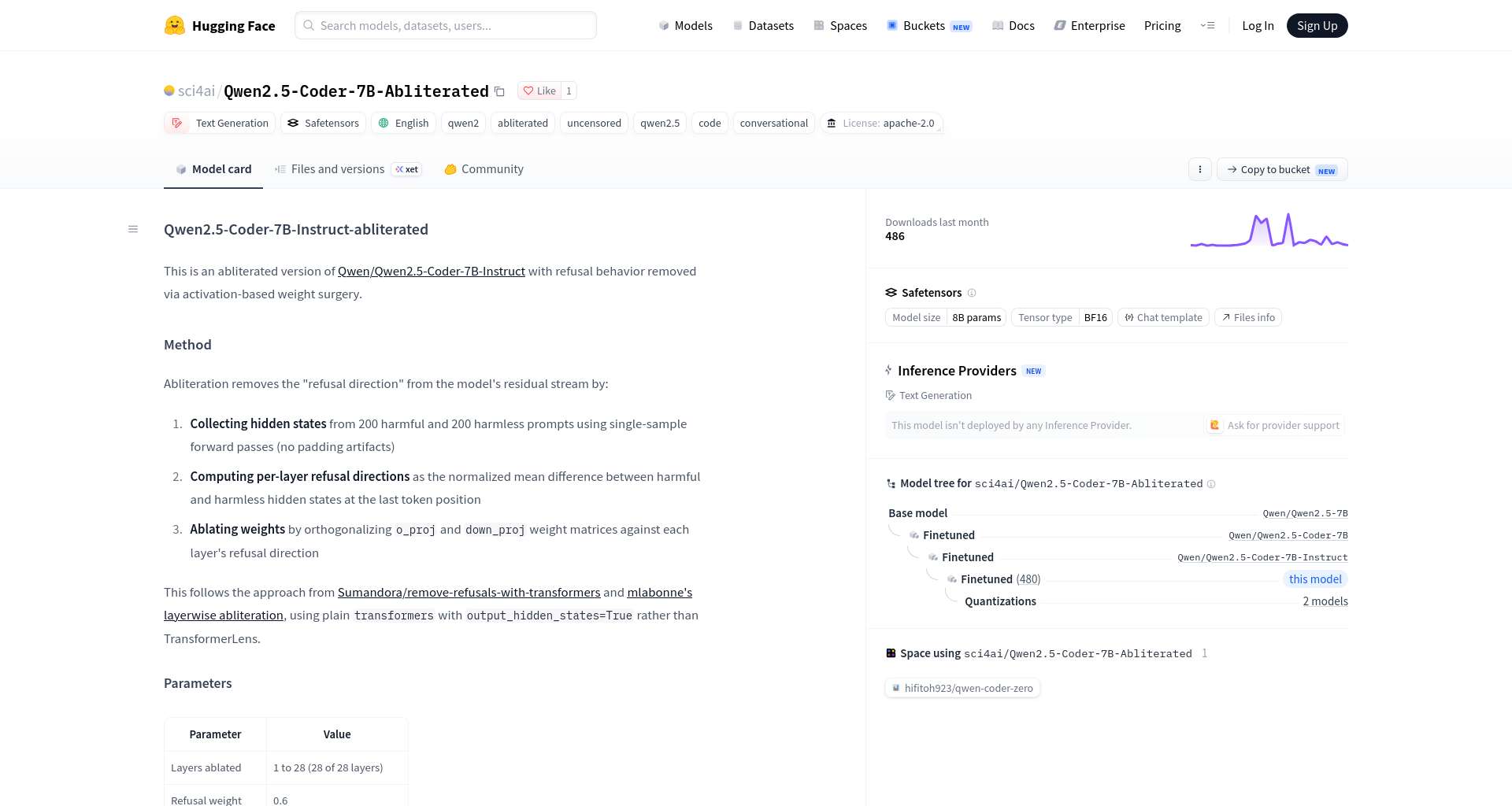
Sources and image references
- sci4ai Qwen2.5-Coder-7B-Abliterated model card
- Ollama Gemma-4-12B-Coder-Abliterated page
- Google Gemma 4 model card and upstream license
- Huihui Qwen3.5-9B-Abliterated model card
- mlabonne Qwen3-8B-Abliterated model card
- Official Qwen3-8B model card
- sahilchachra LFM2.5-8B-A1B-Uncensored model card
- zaakirio LFM2.5-8B-A1B-Uncensored GGUF conversion and runtime notes
- Screenshots above are point-in-time Trawl captures of the linked public Ollama and Hugging Face pages. They are credited at the image locations; interface content and model claims belong to their respective owners.
Keep reading
Related reading
⚡ AI Engineering Briefing
AI model releases, practical tutorials, developer tools, and engineering research. Unsubscribe anytime.
Comments
Comments are temporarily unavailable while the public discussion space is being configured.