Gemini 3.6 Flash: What Developers Need to Know
> Google's Gemini 3.6 Flash cuts token use, adds new pricing, and rolls out to GitHub Copilot. Learn what developers can use now and how teams should test it.
🎧 Listen — ~7 min
Audio generating··· Deepgram pipeline queued
Gemini 3.6 Flash: What Developers Need to Know
Google released Gemini 3.6 Flash and Gemini 3.5 Flash-Lite on July 21, 2026, positioning both models for production AI agents. The release is less about a single dramatic benchmark win and more about the operating costs of agentic software: how many tokens a task consumes, how quickly a model responds, and where developers can actually select it.
The same day, GitHub announced that Gemini 3.6 Flash is rolling out across GitHub Copilot. That gives developers a second path to test Google’s new model: directly through the Gemini API and Google AI Studio, or inside familiar coding tools such as Visual Studio Code, JetBrains, Copilot CLI, and GitHub’s cloud agent.
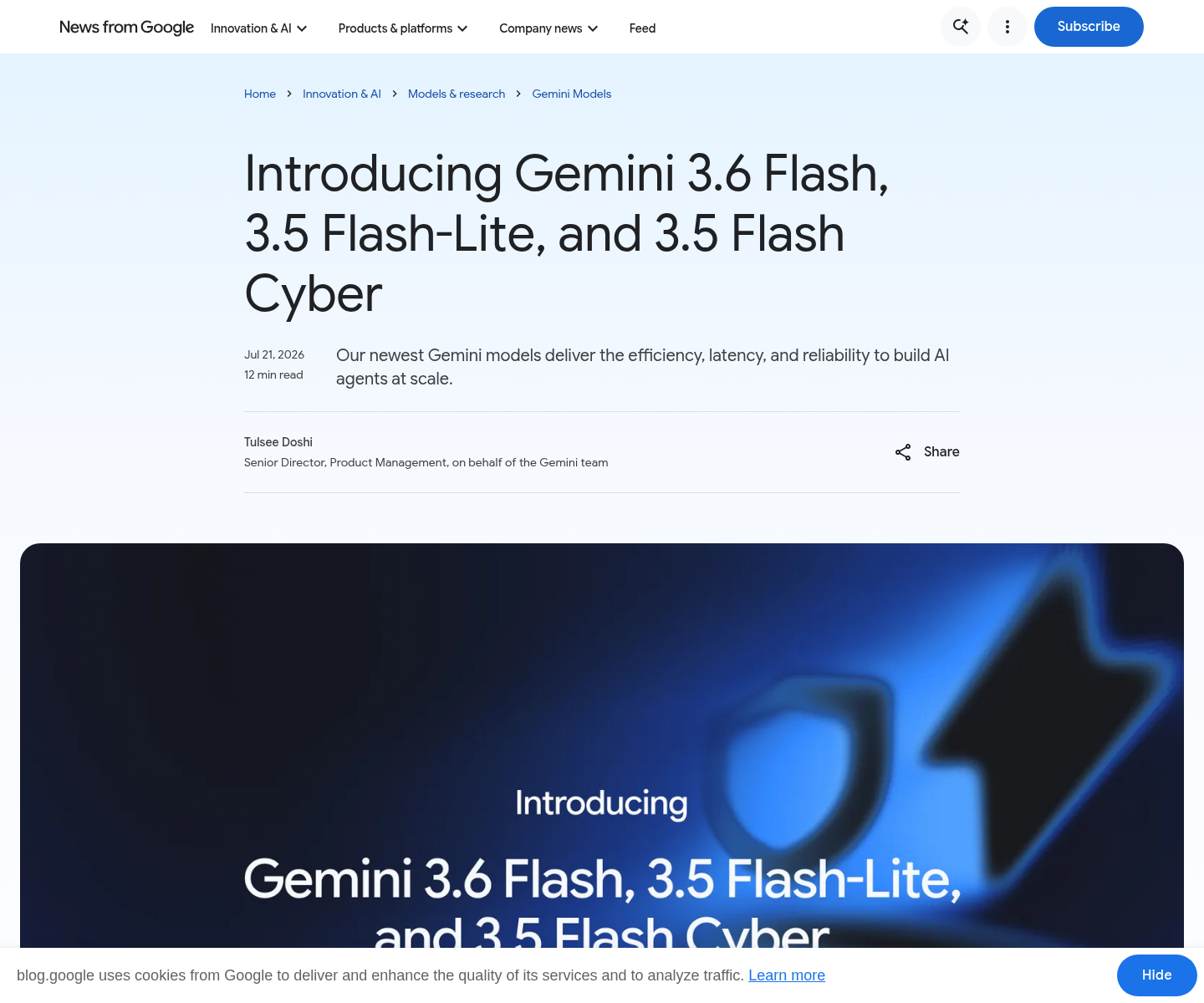
Courtesy: Google. Source: https://blog.google/innovation-and-ai/models-and-research/gemini-models/gemini-3-6-flash-3-5-flash-lite-3-5-flash-cyber/. Accessed: 2026-07-22.
The screenshot proves the announcement is an official Google release and shows the product scope: 3.6 Flash for coding and knowledge work, 3.5 Flash-Lite for speed and cost, and a restricted cyber-security model used with CodeMender. It does not prove that every benchmark will translate to every application, so the practical takeaways below keep Google’s claims separate from my analysis.
What Google released
Gemini 3.6 Flash is the general-purpose workhorse. Google says it improves coding, knowledge work, multimodal tasks, and multi-step agent workflows over Gemini 3.5 Flash. The company reports 17% lower output-token usage on the Artificial Analysis Index and says its price is lower than the previous model: $1.50 per million input tokens and $7.50 per million output tokens.
Gemini 3.5 Flash-Lite targets throughput. Google describes it as the fastest model in the 3.5 series, with 350 output tokens per second according to the Artificial Analysis Index. Its listed price is $0.30 per million input tokens and $2.50 per million output tokens. That makes it a candidate for classification, document processing, agent routing, and other high-volume tasks where a larger model would be wasteful.
The third release is Gemini 3.5 Flash Cyber. It is not a generally available API model. Google says the cyber-focused model is paired with CodeMender and will initially be available only to governments and trusted partners through a limited-access pilot. Treating that as a normal developer option would be inaccurate.
The numbers are useful, but they are not one leaderboard
Google’s announcement includes several task-specific results. The table below keeps the evaluation names intact instead of implying that they are interchangeable.
| Model comparison | Evaluation | Google-reported result |
|---|---|---|
| Gemini 3.6 Flash vs 3.5 Flash | DeepSWE | 49% vs 37% |
| Gemini 3.6 Flash vs 3.5 Flash | MLE Bench | 63.9% vs 49.7% |
| Gemini 3.6 Flash vs 3.5 Flash | OSWorld-Verified | 83.0% vs 78.4% |
| Gemini 3.5 Flash-Lite vs 3.1 Flash-Lite | Terminal-Bench 2.1 | 54% vs 31% |
| Gemini 3.5 Flash-Lite vs 3.1 Flash-Lite | GDPval-AA v2 | 1,140 vs 642 |
| Gemini 3.5 Flash-Lite vs 3 Flash | SWE-Bench Pro | 54.2% vs 49.6% |
These figures are reported by Google, not independently reproduced in this article. They can guide a test plan, but they cannot predict your exact repository’s pass rate, latency, or cost. A coding benchmark may reward one style of patch generation while a production agent spends most of its budget on tool calls, retrieval, or retries.
Why token efficiency matters for AI agents
For a chat response, a 17% reduction in output tokens may feel minor. For an agent running thousands of tasks, it can affect both the bill and the time spent waiting for downstream tools. Fewer tokens can also reduce the amount of text that must be parsed, stored, or passed into a later step.
There is a catch: token efficiency is valuable only when the task still finishes correctly. A shorter response that omits a test, skips a file, or triggers a retry is not cheaper in practice. Developers should measure completed-task cost, not only the model’s price per million tokens.
My recommended test is a small replay set from your own work: bug fixes, documentation changes, extraction, and one multi-tool workflow. Record success rate, total tokens, wall-clock time, tool-call count, and human edits before changing a production route.
GitHub Copilot makes the comparison easier to run
GitHub says Gemini 3.6 Flash is gradually rolling out to Copilot Pro, Pro+, Max, Business, and Enterprise users. The model is available through the model picker in Visual Studio Code, Visual Studio, Copilot CLI, GitHub Copilot cloud agent, the Copilot app, JetBrains, Xcode, and Eclipse. Business and Enterprise administrators must first enable the Gemini 3.6 Flash Preview policy.
The rollout is usage-based and billed at provider list pricing, according to GitHub’s changelog. That detail matters for teams that assume a model picker is covered entirely by a flat subscription. Check the current Copilot model pricing documentation before assigning the model to automated workflows.
GitHub’s integration gives developers a way to compare model behavior inside a real editor and agent surface. That is more informative than a one-off playground prompt because tools, context selection, approval flow, and patch review shape the result.
A practical rollout plan
Start with an evaluation branch. Pin representative prompts and keep the repository, tool permissions, and acceptance checks constant. Then compare:
- Task completion: Did the agent produce an accepted change?
- Review burden: How many lines needed correction?
- Cost: What did the full task consume, including retries?
- Latency: How long did the user or pipeline wait?
- Safety: Did the agent request sensitive access or make unrelated edits?
Use Gemini 3.6 Flash when coding quality and longer-horizon work justify the price. Consider Flash-Lite for high-volume, lower-risk operations such as triage, labeling, routing, and first-pass extraction. Keep a larger model as an escalation path for tasks that fail validation rather than paying the larger price for every request.
Developers can start with the Gemini API model guide or try the model in Google AI Studio. For broader context on agent construction, see my guides to AI coding agents, CLIs, IDEs, skills, and plugins and agent stacks, MCP, and ACP.
What is confirmed, and what is still unknown
Confirmed: Google announced the two generally available Flash models on July 21; Google published the listed prices and benchmark comparisons; GitHub announced a gradual Copilot rollout; and Gemini 3.5 Flash Cyber is limited to a pilot through CodeMender.
Still unknown from these announcements: how the models perform on your codebase, how Copilot’s usage-based charges will affect your monthly spend, and how quickly every Copilot surface will receive access. Those questions need measurement in your environment. No rumor or social-media claim is needed to make a useful decision today.
FAQs
What is Gemini 3.6 Flash?
Gemini 3.6 Flash is Google’s new general-purpose Flash model for coding, knowledge work, multimodal tasks, and AI-agent workflows. Google says it uses 17% fewer output tokens than Gemini 3.5 Flash on the Artificial Analysis Index and lists lower prices for input and output tokens.
Is Gemini 3.6 Flash available in GitHub Copilot?
Yes. GitHub says it is gradually rolling out to Pro, Pro+, Max, Business, and Enterprise plans. It can appear in the model picker across major IDEs, Copilot CLI, the cloud agent, and other Copilot surfaces. Business and Enterprise administrators must enable the preview policy.
Which Gemini model is cheapest?
Among the models covered in Google’s announcement, Gemini 3.5 Flash-Lite has the lowest listed price: $0.30 per million input tokens and $2.50 per million output tokens. Actual task cost also depends on prompt size, retries, tool calls, and the amount of output required.
Can anyone use Gemini 3.5 Flash Cyber?
No. Google says Gemini 3.5 Flash Cyber will be available through CodeMender to governments and trusted partners in a limited-access pilot. It should not be described as a public API release.
Conclusion: test the workflow, not the headline
Gemini 3.6 Flash is interesting because Google is connecting model quality to the economics of agent execution, while GitHub is putting the model inside the tools developers already use. Flash-Lite adds a lower-cost route for high-throughput work. The sensible next step is a controlled replay of your own tasks with acceptance checks and cost tracking.
If you are building an AI coding or automation system, start with ten real tasks, record the five metrics above, and promote the model only when it improves the full workflow. For more practical AI engineering notes, browse the AI tools directory and subscribe to the newsletter.
Sources
- Google: Introducing Gemini 3.6 Flash, 3.5 Flash-Lite, and 3.5 Flash Cyber — July 21, 2026.
- GitHub Changelog: Gemini 3.6 Flash is now available in GitHub Copilot — July 21, 2026.
- Google AI for Developers: Latest model guide — accessed July 22, 2026.
- GitHub Docs: Copilot model billing and pricing — accessed July 22, 2026.
Keep reading
Related reading
⚡ Daily AI Model Drop — Get Kimi K3 benchmarks before Twitter
Join 2,400+ AI engineers. 1 email/day, no spam, unsubscribe anytime