AI Model Tracker: Releases and Benchmark Signals from the Last Seven Days
> A cautious weekly tracker of Gemini 3.5 Flash Cyber and Laguna S 2.1, with labeled benchmark provenance and reproducibility notes.
🎧 Listen — ~6 min
Audio generating··· Deepgram pipeline queued
AI model tracker: the releases and benchmark signals that mattered this week
Published July 22, 2026 · 1,287 words · Research window: July 15–22, 2026 (UTC)
The clearest AI-model signal from the last seven days is not a single new general-purpose leaderboard champion. It is specialization: Google introduced a lightweight cyber model for defenders, while Poolside released an open-weight coding model designed for long-horizon agent work. Both announcements also make the same methodological point: benchmark numbers are only useful when you know the harness, attempt count, provenance, and safety configuration behind them.
This week’s releases at a glance
| Release | What is new | Availability | Benchmark framing |
|---|---|---|---|
| Gemini 3.5 Flash Cyber (Google DeepMind, July 21) | A Flash-based model fine-tuned to find, validate, and patch vulnerabilities | Limited-access pilot for governments and trusted partners via CodeMender | Google reports CyberGym results and internal Big Sleep and Chrome evaluations; competitor scores are explicitly provider self-reported |
| Laguna S 2.1 (Poolside, July 21) | 118B-total-parameter MoE, about 8B active per token, with a 1M-token context window | Open weights on Hugging Face under OpenMDW-1.1 | Poolside publishes benchmark scores and full evaluation trajectories, but notes that some comparison figures come from different providers and harnesses |
The release dates and capabilities above come from the vendors’ own announcements and model card. The table is a release comparison, not a merged ranking.
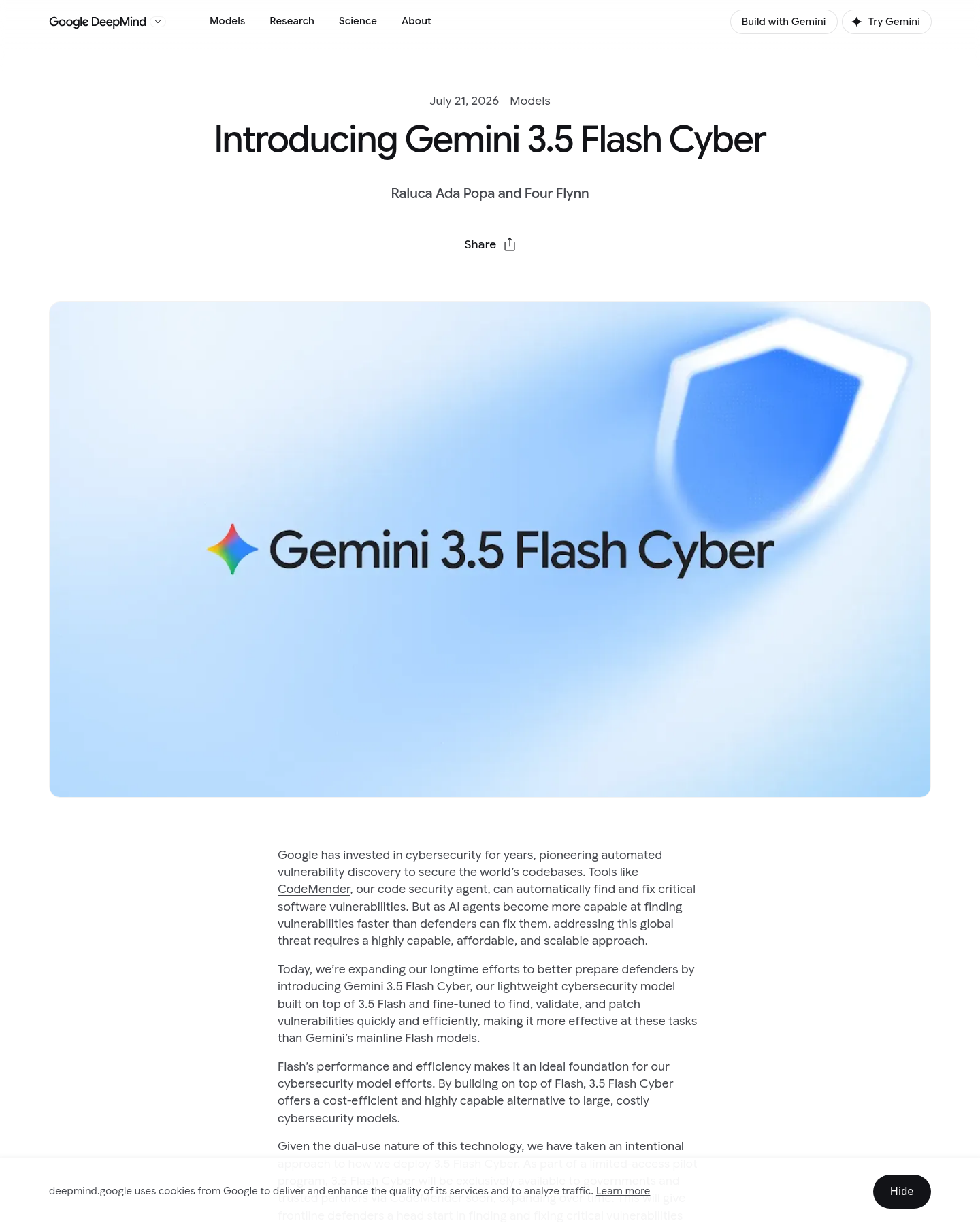
Courtesy: Google DeepMind. Source: https://deepmind.google/blog/introducing-gemini-3-5-flash-cyber/. Accessed: 2026-07-22.
This visual proves that Gemini 3.5 Flash Cyber is presented as a specialized, limited-access cybersecurity release, not a generally available replacement for Google’s mainline Flash models. It also shows why the benchmark section needs careful reading: the announcement distinguishes its own evaluations from competitor results.
Gemini 3.5 Flash Cyber: capability through repeated, cheaper calls
Google’s thesis is economic as much as technical. A lightweight model can explore more code paths when an agent invokes it repeatedly. CodeMender can call Gemini 3.5 Flash Cyber up to five times and consolidate those findings into one report, trading one very expensive call for broader search over a large execution space.
On CyberGym, Google says the configured CodeMender agent achieved competitive performance against significantly larger cybersecurity models. The footnote matters: “Competitor results are sourced from provider self-reported scores.” That means the comparison is vendor-reported on both sides and should not be read as an independent leaderboard.
Google also describes two internal evaluations. In a Big Sleep evaluation focused on hard-to-find vulnerabilities in complex codebases, the company says Flash Cyber surpassed mainline Gemini 3.5 Flash and Gemini 3.6 Flash. On Google’s Chrome production commit-scanning pipeline, it reports a significant uplift over 3.5 Flash. Those are useful directional signals, but they are not public, independently reproducible benchmark results.
One concrete count is more legible than a leaderboard position: across a fixed number of V8 JavaScript Engine invocations, Google says Flash Cyber found 55 unique confirmed issues, compared with 47 for mainline 3.5 Flash and 36 for Claude Opus 4.6. That is still a Google-run evaluation, so I treat it as a vendor-reported result rather than an independent score. The result supports Google’s narrower claim—that repeated, low-cost exploration can improve vulnerability discovery—not a broad claim that this is the best model for every coding task.
The deployment constraint is equally important. Flash Cyber is entering a limited-access pilot for governments and trusted partners through CodeMender. For most developers, the near-term takeaway is architectural: model selection, call count, and aggregation strategy can matter as much as raw model size.
Laguna S 2.1: open weights aimed at long-horizon coding
Poolside’s Laguna S 2.1 takes a different route. It is a 118B Mixture-of-Experts model with roughly 8B activated parameters per token, a 1,048,576-token context window, native thinking support, and published quantized variants. Poolside positions it between its smaller Laguna XS 2.1 and larger Laguna M.1, with local and self-hosted serving in mind.
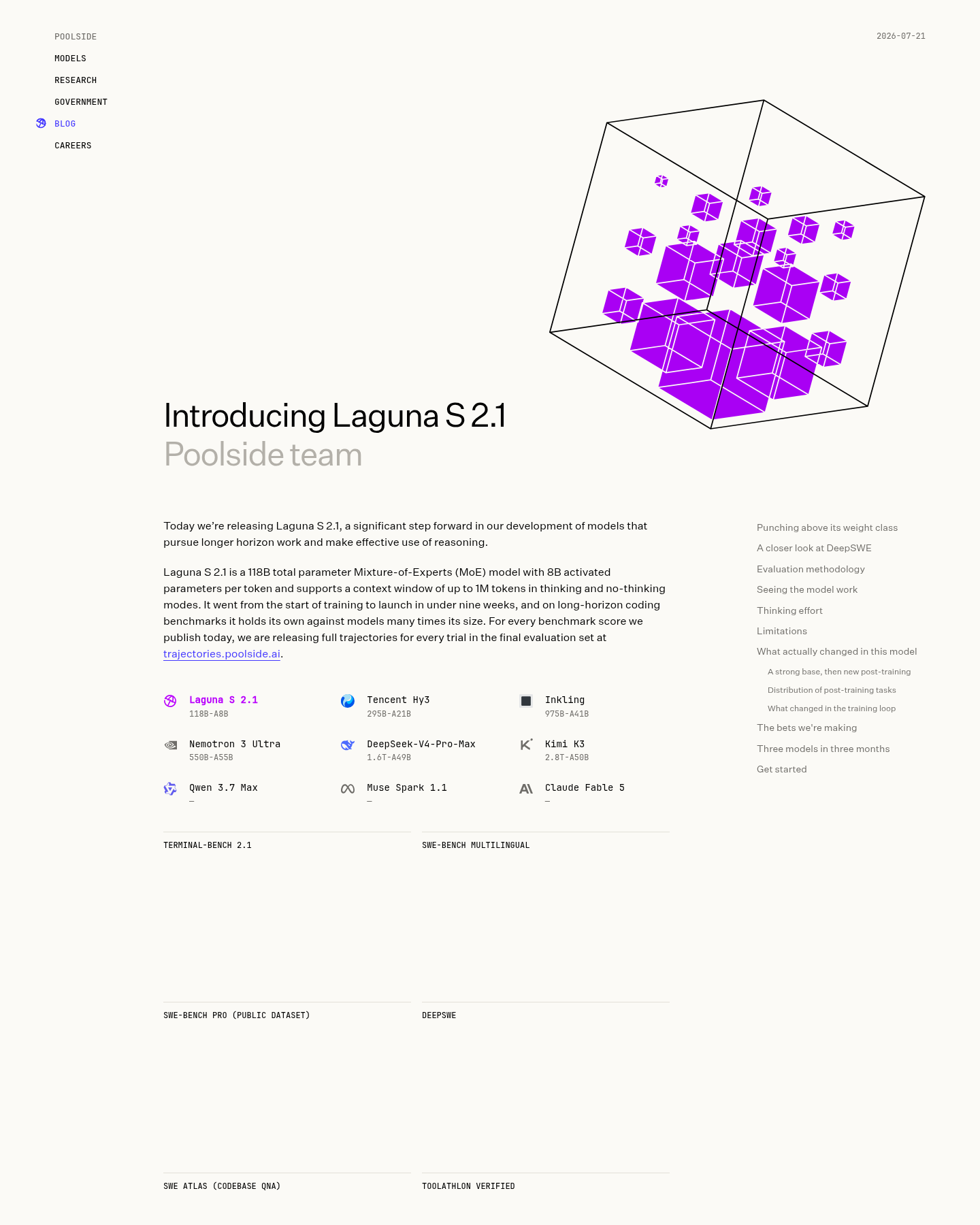
Courtesy: Poolside. Source: https://poolside.ai/blog/introducing-laguna-s-2-1. Accessed: 2026-07-22.
This visual proves that Poolside is shipping an open-weight coding model together with a public evaluation story, including links to full trajectories. It does not prove that every comparison number was produced under one common harness.
An original chart from the cited values
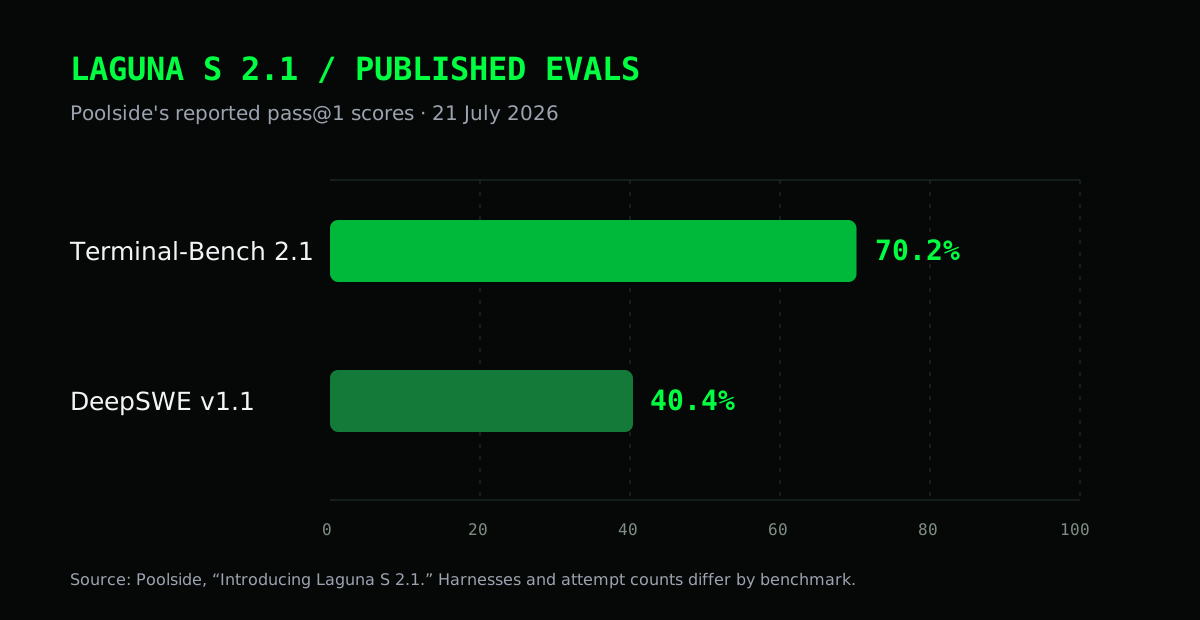
Courtesy: Essa Mamdani. Source: https://poolside.ai/blog/introducing-laguna-s-2-1. Accessed: 2026-07-22.
The chart uses only the two Laguna S 2.1 values Poolside publishes: 70.2% on Terminal-Bench 2.1 and 40.4% on DeepSWE v1.1. Poolside says Terminal-Bench scores average pass@1 over four attempts per task; DeepSWE uses three attempts. That makes the chart a compact view of the release’s own reported results, not a cross-vendor normalized ranking.
Poolside’s model card adds useful implementation detail: 48 layers, a mixture of global and sliding-window attention, 256 routed experts plus one shared expert, and compatibility with vLLM, SGLang, Transformers, TensorRT-LLM, and llama.cpp. The practical appeal is clear for teams that need long context and want control over data locality, serving, and quantization.
The benchmark caveat is unusually explicit. Poolside says it takes the maximum of vendor self-reported scores, benchmark-author leaderboards, or Artificial Analysis for most comparisons, while excluding third-party figures for SWE Atlas. It also says its DeepSWE result comes from Poolside’s own “pool” harness, while other models may be represented by leaderboard results from another harness. I therefore report Laguna’s numbers as Poolside-reported and do not combine them with Google’s internal evaluations.
What changed for model buyers?
Three buying signals stand out.
First, specialized models are becoming more credible when the workflow supplies the missing breadth. Flash Cyber’s value is not merely its single-call accuracy; it is the ability to run many affordable passes over a large codebase. Second, open weights remain strategically relevant for sensitive workloads: Laguna S 2.1’s local-serving options offer a path for organizations that cannot send code or incident data to a hosted API. Third, evaluation transparency is now a product feature. Poolside’s trajectories and Google’s description of safety settings give readers more to inspect than a headline score alone.
For broader context, compare this week’s releases with my guides to AI coding agents, CLIs, IDEs, skills, and plugins and agent stacks, MCP, and ACP. If you are weighing hosted versus self-managed inference, the paid vs. free AI tools guide is a useful adjacent read.
FAQ
Is Gemini 3.5 Flash Cyber generally available?
No. Google says it is initially limited to governments and trusted partners through CodeMender. General customers can access CodeMender’s foundational capabilities through generally available Gemini models, but that is distinct from access to Flash Cyber itself.
Is Laguna S 2.1 open source?
It is an open-weight model released under Poolside’s OpenMDW-1.1 license. “Open weights” does not automatically mean every training detail, dataset, or evaluation condition is open.
Which model scored higher?
There is no defensible single answer from these announcements. Google’s results include internal and provider-reported evaluations; Poolside publishes its own scores and a mixed-provenance comparison table. The two releases target different tasks.
How should I use these benchmark numbers?
Treat them as hypotheses to test on your workload. Record model version, prompt, harness, attempt count, tool permissions, safety settings, and cost. Re-run a small private suite before making a production decision.
Source notes and methodology
I searched for releases and benchmark announcements dated July 15–22, 2026 UTC, then prioritized official vendor, model-card, and project pages. I included only claims I could trace to the cited primary pages. Vendor-reported scores, internal evaluations, third-party leaderboard values, and independent results are kept labeled and are not merged into one composite ranking. Scores may vary with harness, sampling, tool setup, safety refusals, and contamination; the release pages themselves document several of those limitations.
Sources: Google DeepMind’s Gemini 3.5 Flash Cyber announcement, Poolside’s Laguna S 2.1 announcement, and the Laguna S 2.1 model card. All accessed 2026-07-22 UTC.
Keep reading
Related reading
⚡ Daily AI Model Drop — Get Kimi K3 benchmarks before Twitter
Join 2,400+ AI engineers. 1 email/day, no spam, unsubscribe anytime