Cisco Antares Targets Vulnerability Localization
> Cisco's Antares-350M and Antares-1B are open-weight models for vulnerability localization. The VLoc Bench and model cards show why security teams care.
🎧 Listen — ~7 min
Audio summary not available yet
Cisco Foundation AI shipped a narrow security model family on July 21: Antares-350M and Antares-1B. The goal is not generic code generation. It is to find the files most likely to contain a known vulnerability inside a repository.
The release matters because Cisco says the models are compact enough to run locally, which keeps sensitive code inside the team boundary. That makes Antares feel less like a chatbot and more like a triage tool. If you already treat model output as a contract boundary, the same discipline applies here. My earlier posts on MCP Security Threat Modeling and Structured Outputs for Reliable AI APIs are the right mental model.
What Cisco actually shipped
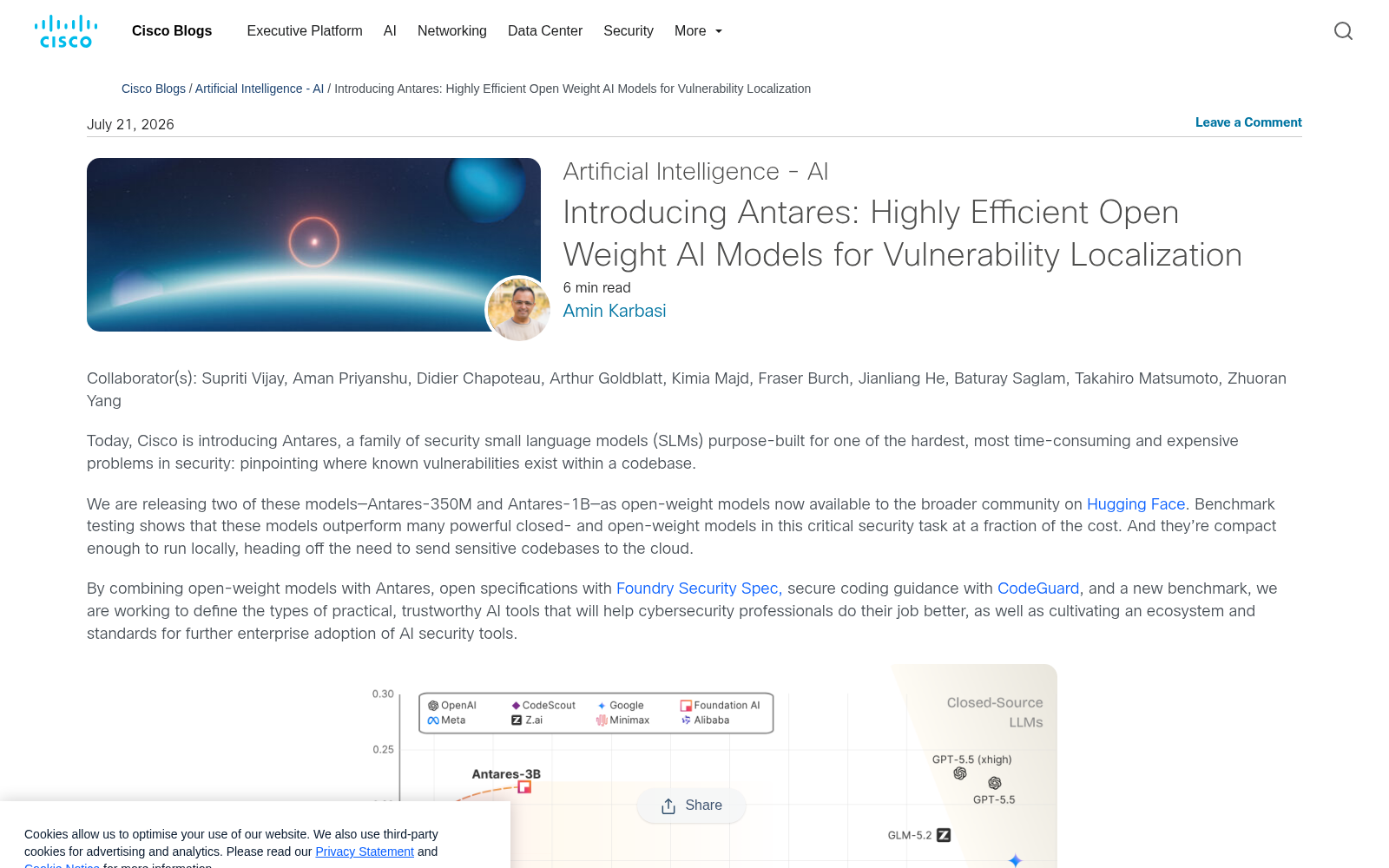
This screenshot confirms the basics: the release date, the open-weight framing, and the task boundary. Cisco is not claiming a universal code assistant. It is claiming a specialized security system that can localize vulnerable files from a CWE-style description and a repository snapshot.
The models sit on IBM Granite 4.0 checkpoints and are released through Hugging Face. Cisco's own announcement says the family includes Antares-350M and Antares-1B, with Antares-3B teased as coming soon. The important part for developers is the deployment posture. Local or on-prem use means you can evaluate sensitive repositories without handing them to a cloud service first.
That matters for incident response on proprietary code, compliance-heavy shops that cannot move data out of boundary, and CI/CD pipelines where a security pass must run before merge. In each case, the question is whether the model can reduce the first pass of human triage.
How the benchmark is set up
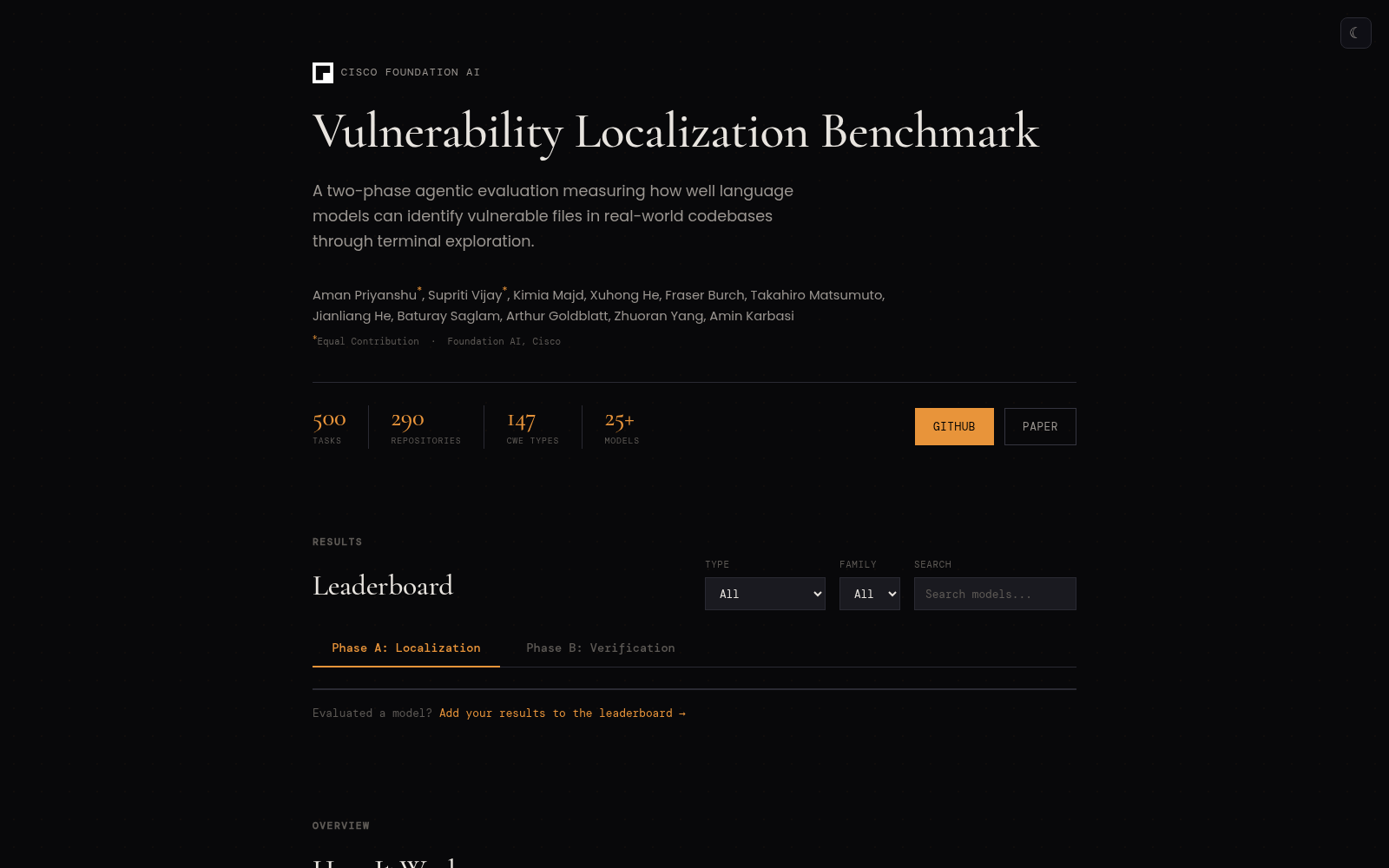
VLoc Bench is useful because it is closer to the real job. The benchmark site describes a two-phase agentic evaluation. Phase A asks a model to explore a repository and localize the vulnerable files. Phase B checks whether the patched repository really stays clean. The site says the benchmark contains 500 tasks, 290 repositories, 147 CWE types, and 25+ evaluated models.
That shape matters. Static benchmarks are easy to overfit. A terminal-driven repo search is harder to fake because the model has to read, search, backtrack, and stop when the evidence is good enough. In other words, the benchmark rewards the behavior security reviewers actually want: focused exploration, narrow claims, and a sane stopping rule.
Cisco says repository size is a major difficulty factor, and the benchmark page says 190 of 500 tasks remain unsolved by every evaluated model. The problem space is still hard. A better model lowers the cost of reaching a defensible first answer; it does not cancel complexity.
What the model cards add
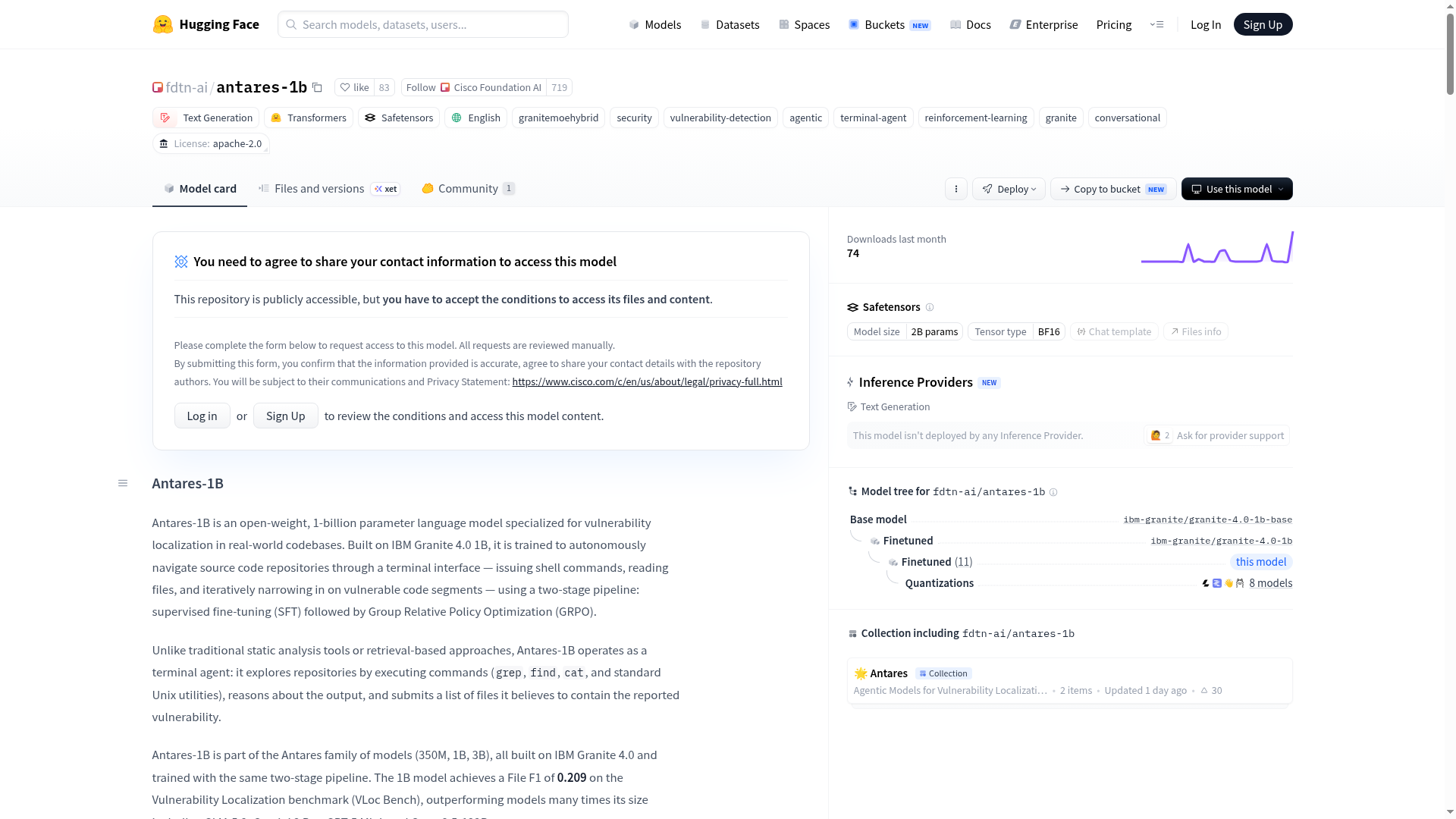
The model cards do more than repeat the announcement. They spell out the intended use, architecture, license, training approach, and operating assumptions. For Antares-1B, Cisco describes a terminal agent built on IBM Granite 4.0 1B, trained in two stages, and designed to issue shell commands, inspect files, and return likely vulnerable paths.
That framing is important because it changes how you should think about adoption. Antares is not a replacement for static analysis, dependency scanning, secret detection, or human review. It is a specialized front-end for the first, messy step of source-code security work. Used well, it can shrink the search space before a human spends time on deep verification.
| Model | Parameters | File F1 on VLoc Bench | Deployment shape | Best fit |
|---|---|---|---|---|
| Antares-350M | 350M | 0.135 | local or single-GPU | cheap first-pass localization |
| Antares-1B | 1B | 0.209 | local or single-GPU | stronger triage and CI gating |
Cisco's model cards also say the family is Apache 2.0 licensed and intended for local deployment in environments that prioritize security and control. For teams handling proprietary code, that is a material difference from an API-first workflow.
Reading the numbers without overreading them
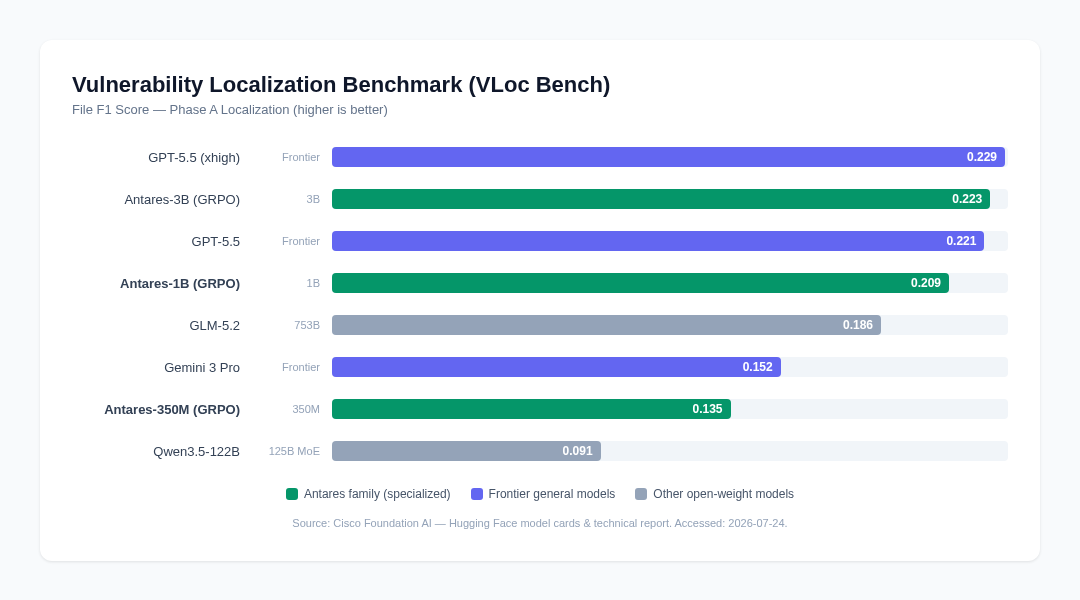
The benchmark chart is the cleanest way to read the headline numbers. Antares-1B posts a File F1 of 0.209, while Antares-350M lands at 0.135. Cisco's chart shows that a small, task-specific model can stay competitive with much larger general-purpose systems when the workload is narrow.
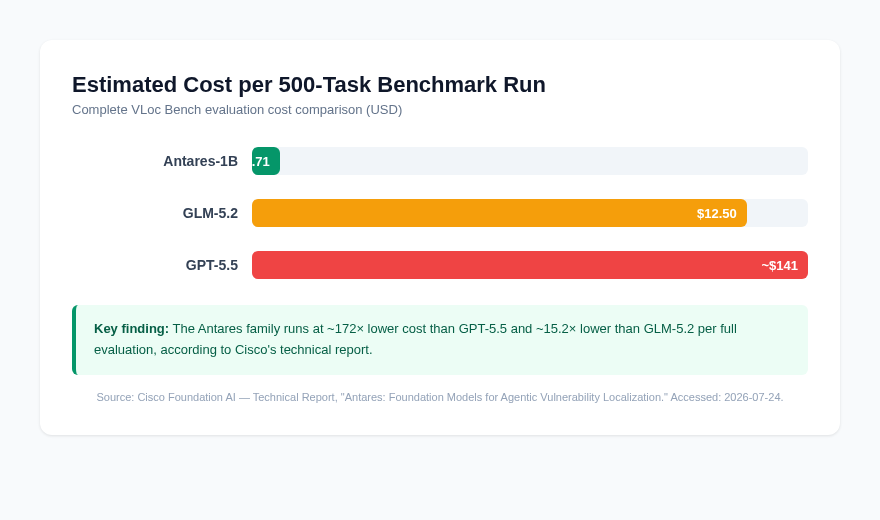
The cost chart pushes the story from accuracy into operations. If Cisco's technical-report accounting is the right basis, the full 500-task sweep is dramatically cheaper for Antares-1B than for large general models.
My read is simple: the product story is the combination of localization quality, local deployment, and low run cost. For a senior developer, that means Antares is most interesting as an always-on assistant inside your secure perimeter.
What senior teams should do next
Start small. Pick one internal repository, one fixed advisory type, and one human reviewer. Measure time to first plausible file, final analyst agreement, and cost per successfully localized issue.
I would also keep the boundary work from OpenTelemetry GenAI Observability close by. If you cannot tell which prompts produced which candidate files, you will not be able to debug the workflow when it misses something important. And if you are wiring the model into a larger agent stack, the orchestration patterns in AI Agent Stacks are a good reminder that tools, permissions, and memory matter as much as model size.
The practical rule is: let Antares narrow the search, not make the final security decision. Keep static analysis, patch verification, and human approval in the loop.
Conclusion
Cisco's Antares release is most useful when you need local, repeatable first-pass vulnerability localization. Test it on one repository and compare the results to your current manual triage lane. The goal is faster, better security review with fewer blind spots.
FAQs
What is vulnerability localization?
Vulnerability localization is the task of finding the source files most likely to contain a known weakness, usually from a CWE or advisory description. It is narrower than code generation or patching, but it is often the hardest part of triage because the relevant evidence is spread across a repository.
Is Antares a replacement for static analysis?
No. Cisco positions Antares as a security localization model, not as a full application-security stack. Static analysis, SCA, secret scanning, and human review still matter. Antares is best treated as a first-pass investigator that can reduce search time before deeper tools run.
Can Antares run locally?
Yes. Cisco says the models are compact enough to run locally and that the family is intended for environments that need security and operational control. That is one of the main reasons this release is interesting for regulated teams and on-prem deployments.
How should I read the benchmark numbers?
Treat them as benchmark evidence, not a guarantee. The VLoc Bench numbers show how the models behaved on 500 curated tasks in Cisco's setup. Your own repos, prompts, permissions, and review standards may produce different results.
Source list and methodology
I used primary sources from the last 24-48 hours UTC and kept vendor claims separate from my analysis. The main sources were Cisco's announcement, the VLoc Bench homepage, the Antares-1B and Antares-350M model cards, and Cisco's technical report.
Primary sources:
- Cisco announcement: https://blogs.cisco.com/ai/introducing-antares-the-most-efficient-open-weight-ai-models-for-vulnerability-localization
- VLoc Bench homepage: https://cisco-foundation-ai.github.io/vulnerability-localization-benchmark/
- Antares-1B model card: https://huggingface.co/fdtn-ai/antares-1b
- Antares-350M model card: https://huggingface.co/fdtn-ai/antares-350m
- Technical report: https://cisco-foundation-ai.github.io/antares/technical-report.pdf
If you run a local security-localization eval with Antares, measure analyst time saved, false positives, and cost per verified issue.
Keep reading
Related reading
⚡ Daily AI Model Drop — Get Kimi K3 benchmarks before Twitter
Join 2,400+ AI engineers. 1 email/day, no spam, unsubscribe anytime