Cisco Antares: Small AI for Vulnerability Triage
> Cisco Antares brings open-weight 350M and 1B models to vulnerability localization. Review benchmark scores, costs, workflow, and security limits for teams.
🎧 Listen — ~7 min
Ready · Cisco Antares: Small AI for Vuln
Meta description: Cisco Antares brings open-weight 350M and 1B models to vulnerability localization. Review benchmark scores, costs, workflow, and security limits for teams.
Primary keyword: Cisco Antares vulnerability localization
Secondary keywords: Antares-350M, Antares-1B, VLoc Bench, open-weight security AI, vulnerability triage
Introduction
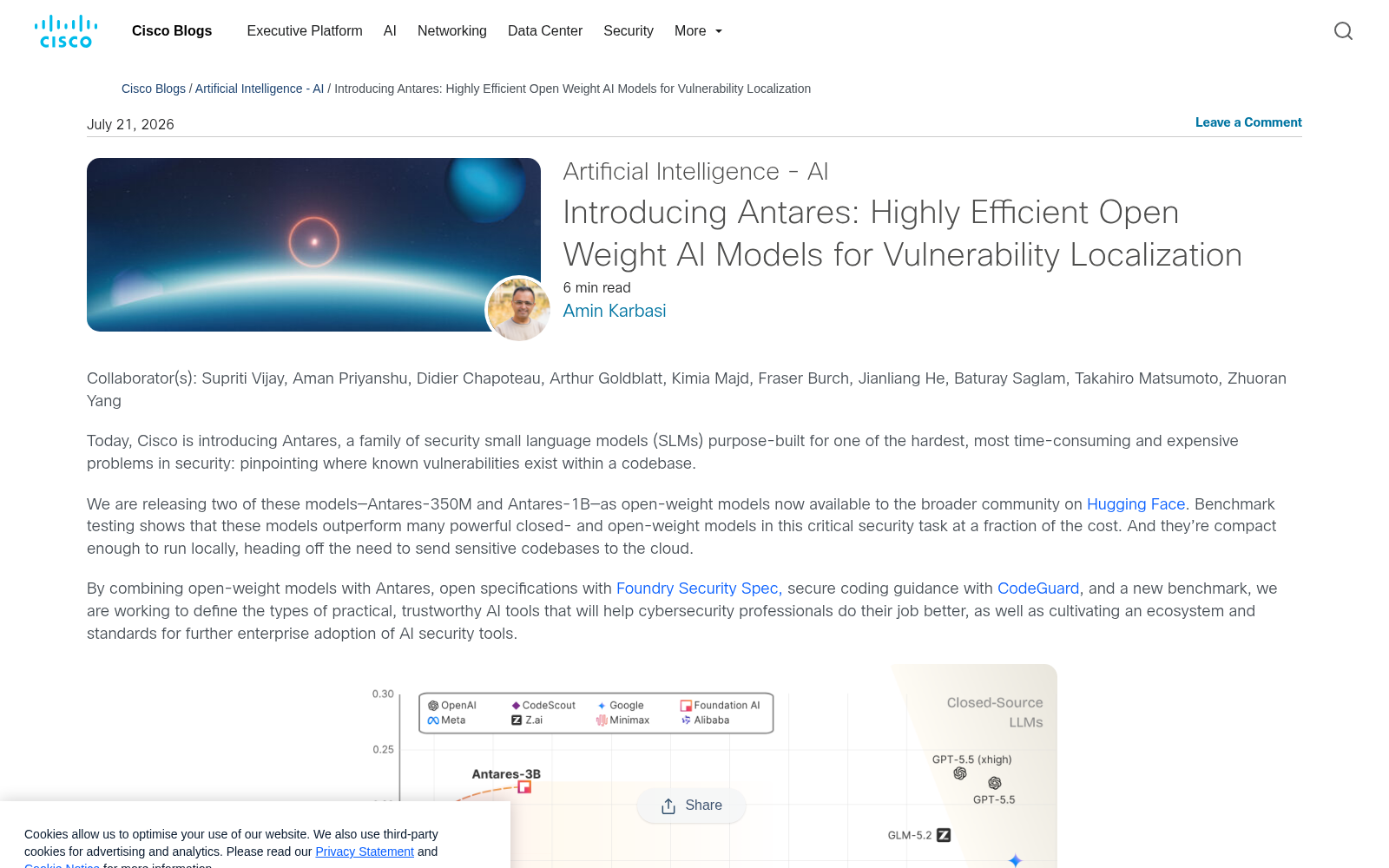
Cisco Foundation AI released Antares on July 21, 2026: two open-weight small language models built for one security task—finding the files most likely to contain a known vulnerability. Antares-350M and Antares-1B are available on Hugging Face under Apache 2.0, with a command-line workflow intended for local or private deployment.
Antares is not a general coding assistant or a scanner for unknown flaws. It receives a CWE description, explores a repository through a read-only terminal, and returns candidate files for human review. Cisco’s Vulnerability Localization Benchmark (VLoc Bench) reports strong results, but they remain vendor-reported.
Courtesy: Cisco Systems, Inc. (Cisco Foundation AI). Source: https://blogs.cisco.com/ai/introducing-antares-the-most-efficient-open-weight-ai-models-for-vulnerability-localization. Accessed: 2026-07-24.
This screenshot proves the release date, the two public model sizes, and Cisco’s stated purpose: locating known vulnerabilities inside codebases. It does not prove the benchmark claims; those come from the model cards, technical report, and benchmark repository cited below.
What Antares actually does
Vulnerability localization starts after a security signal already exists. A team may have a CVE or GHSA advisory, a CWE category from an audit, or a finding from a penetration test, but still need to identify the affected implementation files in a large repository. That file-level search is often the slowest part of triage.
Antares approaches the problem as a terminal agent. It can issue commands such as find, grep, and cat, inspect the results, and refine its search. The model then submits a list of files it believes contain the reported vulnerability. The published workflow allows up to 15 terminal calls before the final submission.
The distinction from static analysis is important. A rule engine searches for patterns defined by a human; Antares tries to decide where to look next from a vulnerability description and repository context. In practice, the two approaches belong in the same pipeline: static tools provide repeatable signals, while Antares can help rank or narrow the places an analyst should inspect first.
VLoc Bench results: specialist accuracy at small scale
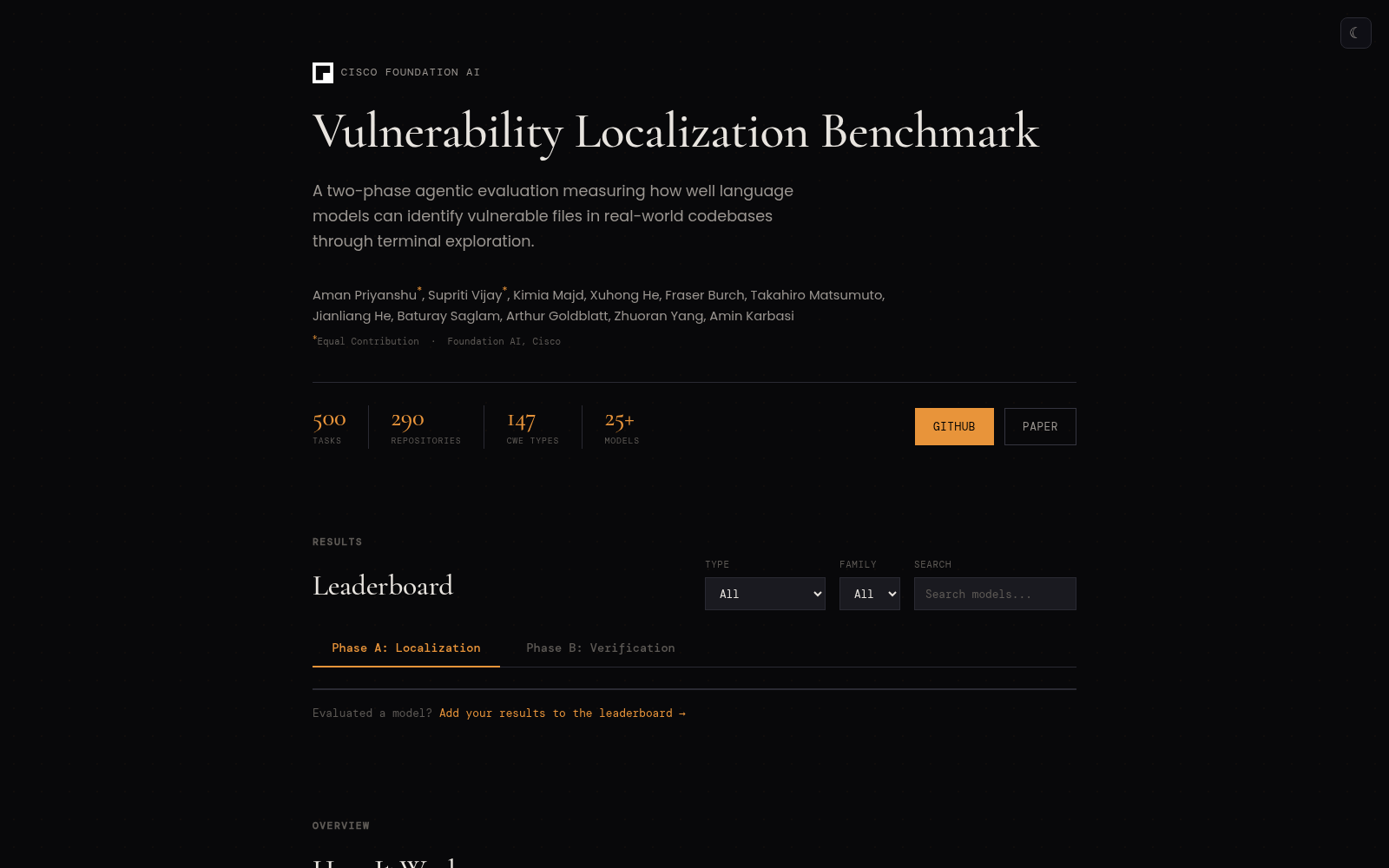
Cisco built VLoc Bench to measure repository-scale localization rather than isolated code understanding. The public benchmark contains 500 real-world vulnerabilities from 290 repositories, spans npm, pip, Maven, Go, Rust, and Composer, and covers 147 CWE types. Cisco says 78% of entries have assigned CVE identifiers. Phase A evaluates finding vulnerable files; Phase B evaluates whether the model avoids false alarms on the patched repository.
Courtesy: Cisco Foundation AI. Source: https://cisco-foundation-ai.github.io/vulnerability-localization-benchmark/. Accessed: 2026-07-24.
The benchmark homepage proves the public evaluation’s scope and two-phase design. It is a benchmark description, not an independent audit of Cisco’s reported model scores.
Courtesy: Cisco Foundation AI. Source: https://huggingface.co/fdtn-ai/antares-1b. Accessed: 2026-07-24.
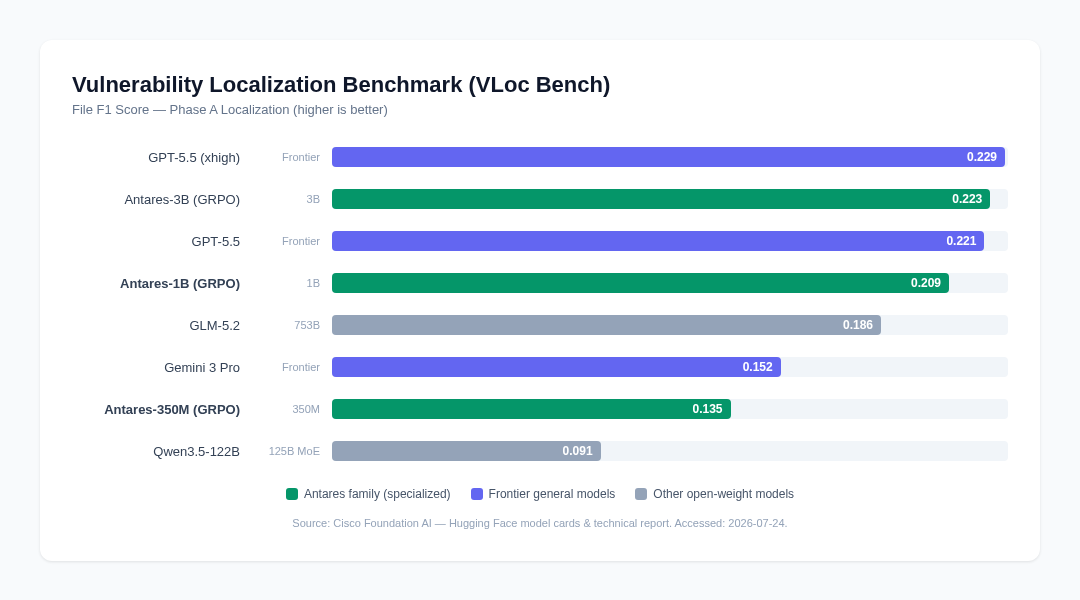
The chart uses the File F1 values published in Cisco’s model cards and technical report. Antares-1B is listed at 0.209, above GLM-5.2 at 0.186 and Gemini 3 Pro at 0.152. Antares-350M reaches 0.135. The unreleased Antares-3B entry reaches 0.223, close to GPT-5.5 at 0.229, but that 3B result is not evidence that a public 3B checkpoint is available.
These numbers should be read with care. File F1 is the harmonic mean of precision and recall over the ground-truth vulnerable files. A score of 0.209 is not “20.9% of vulnerabilities found”; it is an average file-level score across the benchmark’s tasks and runs. The benchmark is difficult for every listed system, which makes the ranking interesting but does not turn it into a production accuracy guarantee.
Cost and deployment are the practical story
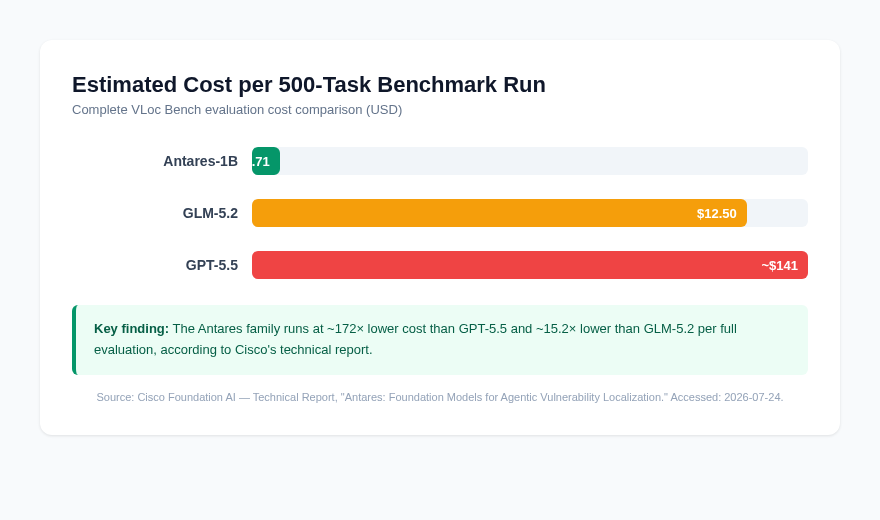
The technical report’s strongest product argument is operational. Cisco estimates a complete 500-task evaluation at $0.60 for Antares-350M, $0.71 for Antares-1B, and $0.82 for Antares-3B. Its comparison lists about $12.50 for GLM-5.2 through OpenRouter and about $141 for GPT-5.5 through the OpenAI API. Cisco reports that the Antares sweep completes in about 15 minutes on one H100 with 16 parallel workers; the exact runtime and cost depend on infrastructure and pricing.
Courtesy: Cisco Foundation AI. Source: https://cisco-foundation-ai.github.io/antares/technical-report.pdf. Accessed: 2026-07-24.
This chart proves only the published cost comparison and its assumptions. It does not predict an organization’s total cost of ownership, which also includes GPU access, orchestration, sandboxing, logging, model updates, and analyst time.
For senior developers and security engineers, local execution may matter more than the raw dollar figure. The model card describes a CLI that runs against a read-only snapshot and returns human-readable, JSON, or SARIF output, creating a plausible CI/CD handoff without sending source to a third-party API. Repository isolation, network controls, resource limits, and command review are still required.
Model design and the limits of the claim
Antares-350M is based on an IBM Granite 4.0 350M backbone with a 32K context window. Antares-1B uses the 1B backbone and a 128K context window. Both cards describe supervised fine-tuning followed by Group Relative Policy Optimization over terminal trajectories. The training data cutoff is April 10, 2025, so the models are not current threat-intelligence feeds.
Cisco’s reported result is about localization, not end-to-end vulnerability management. Antares does not confirm exploitability, assign severity, write a tested patch, or replace dependency scanning, secret scanning, dynamic testing, threat modeling, or human review. The model card also places critical security decisions, autonomous remediation, and offensive use outside the intended scope.
My independent observation is narrower: the release makes a case for testing task-specific models where privacy and repeated scans matter, but transfer to private monorepos and unfamiliar conventions still needs third-party evaluation.
A sensible evaluation plan for engineering teams
Start with a read-only mirror of authorized repositories. Compare Antares candidates with existing SAST and dependency findings, recording precision, recall, analyst time saved, false-positive review time, and escalations. Keep Phase B separate from Phase A.
Do not place the model directly in an auto-remediation loop. A better first integration is a CI job that emits SARIF or JSON as an advisory to a security queue. Require a human to inspect the candidate file, reproduce the issue where possible, and approve any patch through the normal review process.
For broader context on how specialized models fit into developer workflows, see our AI model tracker, AI coding agents guide, and agent-stack architecture guide.
Frequently asked questions
Is Antares a vulnerability scanner?
No. Antares localizes known vulnerability classes by identifying likely files in a repository. It does not claim to discover unknown vulnerabilities, prove exploitability, assign severity, or replace SAST, dependency, secret, dynamic, and human security review.
Can Antares run on proprietary code?
Yes, the published workflow is intended for local or private deployment, provided the organization hosts the weights and inference endpoint itself. The repository still needs a read-only sandbox, network restrictions, access controls, and human review because the agent runs terminal commands.
What do Antares-350M and Antares-1B cost?
Cisco’s report estimates $0.60 for Antares-350M and $0.71 for Antares-1B for a full 500-task VLoc Bench run. Those are inference estimates, not a hosted price or complete deployment budget.
Are Cisco’s benchmark results independently verified?
Not in this article. The scores are vendor-reported values from Cisco Foundation AI’s model cards, technical report, and VLoc Bench materials. The benchmark code and dataset tooling are public, so independent evaluations can test the claims on the same protocol.
Is Antares-3B publicly available?
The public release covers Antares-350M and Antares-1B. Cisco’s technical report includes an Antares-3B evaluation result, but the report says the 3B model is retained for internal use rather than released as public weights.
Conclusion: use Antares as a private first-pass scout
Cisco Antares is a meaningful security-AI release because it targets a narrow bottleneck: finding likely vulnerable files after a team already has a vulnerability description. The open weights, local workflow, SARIF output, and low reported evaluation cost make it worth testing in controlled environments.
The right conclusion is not that a 1B model replaces a security engineer. It is that specialized, private agents may make the first pass of vulnerability triage faster and cheaper. Test Antares against your own authorized repositories, keep the benchmark claims labeled as vendor-reported, and make human verification the gate before remediation or disclosure. Follow the AI model tracker for more release and benchmark analysis.
Keywords: Cisco Antares, vulnerability localization, Antares-350M, Antares-1B, VLoc Bench, open-weight security AI, vulnerability triage, code security
Tags: AI security, application security, open-weight AI, Cisco, developer tools, benchmark analysis
Sources
- Cisco Blogs, “Introducing Antares: Highly Efficient Open Weight AI Models for Vulnerability Localization.” https://blogs.cisco.com/ai/introducing-antares-the-most-efficient-open-weight-ai-models-for-vulnerability-localization
- Cisco Foundation AI, “Antares: Foundation Models for Agentic Vulnerability Localization,” technical report. https://cisco-foundation-ai.github.io/antares/technical-report.pdf
- Cisco Foundation AI, Vulnerability Localization Benchmark. https://cisco-foundation-ai.github.io/vulnerability-localization-benchmark/
- Cisco Foundation AI, VLoc Bench GitHub repository. https://github.com/cisco-foundation-ai/vulnerability-localization-benchmark
- Cisco Foundation AI, Antares-1B model card. https://huggingface.co/fdtn-ai/antares-1b
- Cisco Foundation AI, Antares-350M model card. https://huggingface.co/fdtn-ai/antares-350m
Keep reading
Related reading
⚡ Daily AI Model Drop — Get Kimi K3 benchmarks before Twitter
Join 2,400+ AI engineers. 1 email/day, no spam, unsubscribe anytime