Claude Opus 5: Agentic Coding Gains, API Changes
> Claude Opus 5 changes agent defaults with 1M context, adaptive effort, tool mutation, and cost claims. See what to test before a production migration.
🎧 Listen — ~7 min
Audio summary not available yet
Anthropic’s July 24 release of its newest Opus model is interesting for a less glamorous reason than a new leaderboard position: it changes the API defaults that shape agent behavior. Thinking is on by default, effort now controls how much test-time compute the model spends, and tool lists can change mid-conversation without throwing away the prompt cache.
For senior AI and full-stack developers, the useful question is not “is this the smartest model?” It is: when does a more capable long-running agent justify its token and latency budget, and what integration changes can quietly break an existing harness?
What shipped between July 18 and July 25
| Release or signal | What is verified | Evidence class | Developer consequence |
|---|---|---|---|
| Claude Opus 5, July 24 | claude-opus-5, 1M-token context, 128K max output, thinking on by default, $5 input/$25 output per million tokens | Anthropic announcement and API docs | Re-test max_tokens, effort, tool loops, and cache behavior |
| Claude Opus 5 in GitHub Copilot, July 24 | Gradual rollout to Pro+, Max, Business, and Enterprise; provider-list-price billing | GitHub changelog | The host controls rollout, policy, context assembly, and billing |
| Gemini 3.6 Flash, July 21 | 1M context, 64K output, $1.50 input/$7.50 output; Google reports 58.7% SWE-Bench Pro and 83.0% OSWorld-Verified | Google model card; vendor-reported | A cheaper routing candidate, but not a direct Opus ranking |
The rows are deliberately not a single leaderboard. The Anthropic and Google numbers come from different model cards, harnesses, prompts, and reporting conventions. The GitHub row is an availability event, not an independent quality measurement.
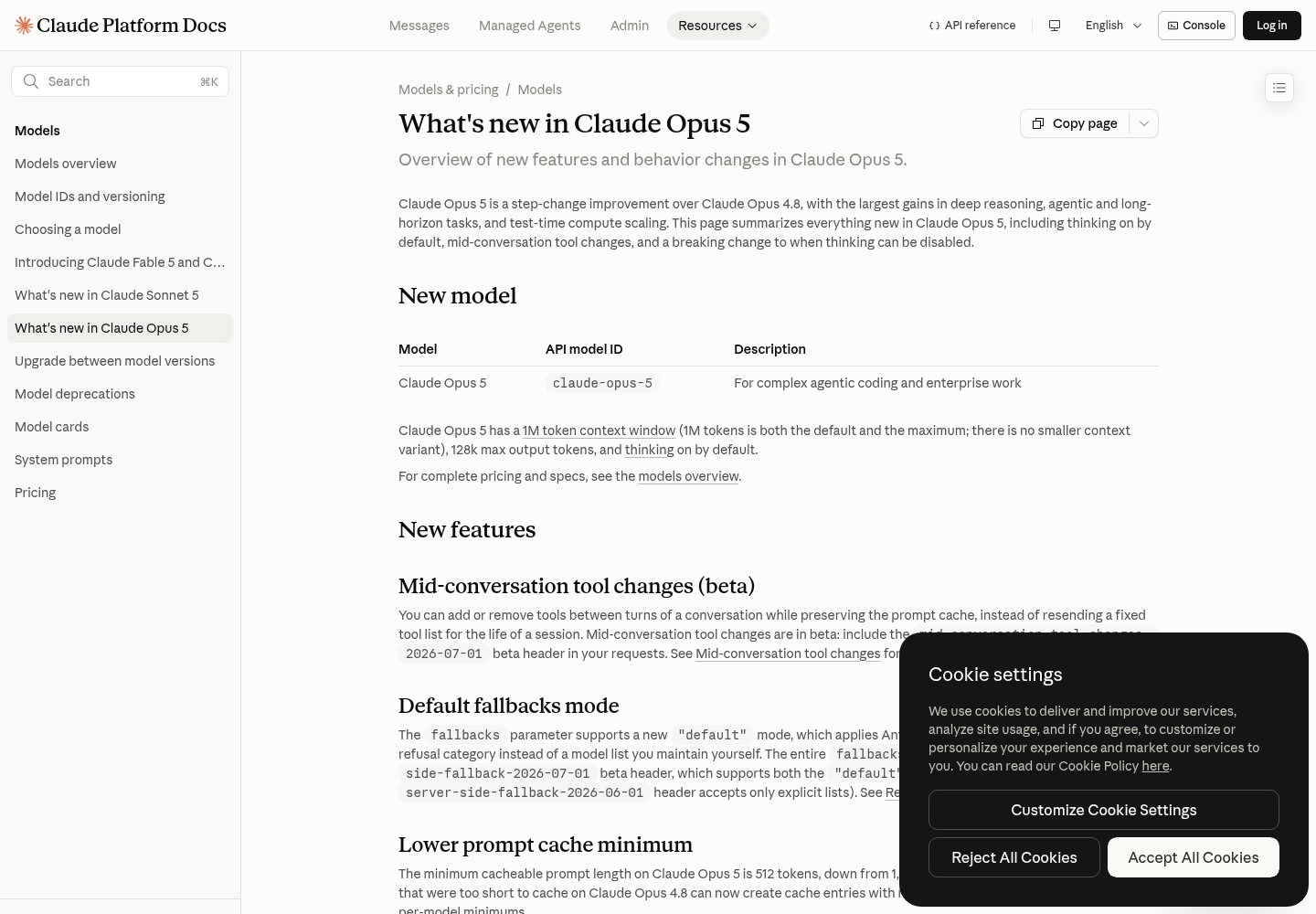
Courtesy: Anthropic. Source: https://platform.claude.com/docs/en/about-claude/models/whats-new-opus-5. Accessed: 2026-07-25.
This visual proves the API-level changes that matter to an agent runtime: the model identifier, context and output limits, and cache-preserving tool mutation. It does not prove task quality, availability in every cloud region, or that a 1M context is economical for a particular workload.
The benchmark signal is strong, but vendor-reported
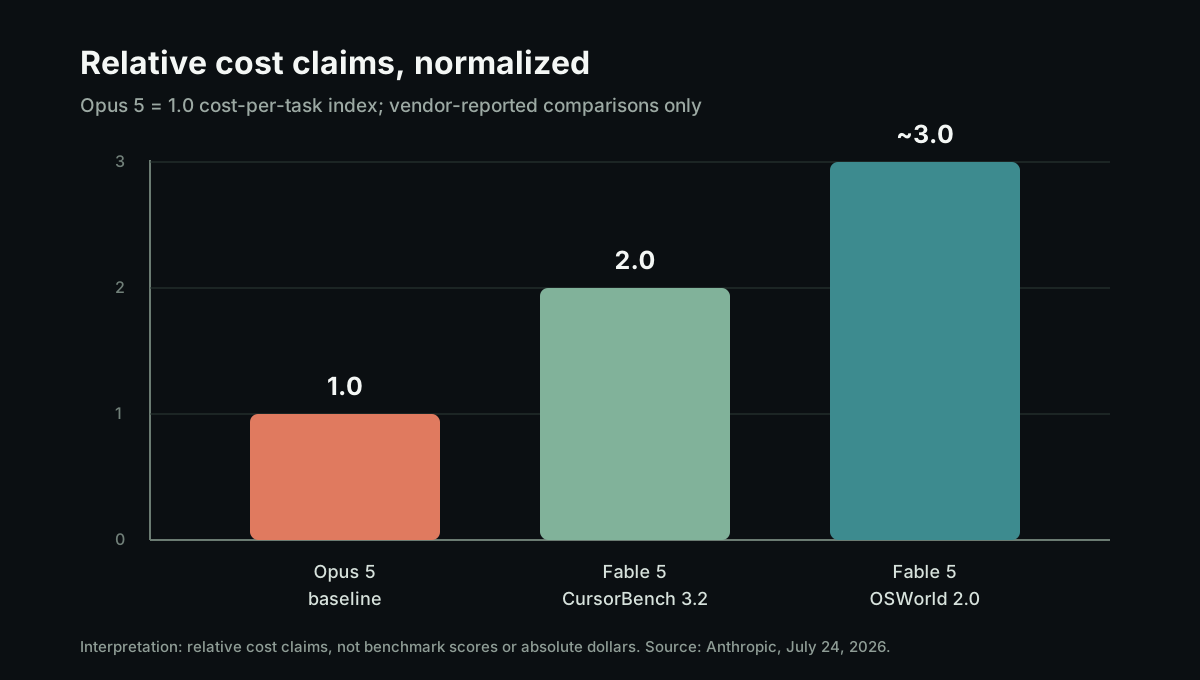
Anthropic says Opus 5 more than doubles Opus 4.8 on Frontier-Bench v0.1 at a lower cost per task. It also reports that, at maximum effort, the model comes within 0.5% of Fable 5’s peak CursorBench 3.2 score at half the cost per task. On OSWorld 2.0, Anthropic says it beats Fable 5’s best result at just over one-third of the cost.
Those are meaningful claims about the operating point Anthropic wants developers to test: quality is plotted against effort and cost, not just one maximum score. But the announcement says the Frontier-Bench run used the mini-SWE-agent harness, a GKE backend, and five attempts per task; Opus 4.8 was used as a fallback when safety classifiers refused. That is useful methodology disclosure, and it is also a reason not to treat the result as a universal coding score.
Original chart: relative cost claims
Courtesy: Essa Mamdani. Source: https://www.anthropic.com/news/claude-opus-5. Accessed: 2026-07-25.
The chart proves only the arithmetic implied by Anthropic’s relative claims: half the cost maps to an index of 2.0 for Fable 5, while “just over a third” is shown as an approximate 3.0. It is not a score chart, does not establish that the two benchmarks are comparable, and says nothing about your own prompt or tool harness.
Google’s July 21 model card offers a useful efficiency counterpoint. Google reports Gemini 3.6 Flash at $1.50 per million input tokens and $7.50 per million output tokens, with 58.7% on SWE-Bench Pro, 49% on DeepSWE v1.1, 78.0% on Terminal-Bench 2.1, and 83.0% on OSWorld-Verified. Those are Google’s measurements. They should not be merged with Anthropic’s Frontier-Bench or CursorBench claims, even when the benchmark names sound adjacent.
The practical comparison is routing, not victory. Use a high-effort Opus call when the task has expensive failure modes: a multi-file refactor, a root-cause investigation, or a code review where a missed edge case costs more than inference. Use a cheaper model for classification, extraction, summarization, or the first pass of a repetitive workflow. Measure whether the cheap pass creates more review work.
The API migration details agents will feel
The biggest behavior change is default thinking. On the previous Opus 4.8 behavior, requests ran without thinking unless adaptive thinking was enabled. On Opus 5, thinking is on by default and output_config.effort is the control surface. Anthropic documents five levels—low, medium, high, xhigh, and max—with high as the default.
That changes the meaning of an inherited max_tokens value because the hard limit covers thinking plus visible output. A previously safe limit may now truncate a tool-using run. Track finish reasons, thinking tokens, tool calls, retries, and task completion rather than assuming a model-ID swap is semantically neutral.
The second change is mid-conversation tool mutation. A planner can start with repository inspection tools, then add a deployment or browser tool after the user approves the next phase, while preserving the prompt cache. That is a useful primitive for least-privilege agents, but it is beta behavior and should be guarded by an explicit capability policy. Tool schemas are executable authority; dynamic addition must be logged and reviewed like a permission change.
The third change is default server-side fallback mode for refusal categories. Fallbacks can improve continuity, but they complicate observability. Record the requested model, actual model, refusal category, and policy decision in traces. This is especially important when a security-sensitive request is routed to a different model with different safeguards.
1const response = await anthropic.messages.create({
2  model: "claude-opus-5",
3  max_tokens: 64000,
4  output_config: { effort: "high" },
5  messages: [{ role: "user", content: task }],
6});
Start at the documented default effort, then lower it on tasks where quality holds. Raise it only when the evaluation shows that extra reasoning buys fewer failures. The model’s ability to spend more compute is a knob, not a guarantee.
A small evaluation plan before migration
Build a private set of 30–50 tasks covering bug fixes, new features, code review, tool failure recovery, and long-context retrieval. Run Opus 4.8, Opus 5 at high effort, Opus 5 at medium effort, and one cheaper routing model under the same system prompt and tool permissions.
Record task success, patch correctness, tests passed, tool calls, retries, input/output/thinking tokens, wall-clock latency, and reviewer minutes. Report cost per successful task and p95 latency by task family. For agentic coding, a model that scores higher but needs twice the review time is not automatically a better production choice.
There is no independent, apples-to-apples Opus 5 result in the primary-source set reviewed for this seven-day window. That is a limitation, not a blank to fill with leaderboard screenshots. Re-run the suite when an independently reproducible harness publishes results, and preserve the exact model version and effort setting.
FAQ
Should every coding agent switch immediately?
No. Test the model-ID migration with fixed prompts, tools, and budgets first. The default-thinking change alone can alter latency, token spend, and truncation behavior.
Is the 1M-token context window a reason to load an entire repository?
No. Context capacity is not context quality. Retrieval, file selection, cache strategy, and instruction placement still determine whether the agent sees the right evidence at the right time.
Is Opus 5 cheaper than Fable 5?
Anthropic reports lower cost per task on named internal evaluations, including half the CursorBench cost and just over one-third the OSWorld cost. Its public token price is $5 input and $25 output per million, so verify your own successful-task economics.
What is the safest way to add tools mid-session?
Treat every tool addition as a permission escalation: require an allow-list, log the schema and approver, restrict network and filesystem scope, and test refusal/fallback paths.
Source notes and methodology
I searched official release, documentation, model-card, and developer-platform pages published July 18–25, 2026 UTC. Vendor-reported claims are labeled as vendor-reported; GitHub availability is labeled as platform evidence. I did not combine Anthropic’s Frontier-Bench, CursorBench, or OSWorld claims with Google’s SWE-Bench Pro, DeepSWE, Terminal-Bench, or OSWorld-Verified results because their harnesses and reporting contexts differ. Prices are current list prices shown in the cited vendor documentation at access time, not a forecast of cloud or subscription billing.
Primary sources: Anthropic’s announcement, Claude Opus 5 API changes, Anthropic pricing, Google DeepMind’s Gemini 3.6 Flash model card, and GitHub’s Copilot changelog. For implementation context, see my AI coding agents guide and agent stack and MCP guide.
If you adopt the model, publish the harness alongside the result. The model choice is only one variable; effort, tools, fallbacks, cache policy, and human review are part of the system you are actually evaluating.
Keep reading
Related reading
⚡ Daily AI Model Drop — Get Kimi K3 benchmarks before Twitter
Join 2,400+ AI engineers. 1 email/day, no spam, unsubscribe anytime