DeepSeek Retires Aliases as V4 Lands
> DeepSeek retired deepseek-chat and deepseek-reasoner on July 24, replacing them with V4-Flash and V4-Pro. Here’s what API teams must change now.
🎧 Listen — ~7 min
Audio summary not available yet
DeepSeek’s latest update matters less as a model launch than as an API contract change. The company has replaced the familiar deepseek-chat and deepseek-reasoner aliases with deepseek-v4-flash and deepseek-v4-pro, and the official docs say the legacy names will be inaccessible after July 24, 2026 at 15:59 UTC.
Aliases are convenient until they become an invisible dependency. If your app, agent, or internal tool still points at a friendly name instead of an explicit model, the runtime can change under you without a compile error or a loud outage.
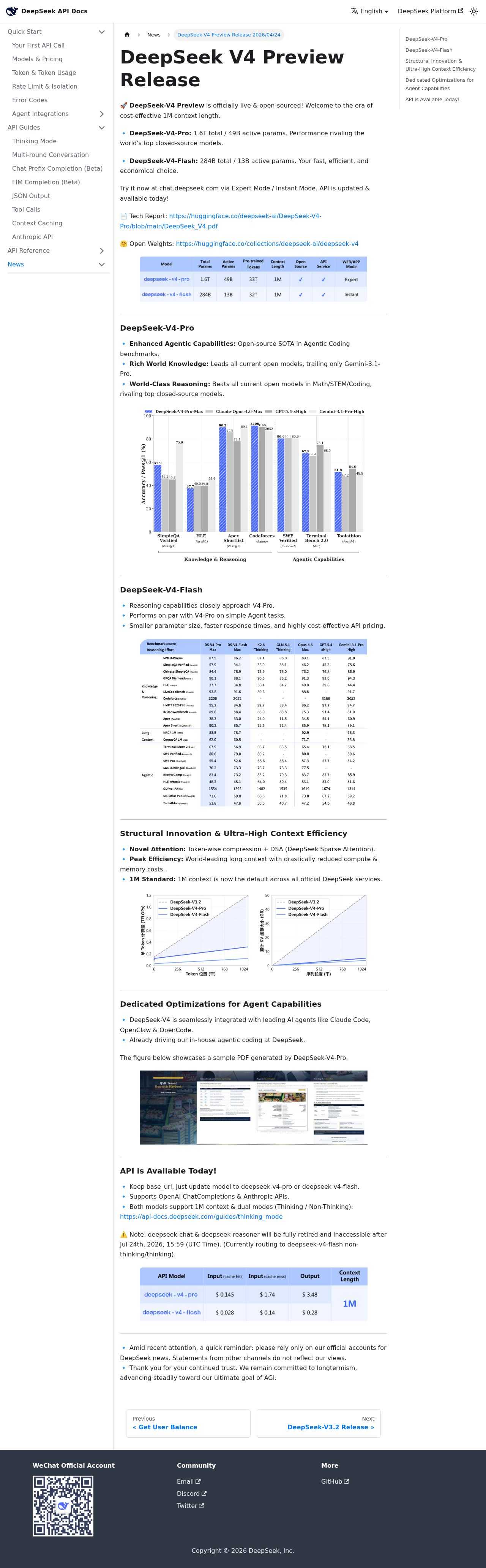
Courtesy: DeepSeek. Source: https://api-docs.deepseek.com/news/news260424/. Accessed: 2026-07-26.
This screenshot proves the change is official and time-bound. It shows DeepSeek V4 Preview, the compatibility note, and the explicit warning that deepseek-chat and deepseek-reasoner are being retired rather than left as permanent aliases.
What changed
DeepSeek’s news post says V4 Preview is live and open-sourced, with deepseek-v4-pro positioned for harder reasoning and agentic coding, and deepseek-v4-flash positioned as the faster, cheaper workhorse. The docs also say the platform keeps the same base URL, so the migration is mostly about model selection and behavior, not transport plumbing.
That sounds simple, but it hides the part that usually hurts in production: the semantics changed even if the endpoint did not. If you were relying on deepseek-chat to mean “cheap default chat” and deepseek-reasoner to mean “deliberate reasoning path,” that assumption now lives behind a compatibility layer and a deprecation deadline.
Here is the cleanest way to think about the transition:
| Old name | Current equivalent | Practical meaning |
|---|---|---|
deepseek-chat | deepseek-v4-flash non-thinking mode | Legacy chat path that now maps to the Flash family |
deepseek-reasoner | deepseek-v4-flash thinking mode | Legacy reasoning path that now maps to the Flash family |
deepseek-v4-flash | Explicit current model | Default choice for chat, extraction, routing, and high-volume tasks |
deepseek-v4-pro | Explicit current model | Better fit for the hardest reasoning or agentic calls |
The important detail is that DeepSeek is no longer asking developers to infer behavior from a friendly alias. It is asking them to be explicit about both the model family and, when needed, the thinking mode.
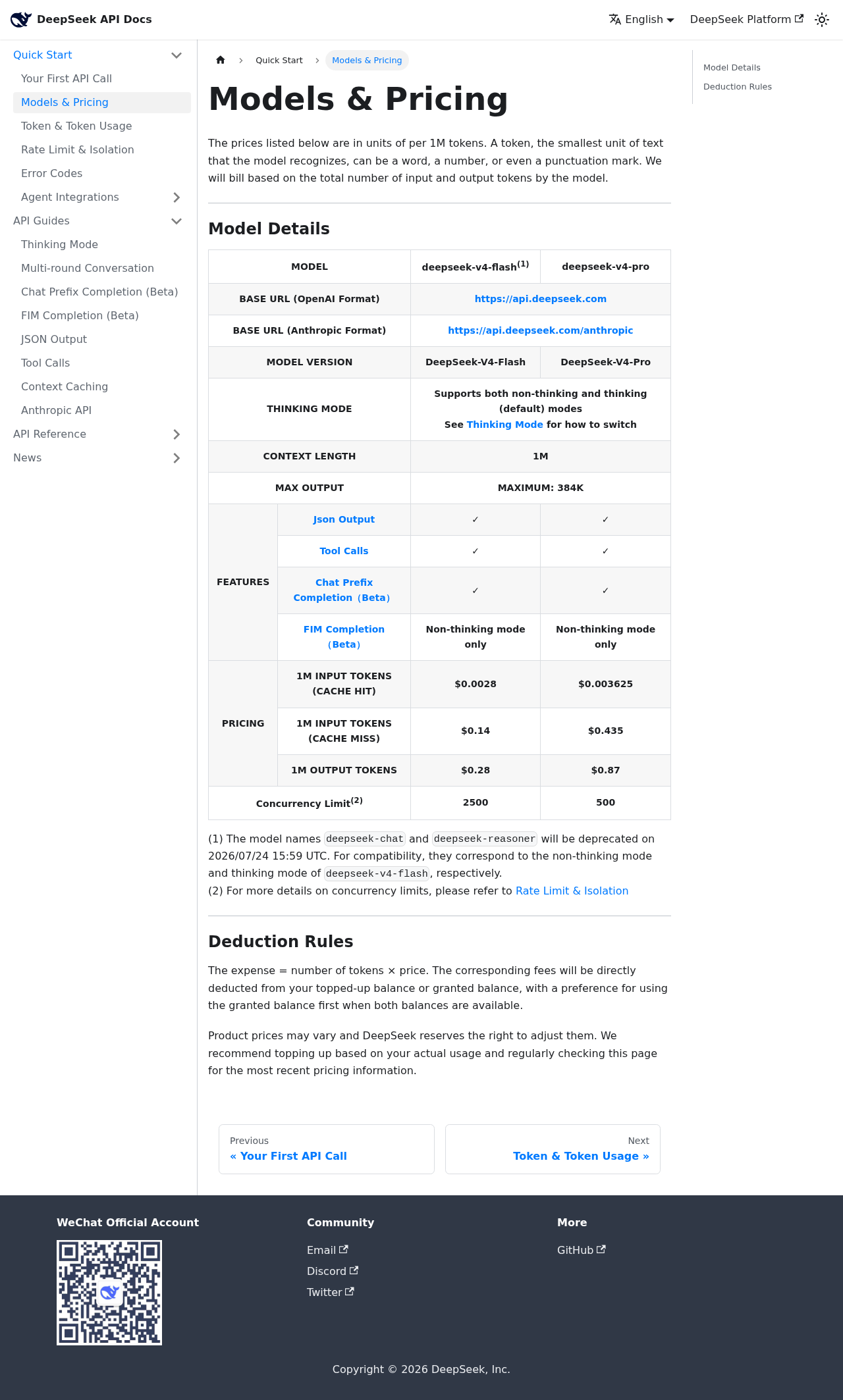
Courtesy: DeepSeek. Source: https://api-docs.deepseek.com/quick_start/pricing/. Accessed: 2026-07-26.
This visual proves the current contract on the pricing side: both models expose 1M context, 384K max output, separate cache-hit and cache-miss pricing, and different concurrency ceilings.
The new pricing and limits
The pricing table is the part product teams will actually budget against. DeepSeek lists per-1M-token prices and separates cache-hit input from cache-miss input, which matters if you have stable system prompts, long context prefixes, or repeated retrieval scaffolds.
| Model | Cache-hit input | Cache-miss input | Output | Context length | Max output | Concurrency |
|---|---|---|---|---|---|---|
deepseek-v4-flash | $0.0028 | $0.14 | $0.28 | 1M | 384K | 2500 |
deepseek-v4-pro | $0.003625 | $0.435 | $0.87 | 1M | 384K | 500 |
The pricing page also says the expense is calculated as tokens multiplied by price, and it warns that product prices may vary. That is not a legalistic footnote. It is a reminder that billing should be measured from live usage, not from a remembered blog post or a stale spreadsheet.
For teams that use prompt caching heavily, the cache-hit column is the real story. If you have a stable system prompt and a repeating policy wrapper, the economics can change a lot. If you do not, the cache-miss rate is the number that matters.
The other number worth noticing is concurrency. Flash gets a much higher limit than Pro, which is exactly what you would expect if the product is meant to split high-volume and high-effort traffic into different lanes. That makes routing a first-class design choice instead of a nice-to-have optimization.
Why this matters for senior developers
This is not just a model refresh. It is a reminder that naming conventions are part of your production surface area.
If you route AI traffic through a shared service layer, alias retirement can create subtle failures:
- the app still connects, but the model behaves differently;
- the model still responds, but hidden reasoning now affects latency or token count;
- the outputs still parse, but your regression suite gets noisier because the model has changed under the same alias;
- billing still works, but prompt caching assumptions no longer match the updated model family.
That is why explicit model pinning matters. A configuration like deepseek-v4-flash is boring in the best possible way. It makes it obvious what you deployed, what you tested, and what you need to revisit when the vendor changes the API surface again.
The other practical lesson is that compatibility does not mean identity. DeepSeek says the old aliases currently map to Flash modes, but the docs also say the legacy names are being retired. Treat the mapping as a migration bridge, not as a permanent contract.
What I would change today
If you maintain a DeepSeek integration, I would run a short migration pass now rather than waiting for the deprecation window to turn into an outage.
- Search the codebase and environment variables for
deepseek-chatanddeepseek-reasoner. - Replace them with
deepseek-v4-flashordeepseek-v4-pro, based on workload. - Make the thinking setting explicit instead of relying on defaults.
- Re-run your structured-output and tool-call tests, especially if the workflow is agentic.
- Re-check cost with both cache-hit and cache-miss assumptions.
- Verify your concurrency expectations if you have bursty traffic.
- Log the exact model string, mode, and request route so you can compare future changes cleanly.
That last step is the one teams skip most often. They keep prompt logs, but not enough configuration metadata to explain why a model changed behavior three weeks later.
If your application already uses strict schemas, this update should still trigger a regression run. A model family upgrade can alter output style just enough to expose weak validation or retry logic. The same advice applies to observability: if you do not trace model version, mode, and latency separately, you will not be able to tell whether a change came from the vendor or from your own code.
FAQs
Should I change my base URL?
No. DeepSeek’s docs say to keep the base URL and update the model name. The migration is about the model field and its behavior, not a new transport endpoint.
Is deepseek-chat still usable right now?
The docs say it is currently mapped for compatibility, but it is also explicitly scheduled for retirement. Treat it as a temporary bridge, not a stable integration target.
Which model should I use by default?
Start with deepseek-v4-flash for chat, extraction, classification, and other high-volume work. Move up to deepseek-v4-pro when you have evidence that the harder reasoning justifies the extra cost.
Does thinking mode matter for billing?
Yes. DeepSeek’s thinking-mode docs and pricing model both make it clear that reasoning behavior and token usage are part of the cost picture. Measure your actual runs instead of assuming a headline rate tells the full story.
Conclusion
DeepSeek V4 is a useful release, but the real signal for developers is the contract change: explicit model names, explicit modes, explicit pricing, and an explicit retirement date for the old aliases. That is better than vague compatibility, but it still demands a migration.
The right move is not to panic and rewrite everything. It is to pin the new model names, test the behavior you actually depend on, and confirm that your routing, caching, and observability still tell the truth. If you do that now, the alias retirement becomes a controlled change instead of an unpleasant surprise.
For adjacent implementation patterns, see the guides on Structured Outputs for Reliable AI APIs, OpenTelemetry GenAI Observability: A Production Guide, AI Agent Stacks: Skills, Plugins, MCP & ACP for Real Work, and MCP Security Threat Modeling Guide.
Sources
- DeepSeek API Docs: DeepSeek V4 Preview Release - accessed 2026-07-26.
- DeepSeek API Docs: Models & Pricing - accessed 2026-07-26.
- DeepSeek API Docs: Thinking Mode - accessed 2026-07-26.
Related reading
Keep reading
Related reading
⚡ Daily AI Model Drop — Get Kimi K3 benchmarks before Twitter
Join 2,400+ AI engineers. 1 email/day, no spam, unsubscribe anytime